Tuesday, June 01, 2021

My calendar for June 2021

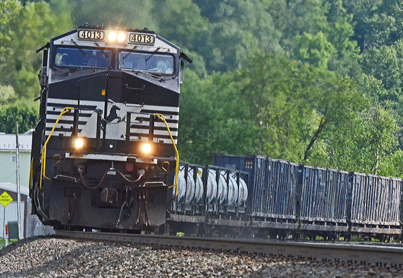
#4001, one of the two Blue-Noses, is part of the lash-up on 22W. (Photo by Jack Hughes.)

—The June 2021 entry in my annual train-calendar is #4001, one of the Norfolk Southern’s two Blue-Noses. The other is #4000.
Norfolk Southern, together with outside sources, is rebuilding many of its aging General-Electric Dash-940Cs, converting them to AC traction.
4000 and 4001 were first, modified by General-Electric and American Motive Power.
Unlike a car or a truck, the gigantic diesel engine in a diesel-electric locomotive doesn’t actually power the railroad wheels.
That engine powers a large generator (alternator?) that generates electricity for motors that power each wheel set.
This is how trolleys worked, except their electricity came from overhead trolley wire, generated elsewhere. A diesel-electric locomotive generates its traction-motor electricity right on the locomotive.
Electric traction has always been appealing. Drive torque is constant. In a side-rod steam-locomotive it comes in pulses that can break adhesion to the rail-head (slippage).
For a while railroads considered electric traction, with the electricity generated elsewhere then delivered by overhead trolley wire.
Some railroads partially converted to electric traction via overhead wire, Pennsy for example.
Electric traction also was much cleaner than steam locomotion. Long tunnels were electrified to get smoky steamers out.
Overhead trolley-wire needs constant maintenance. Amtrak’s Northeast Corridor, mostly the old Pennsy mainline from Washington DC to New York City, is still electrified, as is Amtrak from Philadelphia to Harrisburg PA. That line is also ex-Pennsy.
But most of the old Pennsy electrification that’s not Amtrak was de-energized and wire removed.
Diesel-electric locomotives came into common use after about 1940.
They were called “trolley motors” at first, because like trolleys they use electric traction-motors down at the drive wheels.
But unlike trolleys, diesel-electric locomotives generate their electricity on board.
Most diesel locomotives have four or six wheel-sets on two trucks, eight or twelve wheels total. The wheels are solidly mounted on common axles, two per axle (each side), and they don't differentiate. (Which is why you hear squealing when a train negotiates a curve.)
Like trolleys, diesels used direct-current traction-motors, and remained DC for eons.
Pennsy was AC (alternating current), but only because AC transmitted better over long distances.
Diesel-electrics got more powerful as time passed, even with DC traction-motors. Engine power increased, and traction-motors were improved so they could deliver more power to the rail-head.
Locomotive manufacturers experimented with AC traction-motors. It was found that AC traction could better drag long heavy trains.
Railroads began ordering locomotives with AC traction-motors. And now Norfolk Southern is converting its aging General-Electric Dash 9-40Cs to AC traction-motors.
The “Blue-Noses” were first, plus a few more also with the flame-paint. Now more are converted and even more are scheduled.
Perhaps Norfolk Southern’s best move was getting Pennsy’s old Juniata Shops: a huge complex capable of building complete locomotives.
I toured that facility once, shortly after the Conrail break up, and it was mind-boggling.
Locomotive parts everywhere, plus complete diesel motors ready for installation.
In another gigantic room were locomotive truck after locomotive truck after locomotive truck. Plus overhead cranes on rails to move things. Complete locomotives suspended mid-air, 15 to 25 feet above the floor.
The “Blue-Noses” are only a variation. I’ve also seen yellow plus green. But most Norfolk Southern locomotives are black.

• Conrail was formed after most of this nation’s northeastern railroading tanked, mainly Penn-Central. (Penn Central was merger of the Pennsylvania railroad and New York Central.) Conrail was originally set up by the gumint, but eventually privatized as it succeeded. It was broken up in 1999, much of it sold to CSX Transportation, but a lot to Norfolk Southern.
• It’s pronounced “June-eee-AT-uh;” my mother pronounced it “Juanita,” as does one of my train videos.

Labels:

Friday, April 30, 2021

My calendar for May 2021

Helpers push unit coal up the West Slope. (Photo by BobbaLew.)

—The May 2021 photograph in my annual train-calendar is an image I mistakenly used in at least two prior train-calendars, maybe three. —Mistakenly used again.
It’s helpers pushing a long heavy coal-drag up the west slope of Allegheny Mountain. The train is eastbound on Track-One going through Lilly PA.
The photo was taken years ago shortly after I started chasing and photographing trains with my Altoona railfan friend Phil Faudi. At that time Phil was running a business helping railfans like me chase and photograph trains.
$125 for a full day of chasing and photographing trains — sometimes 30 or more.
Phil was extremely knowledgeable. He knew the railroad, the schedule, and train-numbers. At that time train-engineers were calling out signal-aspects on railroad radio.
We’d be motoring to another photo-location in Phil’s old Buick, he’d hear something on his radio scanner, and suddenly we were doing a bootleg turn to zoom back to the nearest photo-location.
Phil gave up his business, so now it’s my brother and I chasing trains.
That I mistakenly used this image at least twice before, flies-in-the-face of my continually badgering my brother to not repeat a view I already published.
“Aww-man! Brickyard again? We done those bridges in Altoony all too many times!”
Also, the train is going away, and is identified as C-51 in an earlier calendar. That makes it a local (I think), and as I recall it was loaded coal brought out of the Portage or South Fork Secondaries.
Back then the SD80MACs were still in use.
The SD80MACs were supposed to reduce locomotive usage on the old Pennsy main across PA.
That didn’t work out.
What the SD80MACs were good for was dragging heavy trains at slow speed, e.g. coal-drags.
So they were reassigned to dragging heavy coal trains out of the South Fork secondary, or out of Sonmon coal loadout on the Portage secondary.
The Portage secondary is the original Pennsy mainline that was bypassed in 1898.
Both are onto the west slope of what used to be the Pennsy main up Allegheny Mountain.
The railroad is now Norfolk Southern.
South Fork is where the Johnstown flood of 1889 began when a retention-dam near South Fork washed out killing over 2,200.
This coal-drag is either from South Fork or Sonmon.
I keep forgetting I already used it.

Labels:

Friday, April 02, 2021

My train-calendar for April 2021

747 on Two passes an empty unit grain-train on the Cresson-Runner awaiting a crew. (Photo by Jack Hughes.)

—As the dude who designed and produces this train calendar, I continually harangue my brother about not repeating a view I published before.
“Aw man; not them downtown overpasses again, or the Post-Office bridge, or 24th Street. Brickyard is always a repeat.”
My brother and I are the ones taking these train pictures. I also let him drive.
This photo is at a location I never published.
The Route 22 expressway over Allegheny Mountain, which cost a fortune, crosses the old Pennsy main at this location west of Cresson.
Train 747, westbound on Two, passes an empty unit grain-train on the Cresson-Runner. The grain-train is waiting for a crew.
Norfolk Southern delivers grain from out west for an ethanol plant up in Clearfield PA. The branch to Clearfield used to be Pennsy, but now it’s Corman.
It's actually Corman that delivers the grain up to Clearfield, although sometimes they use NS run-through power. Corman has its own locomotives.
Norfolk Southern delivers the grain to a long stick-rail siding beside its main through Cresson. That’s the Runner.
Corman brings the empty covered hoppers back down to Cresson, then leaves ‘em on the Runner, so NS can take ‘em back for another train-load.
So my brother is bopping back north (railroad-east) on Highway-53, probably returning from Summerhill or Cassandra. 53 crosses the Route 22 expressway next to where the expressway crosses the old Pennsy.
A westbound on-ramp from 53 merges into the expressway, and ends just past the railroad overpass.
We avoided this location, thinking it dangerous. We thought we’d be adjacent to 70-80 mph expressway traffic.
My brother noticed another train-photographer set up on the overpass, and then noticed the photographer was on the on-ramp.
The location wasn’t next to expressway traffic. Suddenly this location was safe.
But it’s not very photogenic. Too much tangent track. We need curvature.
If the sun were out, it would look better. But it’s cloudy.
We’re west of the mountain, and clouds flowing east pile up against the mountain’s western slope.
A previously unpublished location, and two trains, a “double.”

• “Stick-rail” is the old way of doing things. Short sections of steel rail, usually only 39 feet long, are bolted together with splices to form the railroad. Now a railroad is formed of “ribbon-rail:” rail welded together in lengths of a quarter mile or more. Most heavy use railroads are ribbon-rail; light use (like short lines) are quite often still stick-rail.

Labels:

Monday, March 01, 2021

My calendar for March 2021

Eastbound stacker negotiates the curve past South Fork. (Photo by BobbaLew.)

—The reason the Pennsylvania Railroad was built, Harrisburg to Pittsburgh, was because PA’s cross-state combination canal/portage railroad was so slow and cumbersome compared to NY’s Erie Canal.
The Erie Canal was through. PA’s combination canal/portage railroad wasn’t. It required changing from canal to railroad.
And the portage railway over Allegheny Mountain couldn’t use the grading technology that came later. Allegheny front couldn’t be canaled.
All across PA Pennsy zigged and zagged up and down valleys to notches through the Appalachians. It followed the Juniata River (“June-ee-AT-uh,” not “Juanita.”)
But there were no notches through Allegheny front.
At Altoona Pennsy attacked Allegheny front. Railroad with cuts, curves, fills, grades, and also a summit-tunnel, got Pennsy over the mountain.
Doing it with 1840s grading was an engineering triumph.
Once across it follows the Little Conemaugh River southwest to South Fork, starting point of the Johnstown Flood.
Tyrone to South Fork is very active, and trains assault the heavens to go over the mountain.
My brother and I chase and photograph trains up and down those 40-50 miles of railroad.
Some parts are 79 mph track-speed, but over the mountain is much slower. Trains have derailed going too fast.
South Fork is our southern-most photo location on that segment — railroad-west.
South Fork is probably 20 miles south of Altoony. It’s where the railroad turns back toward Pittsburgh; that’s the big curve.
I had to pull teeth to get my brother to try South Fork.
“Too far,” he’d always say, and he drives.
Now, all-of-a-sudden, he discovered South Fork. Not me, of course, I’m only the first-born!
The train, a double-stack, is eastbound on Track One.
You’re seeing maybe only 1/10th of the train. Imagine all those containers as trucks on an interstate.
Those interstates would be clogged; plus every truck would need a driver. Probably only two or three are crewing that train.
I also see a borrowed BNSF unit in the lash-up.
250+ containers are not clogging the highways.

• According to my all-knowing mother, the correct pronunciation of “Juniata” is “Juanita.”

Labels:

Tuesday, February 02, 2021

Six targets

Westbound double-stack roars through Fostoria. (Photo by BobbaLew.)

—This photo was taken eleven years ago.
My wife and I (she was still alive then) drove to Altoona to do a train-chase with my Altoona railfan friend, Phil Faudi (“FOW-dee,” as in “wow”).
It had snowed heavily, but driving down was easy. It was mostly expressway back then, but a lot wasn’t.
Pavement was wet, but clear. 3-4 foot snow-berms lined the highway.
In Altoona we headed west up Allegheny Mountain, headed toward a trackside bed-and-breakfast in Gallitzin (“Guh-LIT-zin”) atop Allegheny Mountain.
The snow-berms got much deeper as we headed up the mountain. Road-side the berms were 6-8 feet high.
The Mighty Curve was snowed in, but looked possible.
Hip-deep into the snow-berm. I gave up. Horseshoe Curve was impossible.
We continued up to Gallitzin, which was being cleared by front-end loaders and dump-trucks.
Streets to our bed-and-breakfast were 6-10 foot channels through the snow. Streets were clear, but you only drove in the streets.
When Phil arrived the next day we wondered how we could chase trains in snow so deep.
“I got a couple ideas,” Phil said.
One was Fostoria, location of this photo. Fostoria is the location of that fabulous signal-bridge pictured.
It controls the mainline (Tracks Two and One at left) plus an adjacent siding-track at right (Track Three).
Each track is signaled both ways, rendering a total of six of the old PRR target-signals.
Light was weak, I had to Photoshop© this photo hard to get a usable calendar picture.
Mainly “brightening.”
Still it’s marginal. Shutter speed was down to 1/125th. I shoulda cranked up the ISO (sensitivity).
Below 1/200th you’re asking for trouble. If the train is fast enough, the front of the locomotive blurs.
It’s not too bad, but not as sharp as I'd like. Back then my knowledge of camera operation wasn’t what it is now.
I let the camera work for me. If I set shutter-priority at 1/400th or less, it’ll take the aperture-setting down into “not-enough-light.”
My brother’s camera autos everything, but with marginal light, his shutter-speed will slow enough to blur the locomotive.
So I can control shutter-speed, but I have to pay attention to “not-enough-light.”
The locomotive headlight can also throw off the automatic light-metering. My brother and I both have that problem.
When I took this photo, technica like that wasn’t being factored in yet.
So essentially this photo is a shaddup-and-shoot.
Conditions were horrible, but I got a picture, and Photoshop© saved it.
And it looks like a Union Pacific unit is in the lash-up. Or maybe it’s ex Union Pacific. Norfolk Southern is rebuilding old Union Pacific road-units at its Juniata shops (not “Juanita”).

• “Juanita” is my all-knowing mother’s pronunciation of “Juniata.” I have a train video that makes the same mistake.
• My beloved wife, who accompanied me on every train-chase, and there were many, died two years later (2012).

Labels:

Friday, January 01, 2021

Priorities man!

Amtrak’s eastbound Pennsylvanian blasts toward Plummers Crossing after leaving Tyrone. (Photo by BobbaLew.)

—“04T, east on Two, 244.5; CLEAR!”
Holy mackerel!” I said to myself.
“He’s not in Altoony yet. He still has to stop there and then Tyrone. I might be able to beat him someplace.”
04T is Amtrak’s eastbound Pennsylvanian.
It was about 9:20 AM. I had gone to Altoona myself, hoping to get snow pictures. January, February, and December in my train-calendar should be snow.
I already bought breakfast at a nearby Mickey-D’s, and I returned to my motel room to eat it. 04T makes its Altoona Station-stop at 9:49 AM.
Back then train-engineers were still calling out signal-aspects on railroad-radio, and I was monitoring with my scanner.
244.5 is up Allegheny Mountain, so 04T was coming down.
A signal is at 244.5, 244.5 miles west of Philadelphia. (It may be something other than 244.5.)
WHAM-SLAM! I wolf my McMuffin, then everything in the car! Camera, tripod, lenses in bag. I might be able to beat that sucker!
He’s still gotta stop at Altoona station, then again up at Tyrone.
Hammer down, pedal-to-the-metal! My motor-lodge is in Hollidaysburg, south of Altoona.
Up Plank Road, then on the I-99 expressway, scanner at my side.
By the time I got on I-99, he was making his Altoona station-stop. So I charged north on I-99 past Altoona.
70-75 MPH on I-99, no traffic. Tyrone is about 15 miles north (railroad-east) of Altoony.
Maybe I’ll go to Plummers, which is just east of Tyrone.
“04T, east on Two, 227; CLEAR!”
“I’m even with him!”
I shout. “That’s Fostoria.”
Fostoria is outta sight to the west, but I-99 parallels the railroad.
He’s probably doing track-speed; 65-70 MPH.
“04T, east on Two, 225; CLEAR!”
“I’m still even with him!”
That’s McFarlands.”
I charge off I-99 at the Tyrone exit, then east on 453 toward Plummers.
“04T, east on Two, pulling into Tyrone for his station-stop.”
Toot!” His single horn-toot that he stopped.
His Tyrone station-stop is 2-3 minutes, so I parked my car and jumped around back.
Toot-toot!” “04T, east on Two, leaving Tyrone.”
Camera on, and I lean against the back of my car.
I hear him throttling up, then suddenly there he is!
Ker-chunk!
I got that sucker!

This is what it’s all about, readers. A wild-ass chase to snag train photos.
It was 5° out: bitter cold. But no time for gloves or hat.

Labels:

Tuesday, December 01, 2020

My calendar for December, 2020

Another train-load of Bakken crude descends The Hill. (Photo by Jack Hughes.)

Here it comes! Another train-load of Bakken crude-oil comes down the mountain for east-coast oil refineries.
My brother took this picture five years ago on my birthday in 2015. The train is approaching the 24th St. overpass in Altoona over Pennsy’s old Slope interlocking.
Slope used to have a tower, but now it’s operated remotely from Pittsburgh.
Slope is Altoona’s yard entrance, and long-ago Pennsy founded Altoona because that’s the foot of their grade over Allegheny front.
In the early 1800s, Allegheny Mountain was the barrier to trade across PA with the newly opened Midwest.
Philadelphia and Baltimore worried New York City might become this nation’s primary ocean port. And it did, thanks to New York’s Erie Canal.
Philadelphia and Baltimore had Allegheny Mountain to cross — it didn’t cross New York State.
Now that our economy is so tied to burning petroleum, we look for other crude-oil sources. Saudi Arabia and Venezuela come to mind.
But capitalists found they could frack crude-oil from the Bakken Shale Play under Eastern Montana and Western North Dakota. Crude-oil could also be extracted from tar-sands in Canada.
Viola! A crude-oil supply other than dictatorships and the tempestuous Middle-East.
Pipeline capacity was inadequate, so enter railroad unit oil trains.
The train pictured is all tankcars (“oil cans”) except for the idler between the tankcars and locomotives.
My guess is this photograph is a “shaddup-and-shoot.”
Here comes one
down The Hill, so my brother leaps to the other side of the bridge and shoots.
Being backlit the light is all wrong. My brother prefers lighting the front of the engine. Looking east into Altoony would be okay by this time of day.
Nevertheless, this is how railroading became. Hundreds of tankcars, and only tankcars. A unit-train of nothing but tankcars.
Back-and-forth they go: empty out to the Bakken oil fields, then loaded back to the east coast. —Or Gulf Coast, or southern Californy, or wherever.

• The “idler” is a single unused freight-car behind the locomotives and ahead of the tankcars, to keep the tankcars from rolling into the locomotives if the train derails or wrecks. A unit oil-train has a single idler at each end.

Labels:

Friday, October 30, 2020

My calendar for November, 2020

21V struggles for the mountaintop. (Photo by Jack Hughes.)

—“Not bad, R-J,” my brother declared.
“Tried to tell ya!” I exclaimed.
Thus concluding a torrent of noisy bellyaching refusing to at least check out this location.
My brother Jack was driving per usual. We had driven a long service-road east of Pennsy’s old summit tunnels atop Allegheny Mountain.
We went inside Bennington curve, and passed this location going.
“I’d like to at least check it out,” I said as we returned.
“Yada-yada-yada-yada-yada! Complain-complain-complain-complain-complain!”
By diverting to this location, my brother would no longer be in command. He’d be acquiescing to my desire.
We can’t have that! Not with a retired all-knowing power-plant manager.
Much to my surprise, we drove back to check it out = a rocky overlook between the tracks and the road. I’d seen railfans there before.
The location is towards the top of the mountain. Altoona-to-the-summit is all uphill, and trains slow as they near the top. The grade is constant, but long.
Curvature also slows train-speed, and Bennington is tight and near the top.
The train pictured had just passed Benny at this location. It’s HAMMERING! Run-Eight = full-fuel delivery.

• “R-J” is of course me: Robert John Hughes.
• A diesel-electric railroad locomotive has eight fuel-delivery positions the engineer can use. “Run-Eight” is maximum.

Labels:

Friday, October 02, 2020

My calendar for October 2020

04T (Amtrak’s eastbound Pennsylvanian,) descends the west leg of the Mighty Curve (Photo by Jack Hughes.)

—“Any chance you can get two aging geezers up to the viewing area before 04T comes down the mountain? We heard it calling MO.”
(04T is Amtrak’s eastbound Pennsylvanian).
I had walked into the roadside Horseshoe-Curve museum complete with camera, tripod, and lens-bag.
The Curve itself is up on the mountain-sides.
The viewing-area is right in the apex, but you have to get up to it. There is a 194-step staircase, or the funicular, sort of a glorified elevator except it’s outside.
Cables pull tiny imitation railroad coaches up and down the funicular. There are two cars, one up and one down.
It’s a railway; the cars run on track.
There is no way my brother and I could beat 04T climbing 194 steps.
Two guys were in the museum funicular-area sharing coffee; one to operate the funicular.
“Sure,” they said, even though it wasn’t time. The funicular operates every half hour (although right now it’s not operating due to COVID-19).
I motioned my brother into the museum, and up we went.
Horseshoe Curve is a triumph of 1840s engineering.
It got continuous railroad over Allegheny Mountain without impossible grading. That is, a train could operate up and over the mountain without stopping — although it might need helper engines.
“How come the railroad didn’t just trestle this valley to avoid a horseshoe?” A tourist asked.
“Because that woulda been too steep,” I shouted.
“Look at this railroad,” my brother said; “and the west leg ends higher than where the east leg enters. It’s a 1.75% grade; that’s 1.75 feet up for every 100 feet forward = not very steep, but not as in limiting as 3 or 4% or more. Interstates are limited to 7%.”
Allegheny Mountain used to be the barrier to trade between the east coast and midwest.
The Alleghenies don’t go all the way up into New York State, so New York could build the Erie Canal, which opened up trade to the Midwest, and made New York City the premier east coast port.
Capitalists and investors in Philadelphia and Baltimore worried New York City would forge ahead.
Both Baltimore and Philadelphia had the Allegheny barrier to cross.
Baltimore’s solution was the Baltimore & Ohio Railroad; since railroading technology seemed to be moving ahead of canalling technology.
The state of Pennsylvania built a cross-state combination canal/railroad system, which linked various existing railroads with new canal.
Allegheny Mountain had to be portaged — it couldn’t be canaled.
And grading at that time was so rudimentary, the portage railroad had to have inclined planes.
Cross-state operation was bog-slow and cumbersome = transferring canal-packets to railroad flatcars for operation over the portage railroad, then winching the loaded packets/flatcars over the mountain.
Operation was so slow Philadelphia capitalists came together to found the Pennsylvania Railroad = through continuous railroad across Pennsylvania.
John Edgar Thomson was brought in to engineer the building of Pennsy.
Thomson had built railroads locally, but was in Georgia at the time.
Wisdom suggested putting the railroad up on mountain-sides, to ease the grade over Allegheny Mountain.
Thomson engaged his prior railroad experience, which was to build down in valleys where traffic was. Then take on Allegheny Mountain suddenly.
But not too suddenly.

No switchbacks, nor grades so steep they’d limit train weight. You might need an additional engine to get a train over the mountain, but you weren’t breaking a train into sections — or using switchbacks.
I been wanting to take this picture for years.
My first visit to the Mighty Curve was Labor Day 1968. At that time Horseshoe Curve wasn’t the historical site it is now = no museum, no visitors center, and no funicular.
There was a tiny store staffed by railfans at the base of steps since replaced.
Finding Horseshoe Curve was near impossible; the Mighty Curve is nothing like what’s pictured in photographs, plus no direction-signs.
My wife and I were wandering around west of Altoona, in the wilderness, and suddenly “there it is! We’re right smack in the middle of it! It's up there on the mountain-sides.”
Noisy argument has arisen within my family. A younger brother insists he and my other siblings visited the Mighty Curve before I did.
I’m not so sure about that, since I have memory my parents decided to visit after I did, and I told them entry was free.
I really don't care, but I’ve visited the Curve hundreds of times. Although only a few times at first, then never at all for perhaps 20 years.
And before the historical site, you could get trackside out past the viewing area. Now the viewing area is fenced.
I never developed interest in revisiting the Curve until shortly after my stroke in late 1993. Revisiting would counter my stroke.
My first revisit may not have been until 1996. I got rained out at least once, but then my brother and I decided to ride our motorcycles there. Like I needed a help-mate.
Riding motorcycle after a stroke took nerve, and I’m not loaded with overconfidence. I’m easy pickings for CONSERVATIVES.
I been to the Curve many times since. It’s immensely attractive, right in the apex. Trains are in your face.
And getting a train over Allegheny Mountain requires maximum fuel usage. “Throttle-to-the-roof” in steam parlance, or “Run-Eight” in diesel parlance. Diesel-engines aren’t throttled; in a diesel locomotive “Run-Eight” is maximum fuel delivery.
The other problem is getting down, since west-to-east on the Mighty Curve is down Allegheny mountain. A train has to not run away down the mountain.
Diesel-electric locomotives can have regenerative braking (“Dynamic braking”), wherein their electric traction motors get turned into generators, which add braking.
Downhill is safer as a result. Individual freightcar brakes no longer burn up — they aren’t applied as hard.
It used to be anything descending the mountain was wreathed in brake-smoke, and occasionally trains run away — 60-70 mph through Altoony destroying buildings.
The grade can also stall an uphill train. “Too many cars,” a crewman from a stalled train once told me.
The Curve itself is also an impediment. The wheels aren’t differentiated between the rails. Which leads to metal-to-metal sliding; not much, but that explains all the squealing you hear.
As soon as we got to the viewing area my brother and I set up. It wouldn’t be long; 04T was calling out “MG,” halfway down the mountain.
There it was, glittering stainless behind marginal fall-foliage.
I’d already spent many minutes trying to set up a fantastic photograph.
My brother just shot: no fevered input or poking around.
Just shaddup and shoot! Sometimes that’s what it takes.
If he gets too much, I can always crop, which I probably did — I forget.
All six coaches, plus the P42 up front = the entire train on the west leg of the Mighty Curve.
And unlike the old days, the Pennsylvanian won’t stop mid-curve for the train crew to announce “Horseshoe-Curve;” Pennsy’s triumph of 1840s engineering.

• I had a stroke October 26th, 1993 from an undiagnosed heart-defect since repaired. I pretty much recovered. Just tiny detriments; I can pass for never having had a stroke. It slightly compromised my speech. (Difficulty finding and putting words together.)
• RE: “Throttle-to-the-roof” and “Run-Eight…….”—The throttle on a steam-locomotive, which controlled steam usage, was hinged to the roof of the locomotive cab. As the engineer pulled back on the lever to open the throttle, it angled toward the roof. Wide-open throttle was “Throttle-to-the-roof.” A diesel locomotive has eight fuel input positions. (Diesel motors aren’t throttled.) “Run-Eight” is last = maximum fuel input.
• “MO” and “MG” are telegraph call-letters of old railroad towers once at those locations. “MO” Tower was railroad-east of Cresson, and is long-gone. “MG” Tower (though abandoned) still exists, and is “mid-grade” on The Hill. Both locations are now just crossovers controlled from Pittsburgh.

Labels:

Tuesday, September 01, 2020

Oscar

63Z eastbound through Lilly PA. (Photo by BobbaLew.)

—63Z is the empty trash train returning to the east-coast megalopolis for another load.
Norfolk Southern crewmen call it “Oscar,” after Sesame Street’s “Oscar,” who lives in a trashcan.
The train is going through Lilly (PA) on Norfolk Southern’s Pittsburgh line to Harrisburg. It’s climbing the west-slope of Allegheny Mountain, a fairly easy climb.
The railroad was originally the Pennsylvania Railroad.
The trash-train stinks = rotting garbage.
Often the railroad will add helper-engines to eastbounds to maximize train-weight. They get added to the front and/or rear of the train. (Helper-engines also get added to westbounds.)
Helper-locomotives have to be disconnected, which can be done on-the-fly with “Helper-Link.”
Adding helpers also takes time. The train has to be stopped to add the helpers.
Even though helpers were needed to get over Allegheny Mountain, the Pennsylvania Railroad became extremely successful. Many midwestern railroads were merged into Pennsy to feed the railroad in Pittsburgh.

“How about that overpass in Lilly?” my brother asked.
“Not very photogenic,” I said, having tried it years ago with my Altoona railfan friend Phil Faudi.
My opinion counts for nothing with my brother driving. We go where he wants to go, and I tag along.
“Five-tracks again? Brickyard again? Post-office bridge again? Can I ever get you to try any of my locations?”
“Where to, Robert-John? How about Jackson Street bridge next to Tunnel Inn?”
“The tunnels never work.”
So, under the overpass in Lilly.
I don’t want that bridge in my photo, so out with my cannon (telephoto) and tripod.
63Z looks like it will hit me, but it’s about 200 yards away. (Friends worry I’m too close to the railroad.)
Just shaddup-and-shoot. You never know if it will look good, and this looks pretty good.

• Years ago the first person I chased trains with was my Altoona railfan friend Phil Faudi. (We more or less lost contact.)
• The Pennsylvania Railroad had tunnels atop Allegheny Mountain.
• “Robert-John” is of course me, Bob Hughes (Robert John Hughes).
• My telephoto-lens looks like a log; I call it “the cannon.”

Labels:

Friday, July 31, 2020

The barcode engine

#1111, the barcode engine. (Photo by Jack Hughes.)

—The August 2020 entry of MY calendar is Norfolk Southern locomotive number 1111, the barcode engine.
#1111 is an SD70ACe, called the “the barcode engine” by railfans because its number resembles a barcode.
The picture was taken by my brother in April of 2016, and the train is stopped at the Rose crew-change point north of Altoona in Juniata. The train is eastbound on Track One of the yard-side express tracks. As the railroad approaches Altoona, it splits into express and drag tracks.
Altoona had yard tracks galore, and still does somewhat.
Altoona is just east of Allegheny Mountain, where helper-locomotives were added to attack the mountain. Heavy trains still get helpers.
My brother has photographed #1111 many times. It’s in the railroad’s road-power pool.
The train has three locomotives, and the second is an old EMD SD40-2, (I think = hard to tell).
The train, what I see of it, appears to be mixed-manifest, although that train-number, 67X, may indicate otherwise.
My brother keeps track of every train-number, which we got when the engineer called out a signal on railroad-radio — which we’d monitor with our scanners.
With in-the-cab signaling train-engineers no longer call out signal-aspects.
My brother also has crib-sheets indicating departure and destination. If it were 27N, we’d know it was all auto-racks from Wilmington DE.
67X might not be mixed-manifest. But it looks mixed to me.
Often trains run right through the crew-change area, but 67X needed a crew change.
Norfolk Southern has 20 road-locomotives in paint-schemes of railroads out of which NS was formed. They’re called the Heritage-Units.
The barcode engine isn’t a Heritage-Unit, or anything special (there are others), but railfans adopted it.

Labels:

Saturday, May 30, 2020

Way to go, Jack!

The vaunted UPS-Train (21E), up Allegheny Mountain on Track Three. (Photo by Jack Hughes.)

—My brother and I are over the eastern tunnel mouths atop Allegheny Mountain, and the train is 21E, the “UPS-train” according to my Altoona railfan friend.
It wasn’t easy getting here. I’d been here before with that Altoona railfan, and my brother and I found what looked like the trail to this location.
It was difficult, and I fell once. I hafta be very conscious of footing, lest some root or something trip me.
I wasn't sure it was 21E, but my brother identifies and records every train he photographs. Plus it has the right number of locomotives: three instead of just two.
21E starts at Rutherford Yard east of Harrisburg, collecting trailers (mainly UPS) for delivery to the West Coast. Norfolk Southern operates it to the Chicago area; after that it’s Burlington-Northern Santa Fe (BNSF).
21E has to run on time, or the railroads to get penalized. Those double stacks had me wondering. Usually 21E is just trailer-on-flat-car (TOFC).
My brother also disputes the importance of 21E; that 21J is comparable. I go with my Altoona railfan friend, who hangs out with Altoona trainmen.
I really don’t care, but Hup-hup! 21E is climbing the mountain; we could beat it to MO!”
The train is on Track Three, normally westbound up The Hill. Track Two is adjacent, signaled both ways.
Both Two and Three go through Allegheny Tunnel, the original Pennsy tunnel. That tunnel was enlarged by Conrail in 1995, expanded to two tracks instead of just one, which it had been for years. The original tunnel also wouldn’t clear double-stacks.
Pennsy added another tunnel in 1904. But it was abandoned with enlargement of Allegheny.
That’s Track One top-right on a bridge over what once was a track to New Portage railroad, quickly acquired by Pennsy long ago since it gave them another mountaintop tunnel.
Track One was eastbound-only when this picture was taken, but now it’s signaled both ways. New Portage’s tunnel is higher than Pennsy’s, so a ramp was built up to it. It’s 2.28% (originally 2.36). Pennsy’s climb up Allegheny Mountain is 1.75–1.80%. —That ramp is called “The Slide.”
New Portage Railroad was built by the state to get its combination canal/portage railroad system off its original portage railroad, which had to use inclined-planes over the mountain.
New Portage Railroad was quickly abandoned and sold to Pennsy for peanuts.
The canal is gone, but the tunnel still exists. Pennsy had two tracks in it, but now it’s only one. That tunnel was also enlarged.
New Portage Railroad is also gone — partly obliterated by a new highway alignment.
New Portage gave Pennsy a way to get slow ocean-bound coal-drags over the mountain bypassing Altoona.
I probably took the same picture, but my brother’s worked. 21E is nearly atop the grade. It will be once through that tunnel.
12 miles up the Eastern slope of Allegheny Mountain. Heavier trains often require helper locomotives, but 21E gets by without help. It’s a climb of 1,016 feet.
Long ago Allegheny Mountain was the barrier to trade with the Midwest. The railroad was originally the Pennsylvania Railroad, founded in 1846, but Pennsy is now defunct.
Pennsy conquered Allegheny Mountain, and Horseshoe Curve was how they did it. The Curve is part of the grade, and was an immense project for the late 1840s.

• Not too long ago, train engineers reported signal aspects on Norfolk Southern’s railroad-radio. My Altoona railfan friend, and later my brother and I, would monitor that railroad-radio with our scanners. We knew where the signals were, so that’s how my Altoona railfan friend, and later my brother and I, knew were trains were. We’d hear a signal-report, and off we’d go trying to beat the train to a prime photo location. With Positive-Train-Control, and in-the-cab-signaling, we no longer hear signal reports. We have to wait trackside for a train, and fortunately they’re frequent on this line. The train engineer called out the signal-aspect, location, and train number, which is how my Altoona railfan friend knew it was 21E — and also how my brother knew.
• “MO” are the telegraph call-letters of an old signal tower near Cresson (west slope of the mountain). All it is now is an interlocking (crossovers) = a “control-point.” —The signal-tower is gone.
• A 1.8% grade is 1.8 feet up for every 100 feet forward. Not too bad, but challenging. Get over 2.5% and trouble starts. 4% is near impossible. Highways go above 8%; interstates go no steeper then 7%. Get too steep and locomotive driving wheels won’t hold the rail.

Labels:

Monday, April 27, 2020

My calendar for May 2020

SD40E helper shelters under a highway overpass to avoid a deluge. (Photo by BobbaLew.)

—It’s pouring rain!
My brother and I are set up under the Eighth Street overpass in Altoona (PA). Eighth Street is one of at least four overpasses in Altoona. It’s one-way eastbound, and the adjacent Seventh Street overpass is one-way westbound.
A fifth overpass is up in Juniata, just north of Altoona.
The railroad splits Altoona right down the middle, and years ago Altoona was the locus of operations for the Pennsylvania Railroad.
It is no more, and in fact the railroad is no longer Pennsy.
Now it’s Norfolk Southern, and lots of vacant land remains that was once Pennsy’s yards.
Altoona is just east of Allegheny Mountain, long ago a barrier to east-west trade across PA. New York’s Erie Canal opened up trade with the midwest first, and Philadelphia capitalists worried. A PA state project responded before Pennsy, but it was so cumbersome Philadelphia capitalists sought to do better. Most of the project was a state canal, but Allegheny Mountain had to be portaged.
Ergo, the Pennsylvania Railroad, what soon became a main trading conduit to-and-from the east-coast megalopolis.
Allegheny Mountain remained a challenge. Pennsy had to add helper-locomotives to conquer the mountain.
6301, an SD40E is a helper-locomotive. The railroad still uses helpers to get trains over the mountain.
An SD40E is an EMD SD50, modified and downrated by Norfolk Southern’s Juniata Shops north of Altoona. The SD40Es replaced SD40-2s long used in helper-service.
At 3,500 horsepower the SD50 was pushing its diesel-engine so hard it became unreliable.
Helper-sets are two SD40Es coupled together.
During the downpour a helper-set led by 6301 ventured toward us. But only one locomotive was running. The other had to be started.
Starting an SD40E involves ministrations through open hood-doors. They’re done from that side walkway.
It’s pouring rain, so the helper-set moved under the Eighth Street bridge, so the crewman wouldn’t get soaked.
Here they were right next to us. I whipped my wide-angle onto my camera and snapped some pictures.
WHOOP! The dead unit started. (I think they start with compressed air.)
The helper-set then trundled away — to help yet another train up-and-down Allegheny Mountain.

Labels:

Monday, March 02, 2020

My calendar for March 2020


Amtrak’s eastbound Pennsylvanian stops in Tyrone. (Photo by BobbaLew.)

—The March 2020 entry of MY calendar is Amtrak’s eastbound Pennsylvanian making its Tyrone (PA) station-stop.
Amtrak’s Pennsylvanian is the only passenger-train left on this storied cross-state railroad. There used to be hundreds.
There wouldn’t be any, except it’s state-subsidized. Morning is eastbound, and late afternoon is westbound. It runs all the way to New York City, so has an electrified locomotive east of Harrisburg. Two equipment sets are needed. What I usually see are six AmCoaches per train.
Across PA it’s Pittsburgh to Philadelphia. North of Philly it uses Amtrak’s electrified Northeast Corridor to New York City.
Amtrak also owns the original Pennsy line into Harrisburg. It too is electrified. The Pennsylvanian changes locomotives in Harrisburg.
West of Harrisburg it’s diesel-electric, and 116 is a General-Electric P42. The P42s replaced the EMD’s F40PH locomotives, a full-cab variation of their GP40-2 freight-engine.
The original P40 was designed with safety-in-mind. Its fuel-tank is inside, less likely to puncture in an accident. (The later P42 upgrade is the same.)
Freight-locomotives (as did the F40PH) have their fuel tank slung under the frame between the motor-trucks. It punctured easily, and spilled fuel can catch fire.
The Pennsylvanian doesn’t stop at every burg. It stops at large towns. Tyrone is sort of an exception. It’s where the railroad turns east toward Harrisburg.
Altoona to Tyrone is north-northeast, the railroad following a valley. Across the state the railroad zigs and zags following valleys to notches where the Juniata River flowed between mountain-valleys. The railroad follows the Juniata.
It’s pretty much the same route the old Pennsylvania Canal used, a long-ago State Public-Works project to compete with the Erie Canal. Public-Works failed; mainly because Allegheny Mountain couldn’t be canaled — a portage railroad was required.
Tyrone is fairly large and had a Pennsylvania Railroad station. A station building is still there. It’s very pretty — yellow with green roof — and may not be the first. It’s also no longer a train station; it’s fenced from the railroad. The building is now the Tyrone historical center — or similar.
The Pennsylvanian stops nearby, but at a tiny plexiglas bus-shelter. Passengers wait in their cars.
It’s almost impossible to get that pretty station-building in a picture. My brother-and-I did once after a lotta planning.
But we lost the mountain scenery. It’s also lost in this calendar picture.

East of Harrisburg the Pennsylvanian is electric. This is an EMD AEM-7. (Photo by BobbaLew.)

• According to my latest Trains magazine, Amtrak is considering selling its line to Harrisburg to SEPTA (South-Eastern Pennsylvania Transportation Authority), which runs commuter-trains out of Philadelphia on the old Pennsy mainline.
• “June-eee-AT-uh,” not “Juanita” (my mother).

Labels:

Saturday, February 01, 2020

At the trailer

Westbound auto-racks charge off the 1898 bypass into Portage. (Photo by Jack Hughes.)

—The February 2020 entry of MY calendar is solid auto-racks charging off the 1898 bypass into Portage (PA).
My brother-and-I are at the Portage trailer. An old single-axle highway trailer is parked next to the railroad behind Portage station. We set up at the trailer-end looking into the bypass.
Portage is where the original Pennsy main diverged toward Sonman coal-tipple. (Sonman used to be a mine.)
The original Pennsy main thereafter began a series of torturous curves through Cassandra. That original Pennsy main is now a secondary to Sonman.
The original line through Cassandra is long-gone. But that secondary is continuous, and reconnects to the bypass north of Portage.
That 1898 bypass was a major investment. A massive rock-cut had to be made near Cassandra; then a long fill toward Portage. But that bypass is arrow-straight and miles long.
The railroad now bypasses Cassandra completely, although that rock-cut is the location of Cassandra Railroad Overlook.
That overlook bridge may have once been the highway’s entry into Cassandra. But now the highway bypasses Cassandra too.
The train may very well be 11J, but it’s 2015, before my brother began recording every train-number.
It’s late afternoon, when 11J would come through if late. And 11J is solid auto-racks.
The auto-racks are “excess-height,” but have three interior decks. Years ago auto-racks were open but degraded youth liked to pelt the automobiles with rocks.

Labels:

Wednesday, January 01, 2020

My train-calendar for January, 2020

Norfolk Southern mixed manifest 10N switches onto Nittany & Bald Eagle in Tyrone. (Photo by BobbaLew.)

—It was February 6th, 2015, a Friday. My brother and I were in the Altoona area to get snow-pictures for my train-calendar: January, February and December. It was pretty cold.
Unbeknownst to us, or perhaps known, Norfolk Southern local C42 dropped off cars in Tyrone (probably the previous day) for Nittany & Bald Eagle. Nittany & Bald Eagle is Pennsy’s old Bald Eagle branch, but Norfolk Southern has trackage-rights.
N&BE would take the cars up to its various branches, like State College (Penn State). Norfolk Southern occasionally uses N&BE’s main to get from its Erie line through Lock Haven down to its cross-state ex-Pennsy main through Tyrone.
N&BE is built to the hilt. It needed to support heavy NS coal-trains for a power-plant upstate.
N&BE could not move its local until NS cleared 10N north and 11N south. I think 11N came first, and allowed N&BE to move north before 10N appeared.
N&BE would switch off its mainline to its branches, which would allow 10N to follow on N&BE’s main.
I may have this backwards. Both 11N and 10N may have had to clear before N&BE could use its main. I remember 11N came first, which allowed 10N or the N&BE local.
The January 2020 entry of MY calendar is 10N switching onto N&BE in Tyrone.
2015 is long ago, but I remember 10N holding the N&BE main in Tyrone after we shot the N&BE local north of Tyrone.
Things don’t make sense, but apparently the N&BE local left Tyrone before 10N arrived. We have pictures of that N&BE local up in Bald Eagle, but apparently we returned to Tyrone to get this picture.
I don’t remember.
All I know is it’s snow, and fairly impressive. Every snow-picture in this 2020 calendar is this trip in 2015.
My brother and I hope to hit the area again with snow — I’m running outta snow-pictures.
But we’re both getting old. I turned 71 the previous day; now I soon will be 76, and my brother is 62.

Labels:

Saturday, November 30, 2019

My train-calendar for December, 2019

Norfolk Southern stacker 20T goes under the pedestrian overpass attached to Altoona’s Amtrak station. (Photo by BobbaLew.)

—“I bet I can beat that thing to Altoona’s Amtrak station.” I said to myself. “And take the picture I’ve wanted to get for years.”
I had gone to Altoona alone in bitter cold, and drove directly up Allegheny Mountain. I didn’t go to my motor-lodge first.
Atop the mountain is Gallitzin (“Guh-LIT-zin”). I was headed for the overlook that looks northeast, the best place to hear scanner-chatter.
But I never got there. Something was already headed down Track One.
I drove across Main Street bridge over Track One, and 20T, a stacker, was starting down The Hill. It was headed for New Portage Tunnel.
Pedal-to-the-metal down Sugar Run Road, then into Altoona proper, 10-12 miles. I barreled up Ninth Avenue next to the Hollidaysburg Secondary. Then across 28th St. headed for the Medical Center.
Into its vast parking-lot, then around back. That puts me parallel to the old Pennsy main.
There it is! Altoona’s Amtrak station on the other side, with that gigantic vaulting pedestrian overpass — the picture I’ve wanted for years.
Now all I had to do was wait for 20T.
“Norfolk Southern milepost 238.8, Track One, no defects.” That’s 20T; I beat it, I’m gonna get my picture.
238.8 is far west of Altoona’s Amtrak station, but 20T’s headlight was in sight. 20T had already passed 238.8.
Camera on: check. Gloves off: check. 1/400th: check. Bitter cold, but here it comes.
Click-click-click-click-click! Multiple shots. One has to be right.
That shot has been in my head for years. That vaulting overpass makes it. Give your viewer something to go by.
I’ll try again but westbound; 20T is eastbound.
The shot has to be afternoon light. Morning light backlights everything.
There also is the possibility that overpass might throw a shadow if the sun is out.
So yes, a lotta planning went into this photograph. Eastbounds are usually on One; westbounds on Two — which is too far from this location.
I’ll try the other side, but this side works. And fortunately it was cloudy, a factor I failed to consider. If the sun had been out, 20T woulda been lit wrong.
7607 and 8040 are both General Electric ES44s, 7607 an ES44DC (direct current), and 8040 an ES44AC (alternating current). Both are 4,400 horsepower.
20T is a long double-stack, but I think had only these two units. Stackers aren’t top priority, but close.
Top priority seems to be trailer-trains (TOFC), as was the case years ago. Or perhaps Amtrak, although I think Amtrak might fall second to TOFC.
Keeping Amtrak on time isn’t too hard. The plodders are mixed-manifest — the product of loose-car railroading. In-the-hole (siding) to let that stacker pass. How many times have I found a mixed-manifest stopped in front of Railstream’s Cresson webcam?

• RE: “Scanner-chatter.....” —Back then every time a train passed a lineside signal, the engineer had to call out the signal aspect on railroad-radio. I take along my radio-scanner to hear that, so I know where trains are (I know the signal locations). This is no longer the case with Positive-Train-Control and in-the-cab signaling. All I (we) get are lineside defect-detectors, plus signal callouts at interlockings. (“We” being my brother-and-I.)
• Back when Pennsy was built (1846 or so), the Hollidaysburg Secondary was the original line to the Public Works portage-railroad. Instead of ripping it out when the railroad was completed over Allegheny Mountain, that original line became a branch. Pennsy had car-shops in Hollidaysburg.
• 28th St. is the main drag into Altoona from Interstate-99.

Labels:

Saturday, November 02, 2019

My train-calendar for November, 2019

25V claws toward the summit-tunnel atop Allegheny Mountain. (Photo by Jack Hughes.)

—The November 2019 entry of MY calendar is Norfolk Southern stacker 25V doing the last of the climb up Allegheny Mountain.
It’s westbound on Track Three.
It was taken by my brother. He is on the dirt-track to Bennington Cemetery. The road is right next to the railroad. It could be said the road is part of the railroad right-of-way.
If I could do my 2019 calendar over, this picture would be the cover. I had already picked the picture below, but it’s dull. It’s by me, but often my brother does better. His picture is also sunlit.
Bennington was a coal-mining camp long abandoned. It established a cemetery, and that is still there. It’s off in the middle of nowhere, only accessed by this trackside dirt-track.
Getting to it involves a long drive down a twisting single-lane unpaved road from the actual summit. The railroad tunnels under the summit, and the mine-camp was railroad level.
I’ve never seen the cemetery. All I’ve done is this trackside location. I guess the dirt-track is gumint maintained, a public road.
At least it isn’t “no-trespassing.” Other trackside locations are attained by access dirt-tracks that might be locked by Norfolk Southern.
The dirt-track to Bennington Cemetery has you right next to the railroad. At least it’s safe, but trains are in-your-face.
So here my brother is probably right where the dirt-track turns away from the railroad toward the cemetery.
Trains slow as they climb the grade. This train probably started The Hill at 30-40 mph. As it neared the top it probably slowed, I estimate 15-20 mph for this train.
Allegheny Mountain is a constant climb of 1,016 feet over 12 miles. It’s hard to think of Pennsy as mountain railroading, but it is.
I see Armour-Yellow in the consist. That’s Union Pacific; so are they run-throughs, or Norfolk Southern rebuilds not repainted yet?
Diesel locomotives are so standardized railroads run power through. You may be on CSX. but there goes Burlington Northern Santa Fe.
Norfolk Southern is rebuilding Union Pacific cast-offs at its Juniata shops. I’ve seen NS trains with all Armour-Yellow power.
Usually run-throughs have a Norfolk Southern engine leading to properly interface with Norfolk Southern’s signaling system.
If a Union Pacific engine were leading, it’s probably rebuilt by NS, not yet repainted.

• The correct pronunciation of “Juniata” is “June-eee-AT-uh.” My mother insisted it was “Juanita.”


My cover-shot; an eastbound trailer-train on Track Two in Gallitzin. (Photo by BobbaLew.)

Labels:

Monday, September 30, 2019

My calendar for October 2019


“The trash-train approaches old Slope interlocking.” (Photo by Jack Hughes.)

—“Make sure you get that tree!” I shouted to my brother.
He was already in Altoona. He usually arrives a day before me. I hadn’t left home yet, and he was set up on the 24th Street overpass in Altoona over old “Slope” interlocking.
He’d been up-and-down the railroad, maybe 50-60 miles, in search of Fall color. It was our annual late-October trip in search of an October fall-foliage picture for my calendar.
He called me from the 24th Street overpass: “This is the only place that has Fall color. Everything else is done! One tree is almost red.”
“Make sure you get that tree!” I shrieked.
The October 2019 entry of MY calendar is 63Z, the westbound trash extra on Track Three.
The Trash-Train stinks. It’s loaded with trash and garbage in containers to be landfilled out west.
The train has a helper-set leading. That’s two SD40Es added to help climb Allegheny Mountain. The grade over that mountain begins at Slope. I think there used to be a tower.
Slope is also the eastbound Altoona yard-entrance. It used to be a four-track main (the “Broad Way”); you can see where the fourth track was.
In Altoona the main separates into “express” and “drag” tracks. A westbound might come out of a drag-track, then cross over to Three (leftmost) from One. You can see the beginning of that crossover off One.
“Too dark!” my brother complains.
Well yeah, I probably shoulda lightened it more with my Photoshop.
But it’s also a cloudy day.
Fall-foliage last year fell flat. And there have been extraordinaries (see below).
Fall-foliage in Altoona is fleeting. It may be only a day-or-two. I look at area webcams, but driving there takes me five hours. My brother is nine hours — Boston.
Plus we hafta reserve accommodations in advance, usually a week or two for me, plus back then my brother was working. Recently he retired.
We can’t just drop everything. Ya gotta live in Altoona to get a guaranteed extraordinary Fall-foliage photograph.


This is just a shaddup-and-shoot = a potshot. It’s going away; you’re seeing the rear of two helper-sets on a coal-extra that just descended The Slide
atop Allegheny Mountain. EXTRAORDINARY!
(Photo by Jack Hughes.)


• “The Slide” is the ramp the Pennsylvania Railroad built up from its mainline to get to New Portage tunnel. It’s currently 2.28%; used to be 2.36% —Pennsy’s main is around 1.75-1.8%. “New Portage tunnel” was part of PA’s Public Works System, a newer railroad built to get around the original inclined-plane portage railroad. “Public Works” is early 19th century, meant to compete with NY’s Erie Canal. Public Works eventually failed, and was turned over to Pennsy, who could use a second tunnel atop Allegheny Mountain.

Labels:

Sunday, September 01, 2019

My train-calendar for September, 2019

“That thing has a slug in it!” (Photo by Jack Hughes.)

—My brother and I were in my motel-room near Altoona quietly perusing our day’s train-pictures.
“That thing has a slug in it!” I yelled, stumbling onto my brother’s photo published above.
A slug is a locomotive without the prime-mover (engine). It’s just traction-motors. It’s wired to a “mother,” and draws traction-current from it. A slug can’t run itself; it needs a “mother.”
The train is 12G eastbound on Track One. It’s rounding Bennington Curve near the top of Allegheny Mountain.
The lead unit (6918) is a Norfolk Southern modified SD60E with the “Crescent cab.” It didn’t have that cab originally, and may not be the “mother.”
That second unit (9333) may be the “mother.”
Usually slugs are used where additional tractive-effort is needed, like hump-service. The mother’s electrical output gets spread over additional traction-motors, in this case six.
874 is a former Norfolk & Western SD-40 converted into a slug (RPU6), probably by Norfolk Southern’s Juniata shops.
Most slugs I’ve seen are four-axle, but 874 is six-axle. (NS has a few four-axle slugs.)
You don’t often see slugs as road power. My guess is the Trainmaster needed engines for 12G, and the units pictured were all that was available.
“Take that slug off hump-service, and bring it over here. I need it!”
12G isn’t high-priority like a stacker. Highest priority would be Trailer-on-Flatcar (TOFC). 12G is only mixed freight, loose cars yarded into a train.
Often slugs are a complete locomotive without the engine. They can still have a cab to operate a train — or the control-stand might be removed, but not the cab.
This picture was probably taken in early October when trees are just beginning to turn.
Fall foliage for my brother and I is always a roll of the dice. We don’t live in Altoona — he’s nine hours away, and I’m five.
I look at various webcams in the area. Peak fall foliage may only be a day or two.
Last Fall my brother drove all over the Altoona area in search of fall foliage. He found only one location where trees weren’t done.
That’s next month’s picture.

• For those unknowing, most diesel locomotives are actually diesel-electric. The diesel-engine rotates a generator (or alternator) that generates electricity for electric traction-motors down at the wheels. The diesel-engine is not directly driving the wheels. It’s generating electricity for the traction-motors.
• Some railroad-yards have “humps.” Cars are pushed up the hump, then coast down into the yard. They’re sorted by which track they’re directed to, often assembled into a train. There also are “retarders” to slow the cars, making self-coupling possible without breakage. “Humping” avoids shoving cars with switch-locomotives = flat-switching. But either is loose-car railroading, expensive compared to unit-trains. Many yard humps are being removed. Not too long ago hump-yards were state-of-the-art. Unit-trains beat loose-car railroading.

Labels: