Saturday, February 20, 2021

Fervent pursuit of snow-pictures

Johnstown Tribune-Democrat photographer John Rucosky and Yrs Trly at South Fork, PA. (Photo by Jack Hughes.)

—“I need snow pictures,” I kept saying; “I’m running out of snow pictures.”
Every year Yr Fthfl Srvnt produces a Shutterfly calendar with train-photos taken by my brother and I near Altoona, PA.
Altoona is where the old Pennsylvania Railroad crossed Allegheny Mountain.
Back around 1800 Allegheny Mountain was a barrier to trade between the East Coast colonies, and the newly opened midwest.
That mountain didn’t extend into New York State, so NY was able to build its Erie Canal.
PA built a combination canal/railroad system, but had to portage Allegheny Mountain.
The Pennsylvania Railroad was an attempt by Philadelphia capitalists to streamline trade with the Midwest, since that combination canal/railroad was so cumbersome and slow.
The idea was for Philadelphia to be better able to compete with New York City.
The Pennsylvania Railroad (“Pennsy”) became extremely successful, since it was very well-managed merging feeder-railroads accessing its system at Pittsburgh.
Pennsy disappeared after it merged with arch-rival New York Central Railroad in 1968 (Penn-Central). Penn-Central went bankrupt June 21, 1970.
So “Pennsy” is no more. Its railroad still exists, but as Norfolk Southern.
NS is now one of two major railroad-systems in the eastern USA. The other is CSX.
A lot of NS traffic flows over the railroad that once was Pennsy.
So my brother and I can expect a lotta trains over Allegheny Mountain on the old PRR line near Altoony.
While in South Fork, south of Altoony, a reporter/photographer for the Johnstown Tribune Democrat newspaper, named John Rucosky, stopped to meet us.
“Railfans,” he exclaimed. “I been up and down this Route-53 corridor interviewing business-owners that cater to railfans, but I’ve yet to meet any railfans.”
There we were, my brother and I, freezing in the snow, on a hill overlooking the curve at South Fork.
“This railroad is probably the best rail-fanning location in the entire country,” my brother exclaimed.
“Many trains, and pedal-to-the-metal climbing Allegheny Mountain.”
“Looks like fun,” Rucosky said. “I might hafta try it myself.”


THURSDAY’S PICTURES

My brother drives from near Boston to Altoona on Wednesday — I drive down there on Thursday.
If he gets there early enough, and the light is still okay, he’ll take pictures on Wednesday.
He takes pictures himself all-day Thursday while I drive down.
If I get there early enough, we’ll join up and take pictures together.
Following are Thursday’s pictures, but only the last picture is mine.
(Rucosky called it the “Route-53 corridor.” My brother and I call it the “West-Slope.” The Railroad parallels PA State Highway 53.)

Train 590 (loaded coal) blasts east on One parallel to Thomastown Road (or Thomastown Road parallels the old Pennsy main toward Tyrone, PA). (Photo by Jack Hughes.)

Train 04t (Amtrak’s eastbound Pennsylvanian) makes its Tyrone station stop. Amtrak’s Heritage P-42, #145, is on the point (Photo by Jack Hughes.)

37a, westbound on Two, railroad west of Tyrone. —The old Route 220 highway overpass is in the background. (Photo by Jack Hughes.)

776, eastbound on the siding toward Gray interlocking, railroad-west of Tyrone. (Photo by Jack Hughes.)

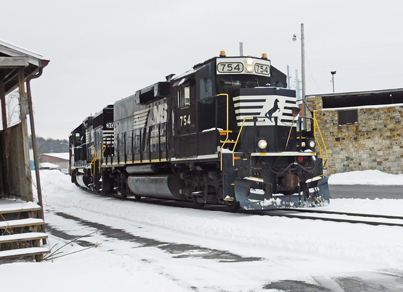
#754, (a motorless slug that can lead) returns from Hollidaysburg into Altoona on the Cove Secondary. (Photo by Jack Hughes.)

37a picks up cars in Altoony’s Rose yard. (Photo by Jack Hughes.)

23m, westbound on Three, arrows into the curve next to South Fork. (Photo by BobbaLew.)


FRIDAY’S PICTURES

A helper-set, eastbound on Two past South Fork, returns to Altoony for another help. (Photo by Jack Hughes.)

25z, westbound on Three, passes South Fork. (Photo by Jack Hughes.)

20r, eastbound on Two, passes South Fork. (Photo by Jack Hughes.)

21g passes Portage on Two. (Photo by Jack Hughes.)

34a, westbound on Three, passes Portage. (Photo by BobbaLew.)

22w has the Erie Heritage-Unit in the lashup. (Photo by Jack Hughes.)

20t, eastbound on Two, passes Cresson. (Photo by Jack Hughes.)

23z, westbound on Three, passes under the MO signals. (Photo by BobbaLew.)


******, my head-honcho lady-friend at the pharmacy I use in nearby Honeoye Falls, to whom I will give this blog link for her son, who like me is a railfan, tells me my brother and I are “amazing.”
What I would tell her instead is we are “nuts.” (One dude is 77 years old; outside in freezing cold three hours.)

Labels:

Thursday, October 22, 2020

In pursuit of fall foliage

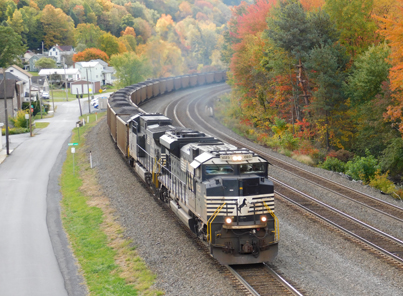
21E approaches Brickyard Crossing. (Photo by BobbaLew.)

—“Call Jack,” I commanded into my new car’s Bluetooth.
I was in Tyrone PA, having completed most of my five-hour drive to the Altoona area.
Tyrone is where the old Pennsylvania Railroad, now Norfolk Southern, turns east toward Harrisburg. It goes through a notch.
Tyrone, north of Altoony, is about as far railroad-east that we go. My brother and I have photographed in Tyrone, so he might be there.
“Where are ya?” I asked.
“24th Street bridge,” he said; so I’d go to 24th St. bridge in Altoony.
No Jack when I got there. I took a few photos, and then called Jack.
“I went to Brickyard. I’m on the embankment. Here comes one!”
I drove to Brickyard Crossing, and there he was up on the embankment with another fan, both sitting in canvas chairs.
The embankment looked too challenging for this geezer, plus I wanted to take what is my lead photo.
That's my cannon (300 mm zoomer) on tripod, although probably only 180–200 mm.
Our usual drill is Jack drives out to Altoona Wednesday, nine hours for him. I drive down Thursday.
Except his nine hours became 10&1/2 hours due to an accident-caused traffic-jam on Interstate-80 in Jersey. Someone flipped their motorhome trailer blocking all three lanes. A crane had to be brought in.
Jack usually arrives in time to take a few photos, but this time it was dark when he got there.

DAY ONE (Thursday October 8th)


Cheat-shot (they’re probably helpers on the rear of 25v). (Photo by Jack Hughes.)

—His first stop was “Five-Tracks” where PA Route 53 crosses five tracks of the old Pennsy up the west side of Allegheny mountain.
“Of all the railfan hotspots I’ve visited I’ve never seen five tracks side-by-side on railroad right-of-way.”
The leftmost track pictured, Main-8, is only a storage siding, but tracks Four through One (right-to-left) are main-line railroad.
Tracks Four and Three (right-most) are on the original Pennsylvania Railroad right-of-way out of Pennsy’s original tunnel. Tracks Two and One are on the right-of-way of New Portage Railroad and aim at New Portage Tunnel.
Pennsy got New Portage when it was abandoned eons ago, since it gave them a second summit Tunnel.
But it was higher, so they had to ramp up to it. One can see the New Portage alignment is higher than the original Pennsy.
Tracks One and Two merge into only one track through New Portage Tunnel.
But the railroad’s crossing of Allegheny mountain is three tracks, not the usual two.
Who knows how long that will last with Precision-Scheduled-Railroading. It used to be four tracks. Conrail cut back to three. (Pennsy-Penn Central-Conrail-Norfolk Southern.)
What’s pictured is what my brother and I call a “cheat-shot.” It looks like the train is approaching, but the locomotives are helping hold back the train going away as it descends the mountain.
The locomotives have engaged Dynamic braking.

Through the rock-cut from the Railroad Overlock bridge in Cassandra. (Photo by Jack Hughes.)

Also from the Overlook bridge, but looking railroad-east. (Photo by Jack Hughes.)

—The first picture is train 36A threading a cut through rock at the end of the 1898 bypass. It has a slide-fence.
The second picture is the same train past the Overlook bridge heading toward Lilly.
(All American railfans, BY LAW, should be required to visit Cassandra Railroad Overlook. Shade man, shade is hard to come by at Horseshoe Curve).

Loaded coal-train 740 eastbound on Track One approaches the overpass in Lilly. (Photo by Jack Hughes.)

—The next place my brother went is the overpass in Lilly PA. It’s just north (railroad-east) of Cassandra.
Grade-crossings are few and far between on this heavily-traveled railroad. I can think of only two between Altoona south (railroad-west) to South Fork, a distance of perhaps 15-20 miles.
Most highways get over the railroad by an overpass built recently. Or perhaps the railroad bridged the highway eons ago. Route 53 still has narrow stone culverts under the railroad.
Sometimes the railroad built the highway overpass; grade-crossings lead to crashes.
This railroad sees a lotta traffic.

—My brother also tried Carneys Crossing before that Route 22 on-ramp, but nothing is worth doing.
Westbounds approach down a long tangent from that on-ramp which isn’t very photogenic.
Carneys is one of the two crossings-at-grade south of Altoona before South Fork. It’s also the location of a defect-detector.
“Norfolk Southern milepost 253.1, Track Three, no defects.”
We hear that on our railroad-radio scanners, and use it to know if a train is coming.
If it’s a full train — not just helpers — we got a minute or two at Cassandra. Or it’s already in sight at Cresson. That defect-detector doesn’t broadcast until the last train-car is past.
If it’s a helper-set, that detect-detector broadcasts well before the helpers are in sight at Cresson.
253.1 isn’t our only detector. There are a few others.

21J. (Photo by Jack Hughes.)

—Another place my brother went is the Route-22 on-ramp near Cresson.
Route-22 over Allegheny Mountain is a gigantic four-lane expressway, built at huge expense, and probably up to Interstate standards.
Route-22 crosses the railroad on a gigantic overpass; and standing on it to photograph trains going under it is clearly unsafe. Traffic would be passing at 70-100 mph.
But recently my brother noticed the bridge over the railroad is near the Route-53 interchange. You wouldn’t be standing next to expressway. You’re standing on an on-ramp to the expressway.
This makes photography here much safer, although you might attract attention from the gendarmerie.
Last visit we tried it, intending our visit would be short. In other words, you hafta know a westbound is coming.
Train engineers no longer call out signal-aspects, but they do call out Control-Points (usually interlockings), and CP-MO is nearby in Cresson.
“21J west on Three, CP-MO, CLEAR!” on our railroad-radio scanners.
Zoom, if we’re near the on-ramp 21J is coming.
Pictured is 21J.
That on-ramp is about where the Cresson runner begins. It’s visible next to the track the train is on, left (right in the cab) of Track Three.
Trains for the Corman branches out of Cresson go onto the Cresson runner. Those branches are old Pennsy.
Notable is a unit grain train for an ethanol plant up in Clearfield.
Nothing is parked on the runner in this photo, but often there is.

21G on Track Four rounds the curve toward Cresson after Five-Tracks. (Photo by Jack Hughes.)

—My brother did get one more usable picture after the on-ramp. A road north of Cresson runs through woods next to the tracks. Along that road is a cut-out that looks at the tracks where the railroad curves towards Cresson.
Distant in the picture is the Route 53 bridge over “Five-Tracks.” Already you can see the higher grading that carries Tracks One and Two toward the summit.
The train is on the original Pennsy gradient, two tracks at this point. The four-track main returns to three tracks at MO interlocking to the west near Cresson.
It’s multiple tracks because Allegheny Mountain could be a bottleneck. Track One was closed for maintenance that day, leaving only two open tracks over the mountain: Three and Four.
Precision-Scheduled-Railroading might eliminate a track, which could throttle the mountain to only one open track during maintenance.
A lot of two-way traffic is on this railroad. I don’t think one track over this mountain could handle all the traffic.

20R, lead by 8105, the “Creamsicle” Heritage-Unit, crosses Porta Road at Brickyard Crossing. (Photo by Jack Hughes.)

—By now I was in Altoony. I found my brother up on the embankment at Brickyard Crossing.
Not long ago there was a Brickyard adjacent to the tracks. It has since been taken down, and replaced by a warehouse.
But railfans and railroad employees still call it Brickyard Crossing.
As noted earlier (see above), I shot a few failures at 24th St. bridge in Altoona, and my brother had to gone to Brickyard.
The “Creamsicle,” one of 20 so-called Heritage-Units painted the schemes of predecessor railroads out of which Norfolk Southern was formed, is called the “Creamsicle” because its colors match those of a Creamsicle = yellow and orange.
The railroad it honors is Interstate Railroad.
8105 is a General Electric ES44AC, 4,400 horsepower.


DAY TWO (Friday October 9th)

25V westbound on Track Three charges the Summerhill overpass. (Photo by Jack Hughes.)

—My brother, who drives us around, seems to finally wanna visit South Fork PA.
Perhaps what interested him was Track One was closed for maintenance, and “CP-W” was involved.
“CP-W” (Control-Point W) is just east of South Fork.
Hooray-hooray!
How many times have I advocated South Fork, but it’s always too far. We end up at the Post-Office bridge in Altoona, or Eighth Street bridge, or maybe the covered pedestrian overpass if we’re lucky.
How many times have we been down that cemetery road east of Gallitzin? Not bad, but anything we shoot there is repeat. I’m looking for a photogenically interesting picture, which usually involves track curvature.
My brother, on the other hand, seeks the standard three-quarter locomotive view — engine bearing down filling the frame.
Which is fine, since I’ve used many of his three-quarter shots in our calendar.
It’s MY calendar — that is, I’m the one who designed it. I’m also the one who chose the pictures.
I like to depict scenery.
South Fork has a gigantic curve west out of the valley toward Pittsburgh.
Very scenic.
But the light can be wrong. Afternoon is backlit; morning light isn’t.
So we’d drive down to South Fork in the morning.
But it was heavily fogged in. Photography was impossible. We couldn’t even see the tracks.
We turned right around and headed back out of the fog.
The next town north (railroad-east) was Summerhill PA. A recent highway bridge is in town, probably to replace a grade-crossing.
We walked up on the bridge, which is just west of where an old Pennsy signal was (since removed with Positive-Train-Control and in-the-cab signaling) to take the above photograph.
Our photo is a repeat, except prior photographs had the signal-bridge.

We beat it! (Train 590, loaded coal eastbound.) (Photo by BobbaLew.)

—“I bet we can beat that sucker!” I said to my brother as we walked down the Summerhill overpass.
An eastbound came through on Two as we returned to my brother’s car.
Hammer down! Pedal-to-the-metal! We’d charge up Route 53 hoping to beat the train.
This is what it's all about, readers. We see a train and chase it.
It was easier when train-engineers called signal-aspects. Those signals have since been removed with Positive-Train-Control and in-the-cab signaling.
Now all the engineers call out are interlockings. All we’d hear are “MO” and “SO.”
We might also hear “MG”, but that’s 15-25 minutes away, plus a westbound has to clear “MO.”
53 parallels the railroad, and goes under it at two points.
“No train yet” as we drove through the first underpass, an ancient culvert.
“We’re ahead of it, but it won’t be long,” I said.
We continued up 53; maybe 10 miles South Fork to Lilly.
By Lilly we were so far ahead we had time to set up. The train wasn’t boomin’-and-zoomin’.
There’s another recent overpass in Lilly, but we didn’t use it.
We’d go out west of Lilly to Plane-Bank, where there once was a Pennsy signal, 254.7 I think.
No cannon-on-tripod this time; that eastbound was coming.

04t, Amtrak’s eastbound Pennsylvanian, passes the railfan platform in Cresson. (Photo by BobbaLew.)

—Our next stop would be the trackside railfan platform in Cresson PA, another location like South Fork that always got poo-pooed.
Pittsburghers would come out to Cresson to escape their smoky city.
Cresson was also the location of Cresson Springs resort, which Pennsy got control of and rebuilt.
Cresson Springs took advantage of mineral-water springs, and the clear mountain air.
Cresson Springs is gone, but the railroad remains. A small display of railroad stuff, plus a pavilion, sits next to the tracks through Cresson. Included is a retired Pennsy caboose.
The platform, for railfans, is at the same level as the tracks — in other words you have the climb steps to get up to it.
I’ve always wanted to try it, and have on occasion by myself. But I never got any trains.
Westbounds were coming when we arrived, but westbounds are too far from the platform.
That platform is not very photogenic = it’s too far from the tracks.
Eastbounds aren’t too bad, but in the afternoon they’re backlit.
Trackage past that platform is a long tangent = no curves at all.
We were the right time and light for Amtrak’s eastbound Pennsylvanian, which was coming per our scanner-feed.

65R charges Carneys Crossing. (Photo by BobbaLew.)

—I’m not too sure where we went after Cresson, but the photographs make it look like we went to Carneys Crossing next.
Carneys is one of only two crossings-at-grade between Altoony and South Fork. The other is Brickyard Crossing up near Altoona.
Neither crossing is heavily traveled, and Brickyard is little more than a street.
Carneys isn’t very photogenic — too much tangent track.
Looking railroad-west is okay with strong telephoto, and the picture has a surfeit of colorful foliage.

21G westbound charges off the 1898 bypass into Portage. (Photo by Jack Hughes.)

—Next would down to the abandoned trailer behind the Portage railroad station. That abandoned trailer has been there for eons.
This shot is a repeat = I even had it once as a Christmas card.
The 1898 bypass begins in Portage; the original Pennsy main also went through Portage, and is now used as a secondary to a coal loadout that was once a coal-mine.
The original Pennsy main also went through Cassandra, with many tight curves. Which is why the bypass was built. It involved a long fill and a rock cut; all straight.

38g eastbound on Two rounds the curve past South Fork. (Photo by BobbaLew.)

—Hooray-hooray! It looks like we’re finally going to South Fork (PA).
Railroad-west across PA, the railroad traverses a long valley from Tyrone south to Altoony. The valley parallels Allegheny-front, then crosses the mountain west of Altoona.
It then turns south again to South Fork, were it turns west toward Johnstown and Pittsburgh.
The railroad turns sharply west at South Fork, although it’s a very wide curve.
As noted above, the light into that curve is much better in the morning. But the morning-fog was so dense we couldn’t photograph anything.
So late afternoon, when the engine fronts are backlit.
Fortunately the sun was very bright, and the sky clear, so back-lighting was minimal.

#4001, a “bluenose,” is in the lashup. (Photo by Jack Hughes.)

—My brother also got one of the two “bluenoses” as part of the lash-up on 22W.
4000 and 4001 are rebuilds of General Electric Dash 9-40Cs built in 1995, then rebuilt in 2015 by GE/American Motive Power into AC44C6Ms.
They were converted from Direct-Current to Alternating-Current.
Other locomotive conversions were also done, and many more are planned. Some were done in Roanoke, and others were done at Juniata Shops north of Altoona.
Norfolk Southern really struck gold with those shops — one of the largest locomotive repair facilities on the entire planet. (It’s ex-Pennsy.)
The paint-department at Juniata shops went bonkers. 20 Heritage-Units in paint-schemes of predecessor railroads, plus other rebuilds in various colors, not just the standard Norfolk Southern black.
I’ve also seen yellow and green, plus other rebuilds that honor veterans and first-responders.

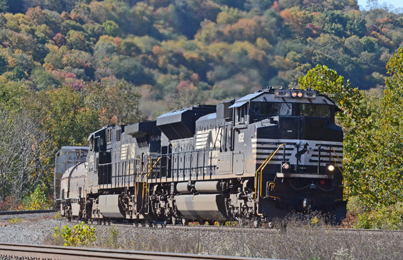
21E, westbound on Three, starts into the turn past South Fork. (Photo by BobbaLew.)

20Q comes and goes under Cassandra Railroad Overlook. (“Coming” by Jack Hughes; “going” by BobbaLew.)

—By now our light was going away.
But Cassandra Railroad Overlook again, where I’d repeat my years-ago shot in the rain.
By this time the rock-cut before the Overlook would be lit, although the light was extreme.
Visible in my “going” shot is Cassandra Railroad Overlook, the old bridge over the railroad where are the 1898 bypass ends.

65M west on Three, passes 20Q east on Two. (Photo by BobbaLew.)

—“Any chance this old geezer can lean on your truck?”
I asked that to two gentleman in a black Chevy pickup trackside at the compressor in Cresson.
The compressor-location in Cresson is west of the railroad, which most of the day doesn’t work, since the sun is in the southeast.
But in late afternoon the sun comes around west of the railroad.
“I am not too stable,” I told them; “and usually my brother parks where I can lean against his truck.
But he parked up there, and I wanna shoot down here.”
“Sure!” they smiled.
“I’m age-76, and I can’t stop. Chasin’ trains since age 2.”
Calling myself a “geezer” always works.
The photo is a “double.” 65M westbound on Three, passing 20Q eastbound on Two.
Also visible is the Cresson runner, but nothing was on it = trains for delivery to Corman.
Anything on the runner would block photography of the Main.

07t (Amtrak’s westbound Pennsylvanian) descends west slope of Allegheny Mountain on Track Three. (Photo by Jack Hughes.)

—Our final stop was Five-Tracks again.
07t (Amtrak’s westbound Pennsylvanian) was coming.
As the chatters say on Virtual Railcam’s YouTube web-stream of Horseshoe Curve:
“Elvis has left the building. We now resume our regular Norfolk Southern programing already in progress.”

Labels:

Wednesday, August 12, 2020

Train-chase from Hell

Westbound empty coal-cars charge off Bennington-Curve onto the long uphill straight towards tunnels atop Allegheny Mountain. An eastbound intermodal is coming down next to it. The third track at left comes down “The Slide” from a slightly higher tunnel atop the mountain. (Smartphone photo by Jack Hughes.)

—“Assuming my brother and I do another train-calendar,” I said to the receptionist at our Motor-Lodge in Altoona (PA)….
“If I mail it to this Motor-Lodge next January are you gonna get it?”
“Yes,” she smiled.”
“I wanna be sure you get it,” I said. “You’re the one who always smiles at me. —Yer doin’ it right now!”
I gave that receptionist our 2020 calendar seven months late. “This is what my brother and I do here.”
She just said hello to me in-passing outside. We recognize each other, and I talk to her.
“Flirting” I call it; but I’m told it’s not.
With MY childhood it’s flirting = EVIL! I’m talking with a female. (Gasp! “Disgusting, I tell ya!”)
I make her smile. Clearly she likes it, and her smile is irresistible.

(That was my first proposed lede. Here’s my second.)

—“Enjoy yourself!” said my smiling 19-year-old female contact at the kennel that boards my dog.
“Would that I could,” I thought to myself. My dog is crippled with a torn ACL. He hops on three legs, and those kennel-ladies rearrange rugs so he’s not on slippery floor.
That 19-year-old calls him “ham,” since he’s such a lovable ham — a people-dog =pet me!”
(That 19-year-old smiles, and I melt.)
All those kennel-ladies love my dog, and are trying to set up a second opinion — since my first opinion was negative.

(That was my second proposed lead. Years ago at the Mighty Mezz I learned: “start with a quote; readers love dialogue, and a quote draws ‘em in. Otherwise what you wrote lines the bottom-of-the-birdcage.”)

But this trip became the train-chase from Hell.

(Enter final proposed lead.)

—Yr Fthfl Srvnt drove all the way to Altoona without his camera. I had all my other photo-equipment, but not my camera.
“We needed your telephoto at Bennington-Curve,” my brother exclaimed.
“No great loss,” I texted another friend. “I have so many images from earlier trips I wasn’t planning on photographing much. My calendar is only 13 pictures, and many are already planned. I only need a few ‘extraordinaries’.”
These Altoona sojourns have become palling around with my brother.
The only two locations not done yet, one of which is Bennington-Curve, I can try again next month when I plan to go to Altoona with a different friend. My brother may not be able to.
All I hafta know is how to get to Bennington-Curve.
So, I let my brother do the photography, with occasional input from me: SHOOT-SHOOT-SHOOT-SHOOT!”
He can’t do motor-drive, and his camera sets shutter-speed itself. Often too slow to stop a train.
What I forgot goes well beyond my camera. “Perhaps my crippled dog is a distraction?”
No change of tee-shirts, no hat (in case it rains), no chocolates.
Worst of all was my camera.

My brother comes a day before me — a nine hour trip from near Boston.
A few days later we ram up-and-down 40-50 miles of railroad, taking fabulous photos of trains. We’re both railfans. Altoona was where the Pennsylvania Railroad took on Allegheny Mountain in the 1840s. At that time Allegheny Mountain was a barrier to East-West trade.
The railroad is now Norfolk Southern, but getting a railroad over that mountain is still a challenge. There are heavy grades both up and down — helper-locomotives often get added.
And that railroad is very busy. It’s still a main trade conduit between the midwest and the east-coast megalopolis.
What I usually say is “wait 20-25 minutes and you’ll see a train.” Sometimes it’s longer or shorter, or tracks get closed for maintenance.
That old mainline across Allegheny Mountain is fabulous for railfans.
Trains galore! And wide-open-throttle climbing. In steam parlance it was throttle-to-the-roof!” With diesels it’s run-eight!”


(Wednesday afternoon)

—Per usual my brother drove to Altoona Wednesday, July 22nd.
He arrived early enough to shoot some photos, his first being at Gray Interlocking. Gray is where a signal-controlled siding merges back onto the two-track main.
The siding runs north (railroad east) out of Altoona all the way to Gray, where are the railroad returns to the two tracks to Harrisburg.

35A (mixed manifest) charges through Gray Interlocking, SD70ACe #1000 on the point. (Photo by Jack Hughes.)

—From Gray my brother charged south to the lower Riggles Gap Road overpass over the tracks, hoping to beat 35A.

35A continues toward Altoona at the Lower Riggles Gap Road overpass. The railroad says 35A is westbound. (Photo by Jack Hughes.)

—Before giving up for the day, my brother went down into Altoona, and up onto the Eighth Street bridge. (Shooting here in late-afternoon puts the sun behind the train.)

Eastbound intermodal 20R goes through Altoona. (Photo by Jack Hughes.)


(My brother alone on Thursday)

Westbound trash-train exits Altoona for The Hill. (Photo by Jack Hughes.)

—On Thursday my brother photographs trains while I drive down. I usually arrive in the afternoon, then we hook up and photograph trains until our daylight goes away.
The first place he went, alone of course, was the 24th St. bridge Pennsy’s old Slope-Interlocking. Slope Tower is gone, and now the interlocking is just Altoona’s yard-entrance, as it was under Pennsy.
Exiting Altoona is 63V, a westbound trash-train. The train is all purple containers filled with trash and garbage for landfilling out west.
The trash-train usually stinks = rotten garbage.

Westbound 21E curves toward Cassandra-Railroad-Overlook on Track-Three. (Probably 50 mph.) (Photo by Jack Hughes.)

—My brother then went to Cassandra-Railroad-Overlook, where the railroad goes onto the 1898 bypass.
An old overpass remains, converted by a local resident into Cassandra-Railroad-Overlook.
He noticed railfans were hanging out on that bridge. He cut the grass, and added tables and chairs.
My brother said many people were there, plus our usual entrance to Cassandra was all torn up. He got there by driving around.
Cassandra-Railroad-Overlook is a great place to watch trains. They round a curve onto the bypass, and you watch from the overpass, or a nearby grassy hillside.
My brother also said a sleepover was planned at the Overlook.
(How anyone could sleep at Cassandra-Railroad-Overlook is well beyond this railfan.)
Reasons for us to avoid Cassandra.
According to Phil Faudi, my railfan friend from Altoona, 21E is the “UPS-train.”
21E used to be all UPS-trailers to the West Coast. It ran on time, or the railroads got penalized.
Phil is the fan who long-ago started me chasing and photographing trains. He did “tours” at that time. We’d ram up-and-down the same 40-50 miles of railroad my brother and I do.
“Drop everything!” Phil would shout. “21E is climbing the mountain! We could beat it to MO.”
We’d bootleg-turn his aging Buick, and pedal-to-the-metal up Sugar-Run Road.
My all-knowing brother disputes that 21E is the UPS-train.
I really don’t care, but I think Phil is right. He says most of the websites my brother relies on have errors. Phil hangs out with Norfolk Southern crewmen.
Phil told me 21E gets three locomotives, in case one fails.
My brother’s Cassandra 21E has only two.
Things probably aren’t what they were years ago, so 21E may no longer be the vaunted UPS-train.

Eastbound 12G (mixed manifest) climbs Track One toward the summit (Photo by Jack Hughes.)

—Then my brother went to “five-tracks,” were PA State Route 53 crosses five tracks of Norfolk Southern’s mainline approaching the summit of Allegheny Mountain.
The two left-most tracks are on the original alignment of the Pennsylvania Railroad. The right-most tracks — the train is on Track-One — are on the alignment of New-Portage-Railroad toward New Portage Tunnel, which is separate from, and slightly above, the original Pennsy tunnel.
Pennsy took over New-Portage-Railroad when it abandoned eons ago. It gave them a second summit tunnel. (They added a third, but it was abandoned when the original tunnel was enlarged.)
“Never before have I seen a railroad mainline with five tracks,” my brother always says. “This is incredible! Even if one of those five tracks is just a siding. Usually it’s no more than two or three.”
The slightly higher New-Portage alignment renders a slightly steeper climb up the west slope.
To get back to the original Pennsy alignment on the east slope, Track-One has to descend a ramp known as The Slide. It’s at 2.28% (originally 2.36%) which isn’t too bad; and now even westbounds are climbing The Slide.
The highway bridge isn’t too bad = traffic is fairly often, but there’s plenty of room to safely set up a photograph. You have to be careful switching sides.
My brother really likes this picture: that 12G is all colorful boxcars slathered with graffiti.

Westbound intermodal on Track-Three cruises downhill through Lilly. (Photo by Jack Hughes.)

—Then my brother went to Lilly (PA) south (railroad-west) of Cresson.
A large street-bridge leaps over the railroad, plus a small creek.
My brother went up on that bridge, from which we’ve shot many times. I don’t consider the view photogenic, although it’s worth seeing.
The sun always lights only one side of the train, and in the morning it won’t light the front of the locomotive = back-lit. Also, too much straight railroad = to get any curvature, ya gotta telephoto.
I coulda called the train a “stacker,” since it has double-stacks. But it also has TOFC (trailer-on-flatcar).

Westbound 294 on Track-Two trackside through Altoony. (Photo by Jack Hughes.)

—The railroad fronts some of the streets in Altoona. One street runs parallel to the tracks, and houses are on it.
The houses are on one side of the street, and the tracks are on the other side. A waist-high fence separates from the tracks.
I could never live there: I’d be up all night watching trains.
We tried this location last year, but it doesn’t work very well. Light-wise you’re on the wrong side of the tracks. Plus the background is turgid.


(Paling around all-day Friday with my brother.)

747 (westbound on Three) passes the empty grain-train on the Cresson runner. (Still foggy!) (Photo by Jack Hughes.)

—On Friday my brother and I chase and photograph trains all day.
But —A) I didn’t have my camera, and —B) There were only two places we wanted to go, both to which we never had been.
First was what I call “the ramp,” railroad-west of Cresson. It’s an on-ramp from State Route 53 onto the Route 22 expressway.
That expressway crosses the railroad on a large bridge, and we haven’t tried it for fear of parking/standing on that expressway.
But the previous day my brother noticed another fan photographing from that bridge, and that fan wasn’t actually on the expressway.
He was on an on-ramp that’s part of the bridge.
The Cresson runner ends at that bridge. Norfolk Southern parks grain-trains on that runner for a transfer to Corman.
Corman operates the old Pennsy branches out of Cresson, and there’s an ethanol plant up in Clearfield (PA).
The grain-train is for that ethanol plant.
Corman brought empty covered-hoppers back to Cresson for transfer back to Norfolk Southern.
The grain cars are on the runner, ready to merge onto the mainline. Engines are attached, but need a crew.
Meanwhile, westbound 747 on Track-Three hurries past the grain-train.

Eastbound intermodal on Track-Two starts into “Benny.” (At left is Track-One; and in the distance are the summit tunnels atop Allegheny Mountain. Also in the distance is “The Slide” down Track-One.) (Photo by Jack Hughes.)

—Next would be Bennington curve, a location from which we never shot.
We’ve shot inside the curve, but not outside. The location was a rock outcropping near and above the tracks.
Getting to it was challenging, although we took the hard way = through woods, no paths.
I fell twice crossing downed trees. I was sidestepping, but the trees were only a few feet apart. My balance is awful, so I used my brother’s umbrella as a cane.
Bennington curve is where Pennsy’s “Red-Arrow” passenger-train from Detroit flew off the track at 3:21 a.m. February 18, 1947 after descending “The Slide” at too high a speed without brakes.
All told, 24 were killed and 138 injured.
The “Red-Arrow” was running late, and had two double-headed K4 Pacifics pulling it.
“Benny” is a sharp curve; 30 mph speed-limit. Nearby is the abandoned Bennington mine-camp, with Bennington Cemetery = out in the middle of nowhere.
To get to it you have to travel a trackside one-lane dirt-road — it’s right next to Track-Three.
We stayed there about three hours, and photographed many trains.
It’s a fabulous location, and I’m glad we found it.
That rock overlooks the entirety of Bennington curve, which means the train is in view as well as the locomotives as the train rounds the curve.

591 (empty coal-cars) on Track-Three comes off Benny toward the summit tunnels. It’s passed by 20R headed down The Hill on Track-Two. (Photo by Jack Hughes.)

38A descends The Slide. (Photo by Jack Hughes.)

—Track-One over the mountain had been closed for maintenance pretty much all day. Track-One includes The Slide.
Before we left Benny Track-One was cleared for service. Supervisors patrol the tracks often to locate flaws, like at switches, that need repair. They use pickup trucks with retractable railroad wheels.
Soon 38A was descending The Slide on Track-One.
Things are no longer what they were with in-the-cab signaling. Train-engineers no longer call line-side signals, which we’d hear on our scanners.
Many of those line side-signals have been removed.
But my brother is “smarter than the average bear — nyuk-nyuk-nyuk!”
Train-engineers still call out signals at interlockings, plus in-the-cab signal-aspect changes.
There still is chatter on railroad radio.
Plus he also has crib-sheets galore, and knows what to expect.
He also monitors a new railfan website called PT-242, which logs every train past Horseshoe Curve.
The Mighty Curve is part of the railroad over Allegheny mountain, and 242 is the milepost location from Philadelphia.
“23Z, westbound on Three, just passed the Mighty Curve. We could beat it to Portage.”

23Z, Penn-Central Heritage-unit on the point, curves off the 1898 bypass into Portage. (Photo by Jack Hughes.)

—We packed up and left Benny — no falls, since we were on paths.
That rock outside Bennington curve is the BEST location we ever been to.
We motored to the abandoned trailer behind the old railroad station in Portage.
Portage is where the 1898 bypass eastbound begins. The original Pennsy mainline remains — it’s used as a secondary to-and-from a coal loadout.
We been to that Portage trailer many times — my 2019 Christmas-card is from that trailer.
But this time the trailer was socked in by weeds.
Boring to this kid, but my brother has the camera — and the Penn-Central Heritage-unit was on the point.


(Addendum)

—Amidst all this, and out in the middle of nowhere at Bennington curve, I got a deluge of faraway phone calls concerning my dog.
Luckily I had my iPhone and working cell-phone service. All calls were from home, 265 miles away — although my phone nearly died.
My crippled dog developed an infection in his ailing leg, and had to be taken by my kennel-friend to an emergency veterinary service.
With COVID-19 that friend had to wait outside four hours.
I was making a torrent of executive decisions from out in the middle of nowhere.
You do pretty good for a stroke-survivor,” my brother commented.
My kennel-friend finally retrieved my dog, along with anti-infection pills. I shouldn’t have gone to Altoona, but “go to Altoona,” she said. We didn’t expect such a mess.

• RE: “throttle-to-the-roof” and “run-eight.” Steam locomotives usually had their throttle lever, maybe three feet long, hinged to the cab roof. Pulling it back all the way — full throttle — meant angling that long lever up toward the cab-roof. Diesel locomotives usually have eight throttle positions on their control-stands. Run-eight (the final position) is maximum fuel delivery = the equivalent of full throttle. (Diesel engines aren’t throttled.)
• I had a stroke October 26th, 1993 from an undiagnosed heart-defect since repaired. I pretty much recovered. Just tiny detriments; I can pass for never having had a stroke.

Labels: