Sunday, May 09, 2021

Mighty Weggers

—Nearly 55 years ago Yr Fthfl Srvnt received his BA, then returned home to the same sorry litany of angry put-downs and sanctimonious badmouthing he left behind for college.
Despite being a misfit, an agnostic among zealots, my college, Houghton (“HO-tin;” as in “hoe,” not “how” or “who”), in Western NY, was the first hyper-religious institution to not automatically adjudge me rebellious and Of-the-Devil.
It was my professors, adult authority-figures who wanted me in their classes.
“That Hughes kid can think. He might say something that makes me think.”
My bereavement-counselor tells me Houghton was my first step away from my horrible childhood.
After college returning home was extremely depressing.
College had been fun. My father was angry as Hell, because Houghton hadn’t “straightened me out.”
After a month I wanted out.
My mother was distraught. It was the equivalent of running away.
My father cosigned to buy me a car: $600 for a used ’61 Corvair Monza coupe with PowerGlide.
I loaded my meager belongings in it and headed north.
I never could pay the $600, which my father complained about until he died. Despite my giving thousands to my younger siblings to help them with college expenses.
North to Rochester to hook up with my wife-to-be.
She began Library-Science at Geneseo State College. She’d been in my class at Houghton.
The first night I had to sleep in my Corvair impossible!
The next day we motored up to Rochester to get myself living-quarters, a $10-a-week sleeping room. (That may have been $10-a-month.)
I would eat in restaurants until my money gave out.
My sleeping room was at 136 Chili Avenue, just west of where Rochester’s W. Main St. ends.
I had kitchen privileges, but rarely used ‘em. It was too much trouble.
West Main ends just west of Bull’s-Head, splitting into Chili and West Avenues.
On West Avenue were two side-by-side supermarkets, a Weggers and a Star Market.
Weggers was more amenable. I went there to buy Campbell’s canned beef soup and rolled chocolate cake.
I’d take both to my sleeping room, and heat the soup in a small pitcher with a coffee-coil.
That was supper when I didn’t eat out.
It was a meager start for leaving madness behind.
No way was I going home. Have my father celebrate return of his Prodigal-Son? The fact I failed?
No way José!
It’s been Weggers ever since.
For a long time it was East Ave. Wegmans. That was when we lived in our tiny house on Winton Road in Rochester.
We could walk to it.
After we moved out to West Bloomfield, I used the Pittsford-Plaza Wegmans coming home from work.
That store has since been rebuilt into what I call “the-jewel-the-crown.”
Some of it has two stories, and ya need a powered cart to shop it. Its parking lot is so big they need a valet service.
I haven’t been in a Weggers yet that didn’t have a G-gauge model train running over the cheese-bar.
“BAMP-BAMP-BA-BAMP!” (The grade-crossing horn signal.)
East Ave. Wegmans has also been rebuilt — a gigantic superstore I’ve never been to.
The Henrietta Wegmans was also rebuilt into what I call “the Palace.” Clocktower, parapets, glitz everywhere. All it needs is a moat, and perhaps a carousel.
“What if all I need is bread?”
Wegmans expanded all over the northeast, complements of Danny Wegman, Ferrari-driving son of Robert Wegman.
(I met Danny once.)
Robert used to be incensed Danny wanted to put in “Market Cafés” (eating parlors).
We’re a grocery, Danny!”
Nevertheless, “good call Danny!”
Perhaps another Weggers paradigm is “just spend the money. It comes back in buckets.”
There goes another Weggers truck!”
My first stop driving back from chasing trains in Altoona is the Williamsport Weggers. It’s always packed with thunder-thighed Harley-mamas in short-shorts.
A couple years ago I returned to my south-Jersey roots. There in the vast abandoned parking-lot of the defunct Garden State Park horse-racing track was the Cherry Hill Wegmans.
Wegmans goes after suburban markets, or the rich wannabees.
I tell a girl with whom I graduated high school (1962) to try the new Weggers not far from her home in southeastern PA.
I keep telling my brother in northern DE that Weggers is coming.
So Sunday-Sunday-Sunday! Off to the Canandaigua Weggers to buy groceries for the coming week.
Mainly bananas. Weggers are pretty good. They’re not used as baseball bats.
“Yo Matt; lob me that there peach so I can bat it outta the store with this here banana!”
And maybe I’ll meet *******, a pretty lady-friend who stocks produce at that supermarket.
Plus ******, another lady friend who often works self check-out.
Danny deserves that Ferrari.

• “Chy-lye;” all “eye.”
• “Parable of the Prodigal Son:” Luke 15:11–32 King James Version. (My father was a Bible-beater.)
• No lady friends at Weggers yesterday.

Labels:

Sunday, September 20, 2020

Youtharama

—During my teen years my hyper-religious parents made me hang out with a group of teenagers allied to my church.
This was probably a mistake, since all the others were ne’er-do-wells like me, evil and disgusting. Hardly people that would “straighten-me-out!”
Our group was led by an adult who may have been a Dupont Vice-President. (Dupont rules northern DE, and I am somewhat native — moved there at age-13 from south Jersey.)
That guy, and his wife, had a “burden” for us, because most adults in the church considered us disgusting.
I still remember a church deacon sanctimoniously telling me I was “degraded.”
For which reason I immediately established the founding chapter of DYA (“Degraded Youth of America”) in my high-school.
It countered my high-school chapter of Youth-for-Christ (YFC), which I also was forced to join.
Our leader would drive us all up to Philadelphia (from Wilmington) to attend a Youtharama gig.
I suppose “Youtharama” is a takeoff on “Cinerama.” Youtharama began in 1956; an attempt to bring religion to youth, an outreach of Percy Crawford, a Philadelphia radio-evangelist.
What a wonderful idea, except we ne’er-do-wells pursued less boring options.
Youtharama wasn’t interesting to us.
Jokes, and singing, and finally an alter-call, wherein zealots in the crowd all got up to “go forward.”
By so doing they hoped to persuade the average attendee to also go forward.
What we did instead is sneak out to ride Philadelphia’s Broad-Street subway.
It wasn’t far, and didn’t cost much.
Riding a subway was much more interesting to this railfan than religious posturing.
Another diversion was to sneak elsewhere in the building to drop spitballs in people’s drinks.
This actually happened, readers. A reception-dinner was being held elsewhere in the building, and we ne’er-do-wells were in a balcony above the reception.
We could drop spitballs in people’s drinks. The spitballs were made from Youtharama programs.
Despite our evil tendencies, that adult leader left his mark. I saw him years later after he left Dupont to found an antiques store with his wife in Wilmington.
No contact, but I think they recognized me.
Meanwhile my sister married and then divorced one of my fellow ne’er-do-wells. He became a hippie.

Labels:

Wednesday, September 02, 2020

My fabulous memory

—“How does he remember this stuff?” My sister yelled.
I wrote a gigantic trivia quiz for my parents’ 50th wedding anniversary in 1991.
The party was in south FL, and by then my parents were in assisted-living (I guess) in an apartment we children called “the last motel.”
My quiz asked the name of the Fire-Chief in our little south Jersey suburb during my childhood (the ‘50s).
Philpot!” my father snapped.
“He knew it!” I shouted.
How does he remember this stuff?” My sister yelled. Me or my father, I don’t know who. But I been told I have an incredible memory.
I guess I do, but what I always said was “how can I forget?”
In 1956 I dressed up for Halloween as Elvis Presley, complete with charcoal sideburns.
The infamous Hilda Q. Walton, my hyper-religious Sunday-School superintendent neighbor, sanctimoniously declared Elvis to be the “bane of western civilization.”
How can I forget that: etched in my mind til the end of time.
Ed Sullivan had Elvis on his TV program, but only pictured from the waist up.
Swiveling hips were Of-the-Devil back then.
My how things changed!
What passes for music now is continuously repeating the F-bomb to thunderous jabbering — totally devoid of pitch.
At least Chuck Berry and Little Richard could carry a tune.
The last rock ’n’ roll album I bought was by Def Leppard with “Photograph.”
Now I listen to Bach and Beethoven. And the good radio is oldies from the ‘80s.

So now for a fond memory from long ago.

In 1959, 1960, and 1961, at ages 15 through 17, Yrs Trly was on the staff of a religious boys camp in north-eastern MD.
My job title was Counselor-in-Training (CIT), but I also was stable-staff.
Since I was willing to muck stalls and teach horsemanship, everyone else on stable-staff could play cowboy. I hardly could ride horseback at all, so was assigned a nag.
The camp was on Chesapeake Bay, which allowed excellent canoeing. All the camp had were canoes — sailing was after my time.
Most memorable is when me and another staffer “borrowed” a canoe, so he could go out onto the bay and smoke his beloved Marlboros. (Fortunately I never smoked.)
That staff-member was kitchen crew, the most sinful employees on the staff. How they were hired by Bible-beaters is beyond comprehension.
How they hired me is also beyond comprehension, a disgusting agnostic. But I could spin a good story — as I’m doing now.
It was dusk, and the bay was placid = no wind. Plus no speedboats to roil the surface.
Far away in the distance a giant 50,000 foot thunderhead loomed. It was probably deluging northern DE. Lightning flashed cloud-side, but we were too far away to hear thunder.
That image is still in my head. Lightning-bolts cloud-side, but silent.
Images like that I never forget. Perhaps my sister would, but that thunderhead is goin’ to my grave.
Along with “Big-Daddy” Don Garlits at Cecil County Drag-o-Way in 1965, a P-51 Mustang flying aerobatics at Geneseo airport, and restored Nickel Plate steam-locomotive 765 doing 70 mph on the old Chesapeake and Ohio railroad in WV.

• RE: “Don Garlits at Cecil County Drag-o-Way in 1965……”—He laid rubber the entire length of the quarter-mile dragstrip, and his car was so loud you had to cover your ears. Flames fifteen feet high came out of the header-pipes, and when he finished the race you smelled model-airplane fuel = nitro-methane. He was racing a 900-pound unblown fuel-burning Chevy. The Chevy red-lighted, but Garlits beat him anyway!

Labels:

Tuesday, January 28, 2020

Many years ago.......

.....Summer of 1964, following my sophomore year at college.
A friend at my church convinced me to try what he said was a wonderful way to make megabucks at a summer job.
It was selling Grolier encyclopedias door-to-door.
Training was said to be paid, but I never received a penny. Promises-promises if I asked.
I guess the goal was to successfully sell a set of encyclopedias, to find a sucker.
Glitz and glamour were paraded every-which-way: fabulous jaunts to Hawaii, Las Vegas, etc. But the goal was to find that sucker.
We’d patronize some fancy restaurant before door-to-door. (I think they were paying my tab.)
That was after two weeks of so-called training: how to present our product as the deal-of-the-century. Lots of drama and room-filling displays; no pyrotechnics though.
I guess my friend was successful, but to me it was a snow-job. The goal was to take advantage of some sucker.
My doubts increased as we began working an apartment complex where door-to-door salesmanship was prohibited. The idea was to not get caught. We were sneaking door-to-door.
I managed to get inside one apartment. My presentation was horribly scattershot, but the young newlyweds were interested.
I didn’t succeed but came close. No matter, it all seemed stupid to me. $1,500 for books that never get cracked, plus trinkets that wouldn’t get used. Landfill for everything, except I fleece my clients outta $1,500.
I finally gave up — I stopped showing up. Two weeks of pointless blathering, then sneaking around door-to-door — usually to get sent packing.
The fact we patronized some glitzy restaurant beforehand, didn’t counteract the sucker-search.
Ferraris and Hawaii junkets were hot air.
I switched back to my lowly laborer’s job for a contractor painting high-steel in my father’s oil-refinery. At least there I got paid.
My first job after college was a bank in Rochester, NY. At first I was clerical, but I was soon switched to sales.
“Rules are made to be broken,” I was told.
It quickly became apparent I didn’t have a viper attitude. Some low-level cutie-pie mistakenly bounces a check, and it’s “What can you do for me, honey?” A Xerox vice-president overdraws his bank account, and quickly gets approved. Can you say “interest-free loan?”
Is this what our nation became, now that the postwar bubble is over? Vipers hot to make a killing? No wonder The Donald is prez.
I guess I never fit = too liberal. And now some of my very best friends are bleeding-heart females. The macho dudes are no fun talking to.

Labels:

Sunday, July 28, 2019

“Sock-in-the-Wash”

Sergy. (Long-ago photo by BobbaLew.)

—The September issue of my Hemmings Classic Car magazine has a cover-feature of a 1954 Chevrolet Bel Air convertible.
It immediately reminded me of my sister’s first boyfriend, Sergei Serochnikov (“sir-gay”). My sister called him “Sergy.”
Sergei had a 1954 Chevrolet Bel Air convertible, powder-blue with a navy insert.
My sister died of pancreatic cancer almost eight years ago. She was slightly younger than me; I’m first-born of seven. Four of us remain.
My sister had a very hard life. She married four times. I’m only once despite being “heathen” and a “bleeding-heart Liberal” (her words; “heathen” is my wife’s aunt).
My parents were hyper-religious. My wife’s relatives were too, although not as judgmental.
Thankfully the last time my sister married she got it right. Her last husband seemed able to deal with her, or her with him. My wife was always the BEST friend I ever had, and she’s gone too.
“Sergy” was a really nice guy, a child of Russian immigrants. He was Class of ’61, I think, at Brandywine High-School. My sister was Class of ’64; I’m ’62.
My sister was madly smitten with “Sergy.” I used to criticize her, like it was all an act.
My father, probably angry my sister dated anyone, called him “Sock-in-the-Wash.”
Sergy took my sister to the Senior Prom, after a screaming Mexican standoff between my sister and my hyper-religious father, who considered dancing Of-the-Devil.
My mother settled it: “Oh Tom, I don’t think it will hurt.” So ended my father’s position as head-of-household.
Prom for me? Are you kidding? I never went to no prom. My wife didn’t either, but not for the same reasons.
At that time our family car was a 1953 Chevy, the infamous “Blue-Bomb” (it was navy-blue). It was the car in which I learned to drive. But a year late because at age-16 I was “too immature” — that is, I couldn’t worship my father.
Sergy let me drive his car. Top-down, but it was more a pig than the Blue-Bomb. It was probably better maintained — my father never did any such thing — but was a PowerGlide Six. (The Blue Bomb was also PowerGlide.)
PowerGlide was Chevrolet’s introductory two-speed automatic transmission. “Slip-and-Slide with PowerGlide.”
The engine was a 235.5 cubic-inch version of their venerable “Cast-iron Wonder” introduced in 1937. It was also called the “Stovebolt-Six,” because it could be overhauled with stuff from your hardware-store, e.g. stove-bolts.
The fact Sergy’s car was a convertible made it overly attractive to my sister. The guy who became my sister’s first husband bought a brand-new Pontiac convertible while I was in college.’64 or ’65 I think.
A ’54 Chevy was a turkey compared to Chevrolets for 1955.
Top-down is attractive, but would I consider such a car?
That magazine-car’s owner gets to relive his youth, but no way would I drive such a thing.
And convertibles were skonked by air-conditioning. Beyond 10 miles, no top-down for this kid.

“See the U.S.A. in your Chevrolet”
(Long-ago photo by Bobbalew)


• “ See the U.S.A. in your Chevrolet ” was Dinah Shore in the ‘50s.
• The Blue Bomb was the only car our family had that made an entire vacation-trip without breaking down — at least while I was growing up. It went all the way to Minneapolis/St.Paul and then back. 1960. (I coulda been driving then, but was “immature.” “Thomas, you gotta let him drive.”) It failed inspection just after 100,000 miles. (No lining on the brake-shoes.)
• The picture is just before my accident, which punched in the front. No bodywork; “just make it drivable.”

Labels: ,

Saturday, August 25, 2018

Sandy Hill — 2

(“Sandy-Hill,” eight years ago, was my first Sandy Hill blog.)

During the summers of 1959, 1960, and ’61, when I was 15, 16, and 17, I was on the staff of a religious boys camp in northeastern MD, on the upper reaches of Chesapeake Bay.
I was a CIT — Counselor-in-Training. The camp’s name was Sandy Hill.
How I, an agnostic, made the staff of an evangelical organization, is debatable. I always say it was because I was good at slinging words, mainly the application essay.
Pay was extremely minimal, even for full-on counselors. Usually they were college-students; summer vacation from regular college pursuits.
As a religious camp it drew its staff from religious colleges. CIT’s like me were usually ex-campers. I’d been a camper since 1954 = five times, two weeks per time; except my last year, 1958, was four weeks. My father always hoped that camp would make me a zealot.
CIT’s filled in regular counselors on their day off. I also lived in a regular cabin with a full-fledged counselor.
In 1959 I did only the final five weeks. In 1960 I did the first five weeks, although only four were actual camp. The first week was prepare camp and religious contemplation. That included communion from a common chalice. The camp nurse was aghast! The camp didn’t have a communion set.
In 1961 I did the entire season, 10 weeks total.
I was also a stablehand, although my ability to ride horse was questionable. But the horsey guys loved the fact I mucked stalls, and taught camper horsemanship classes. That meant they could pretend they were cowboys.
I also got better riding horse. By 1961 I was Assistant Horsemanship Director, and pretty much ran things myself. The Horsemanship Director had a camper-cabin, so couldn’t do much. (In 1959 and 1960 the Horsemanship Director didn’t have a cabin.)
The need to bring in and feed the horses meant I could skip the daily chapel requirement.
By 1961 I was leading trail-rides. Our horses were nags, el-cheapo rentals from a horse farm. The ride-leader took the spunkiest horse. I usually did okay, but the horses ran away once, complete with terrified campers. Our horses galloped back to the stable to stand around and eat.
Our camper cabins were rustic. No electricity, and no windows. Open but fully screened. We weren’t in tents, and had wood flooring, not dirt. We were sheltered from rain, but if it got cold all we could do was roll large canvas tarps over the screens.
The entire top half of the cabin, under the roof, was open, but screened. Nighttime illumination was by kerosene lantern, or flashlight of course.
Camp was on a named river, Elk River. But where we were that river was more than three miles wide — more a Chesapeake Bay inlet. It had tides, but wasn’t salt-water. A channel was dredged in the middle to pass ships. It went north to the Chesapeake & Delaware Canal, a shortcut between Chesapeake and Delaware bays.
The “Muddy Elk” allowed all kinds of water sports, but Sandy Hill didn’t do much. All we had were five wooden Old Town canoes: two 17-footers, a 16-footer, an 18, plus a gigantic 24-foot “warrior-canoe.” It could accommodate an entire cabin: 10 campers, plus two adult staff-members. —I could be one of those adults.
Every summer, usually in August approaching the end of the camping season, it got cool enough to roll down the cabin tarps. Summer was winding down. Hot days returned, but winter’s icy blast was coming.
We’d walk around in jackets trying to shrug off the cold; temperatures were in the 60s, or even 50s.
The other day was like that here in West Bloomfield. My sugar-maple (actually my deceased wife’s father) will soon turn red, and I’ll be blowing snow in maybe 10 weeks.
Sandy Hill was one of my happiest lifetime interludes. The fact I was on-my-own, no longer at home, made college easy-as-pie. Others in my college class mention how difficult was that transition.
But mainly Sandy Hill left many pleasant memories. Most memorable was drifting at dusk in a camp canoe, on the dead-calm Elk, with another staffer sneaking Marlboros.
(The 1960 season was awash with sinners.)
20 miles north a gigantic 40,000-foot thunderhead hurled lightning-bolts cloudside. Dead silence; we were too far away to hear thunder.
That image is goin’ to my grave.

• Being a boys-camp, the only females were -a) the camp nurse, and -b) the dining-hall hostess.
• That previous blog has me a camper six times. Five is more like it.
• Sandy Hill was previously a DuPont family summer estate. It had a mansion-house, plus a dock into the Elk River. Camp Senior-staff, including wives, stayed in the mansion-house. That mansion was on a promontory overlooking the Elk River, about 100 feet above the river. The mansion still stands, but the dock washed away in a hurricane. Camp was about 2-3 miles from the main road, which meant the camp road passed large pastures that were farmed. A husband-and-wife lived year-round in a small bungalow on camp property — they did the farming, and the wife also laundered counselors’ clothes.
• RE: The river-channel and the Chesapeake & Delaware Canal...... —They probably wouldn’t clear a really big ship, but cleared the average freighter. Occasionally a freighter ran aground = stuck in mud beside the channel. Tides ran as much as 5-6 feet, usually enough to free a grounded ship.

Labels:

Sunday, July 15, 2018

Facebook to *****

“Yer PRIVACY is the price of admission to the 21st century.”
I said that correcting a dreadfully long post to the Facebook of a girl with whom I attended college. I was changing “security” to “privacy.”
That girl was in the running. She was such fun to talk to I was interested.
Thankfully nothing came of it. We would have been at each other’s throats in no time. I married another college cohort who became the BEST friend I ever had. Cancer took her six years ago.
Yrs Trly has a Facebook. I do little with it. The fact I have one is due to a fast-one by Suckerbird and his cronies.
How this girl discovered me I have no idea. Perhaps I was suggested having graduated the same college. Facebook does that to maximize “friend” suggestions.
This wasn’t the first time. My first high-school “girlfriend” (?????) also contacted me via Facebook.
LA-DEE-DAH! We’re Facebook “friends,” as are me and my college friend.
My high-school friend lives on the other side of the continent.
“Are you who I think you are?” my college friend asked. “Pot-room at Houghton?”
“Nope,” I said. “Dish-Room.” She was “Serve-up,” then she put dishes away after washing.
So began our exchange of fond memories = our long ago yammering in the college dining hall.
Kierkegaard, metaphysics, meaning of life, etc. A fabulous discussion. 74 years on this planet, and I count people who follow my philosophizing on one hand.
That’s not elitism. I have too many friends not into philosophy. I often have to explain what I said. I avoid philosophy — people are interesting without it.
But I didn’t avoid philosophy with this girl; my wife neither.
52 years have passed since I graduated college, and I left that girl behind.
No matter! I consider myself lucky to have ended up with the best friend I ever had. She actually liked me, and after my childhood I needed that.
But it’s pleasant to strike sparks again with my old college friend. Perhaps we can meet sometime.
What follows is some of my Facebook post:
“I never regretted Houghton. It was the first religious institution that valued and solicited my opinions, instead of automatically adjudging me a threat to thems in command — i.e. rebellious and ‘of-the-Devil.’ That was ******** and ****** at first, then ******* and also ******.
I barely graduated, but can still recite Shakespeare’s 116th sonnet from memory. Also ‘WHAN that Aprille with his shoures soote, The droghte of Marche hath perced to the roote, And bathed every veyne in swich licour.’ That’s the opening lines of Chaucer’s Canterbury Tales in Middle English. *** **’s fault.
And every quagmire is a ‘slough of despond’ = Pilgrim’s Progress by John Bunyan.
I woulda been attracted to Bach anyway, but Houghton sealed it. ‘Brandenburg Concertos,’ ‘Air on a G String,’ ‘Jesu Joy of Man’s Desiring’ segued into Louie-Louie on the Gao upright. (Click the link, *****; it’s the greatest rock-’n’-roll song OF ALL TIME).
Green Onions on the Steinway Model-D concert-grand in the Chapel-Auditorium. (“Once you’ve played a Model-D everything else is junk.”) —I lost piano with my stroke.
All that stuff still rings in my head — thanks to that funky little Podunk college out in the middle of nowhere. I’ve yet to figger out the microwave at my local grocery, which has a “Market-Café.”
I too attended my 50-year college reunion. The place no longer is what it was when we were there, but that bell-tower still rings every hour.
My turnaround from a dreadful childhood began at Houghton, plus it bequeathed me THE BEST FRIEND I EVER HAD.”

• “Houghton” (“HO-tin;” as in “oh,” not “how” or “who”) is Houghton College in western New York, from where I graduated with a BA in 1966. I’ve never regretted it, although I graduated a Ne’er-do-Well, without their blessing. Houghton is an evangelical liberal-arts college.
• I had a stroke October 26th, 1993 from an undiagnosed heart-defect since repaired. I pretty much recovered. Just tiny detriments; I can pass for never having had a stroke.
• “Gao” is Gaoyadeo Hall at Houghton. It was a dorm, but also had a dining-hall. That dining-hall had an upright piano I often played, usually boogie-woogie, much to the dismay of most Houghtonians. Gao was torn down years ago. “Gaoyadeo“ is an indian term.

Labels:

Friday, March 16, 2018

Incomplete link

“What is it with these goofballs?” I asked my good friend **** *****, referring to a computer hairball on my end. **** is retired from management at Regional Transit Service, where I once drove bus.
***** was one of the BEST management persons at RTS, where many in management were jerks.
In fairness I should also note -a) many bus-drivers were jerks, as were -b) many mechanics.
“That stupid Pineys link doesn’t like the closing-parenthesis at the end. You’ll hafta Google ‘New Jersey Pine Barrens’ yerself.”
I was responding to *******’s most recent e-mail. It forwarded a newspaper article about mysterious railroad-tracks along a south-Jersey beach. Normally the tracks are covered by beach-sand, but recent nor’-easters unearthed the tracks.
Herewith the link: http://www.dailymail.co.uk/news/article-5494583/Famous-buried-ghost-tracks-reappear-Cape-May-beach.html?ito=email_share_article-top
My response recounted discovery of abandoned and never removed railroad-tracks up in the south-Jersey Pine-Barrens. Central-of-New Jersey (CNJ), which mainly served north-Jersey, had a branch down the central spine of New Jersey to serve south-Jersey. My guess was it served sand-mining, and perhaps cranberry farming in local bogs.
The line didn’t make sense once the state started building highways that encouraged auto-use. But it still existed in the early ‘50s when I was a child — perhaps later than that.
Mined sand often traveled west, not north.
The Pine Barrens from Apple-Pie Hill fire-tower.
The Pine-Barrens are table-flat topography covered by mostly scrub-pine. The soil is very sandy, as the area was once under receding ocean. In order to get to the south-Jersey seashore, you have to cross the Pine-Barrens.
My family lived in a suburb in south-Jersey not far from Camden-Philadelphia. We went to the south-Jersey seashore often as I was growing up. That CNJ spine-line was north-south, so we crossed it driving east to get to the seashore. I don’t recall ever seeing trains on it.
That railroad was smack in the middle of the Pine Barrens. Probably the only freight there was sand from sand-mining. Farming was minimal in the Pine-Barrens, since the soil wasn’t advantageous to farming. About the only farming there was was cranberries in bogs. But for that you need a bog. Water was here-and-there in the Barrens, but not prolific. Look at that Apple-Pie Hill pic, and where’s the water?
Driving across the Barrens was always boring. Fire-towers appeared on the distant horizon looking like matches. Leaving our home, surroundings seemed pretty much the same for 15-20 miles. Then we’d merge into the Barrens = table-flat as far as the eye could see, and covered with scrub-pine.
We’d see Smokey-the-Bear warnings about fire-danger. The Barrens often had forest-fires. Back then was before Atlantic City Expressway, and I think we crossed that CNJ line at Chatsworth.
The Barrens are a completely undeveloped area surrounded by extreme development. The Barrens are attractive since land there is cheap. The residents, so-called “Pineys,” are very rural and outback, totally unlike their suburban neighbors. They are few and far-between.
The Barrens prompt various stories. Foremost is “The Jersey Devil.” People suggest Jimmy Hoffa is buried in the Barrens. New York City’s Mafia supposedly disposed its enemies in the Barrens. Dark and foreboding, you see little civilization in the Barrens. It’s right in the middle of the east-coast megalopolis.
I always say north-Jersey’s the dump for New York City, and south-Jersey’s the dump for Philadelphia. The Barrens seem separate from both.
Railroad construction across the Barrens was slam-dunk. No mountains to climb, no civilization to thread. Arrow-straight. Trains could run 100+ mph — Philadelphia to the south-Jersey seashore. (Philly-to-Camden was a ferry-crossing.)
Baltimore & Ohio in concert with CNJ ran a glitzy Jersey City to Atlantic City passenger-train called the “Blue Comet.” (Jersey City is across the Hudson from New York City.)
The Blue-Comet ran down CNJ’s spine-line to Winslow Junction in central New Jersey. At Winslow it switched to Reading’s “Atlantic-City-Railroad.” Both CNJ and Reading at that time were affiliates of B&O.
Camden & Atlantic, built in 1852, was the first railroad into Atlantic City, and was instrumental to its development. The entire south-Jersey seashore attracted Philadelphia residents. Atlantic City Railroad was built because of Camden & Atlantic’s success. Pennsy bought Camden & Atlantic to take part in the Atlantic City traffic boom.
During the late 1800s Pennsy and Reading would race to the seashore; 100+ mph with teapot locomotives having gigantic 84-inch driving wheels.
The railroads on the Monopoly game are -1) Pennsylvania, -2) Reading. -3) Baltimore & Ohio, and -4) “Short line,” which is actually “Shore Fast Line,” a trolley that ran from Atlantic City to Ocean City to the south. (Shore Fast Line abandoned in 1948, shortly after I was born. Its wooden trestle to Ocean City burned.)
That CNJ spine-line continued south of Winslow, including through Vineland to Bridgeton. Most was eventually abandoned.
In the ‘70s or early ‘80s my wife and I set out in search of old hangouts in the Pinelands. In the ‘50s our family often visited Apple Pie Hill. It had a raised wooden observation-deck. We were looking for it.
Apple Pie Hill we found, but the observation-deck was gone. Driving all over on sandy one-lanes we encountered overgrown railroad tracks out in the middle of nowhere. They were remains of that CNJ spine-line, abandoned but not removed.
Railroad track is fairly permanent. If not for scrub-pine and trees between the ties that spine-line still looked operable. Maybe 5-10 mph at most, and expect to derail. (More-than-likely the rail would turn over.)
****’s link reminded of our long-ago discovery. CNJ’s spine-line was now a ghost railroad deep in the Barrens. It prompts wondering and Google-searches. Tracks abandoned long ago on a south-Jersey beach prompt similar wondering.
So began response to *******’s e-mail link. It required a link to a Wiki article about the Barrens. I have a generic link memorized in my computer-files. I overwrite so it becomes “<a href="https://en.wikipedia.org/wiki/Pine_Barrens_(New_Jersey)">south-Jersey Pine Barrens</a>,” for example.
I did so with my response to ******’s e-mail. The Wiki-link has “(New_Jersey)” in it (as above). The end-parenthesis wouldn’t pick up as part of the link. I didn’t know this until after my e-mail was sent; links in e-mails aren’t active until sent. Not until after I send can I test that link.
The link went off to Never-Never land; it wasn’t picking up the end-paren. I tried again = just the link. It bombed again. It wasn’t picking up that end-paren, and again I couldn’t know that until I could test that sent e-mail.
I gave up; suggesting **** Google “Jersey Pine-Barrens” on his own. He could trigger that Wiki-link getting their Pine-Barrens link complete with end-paren.
Finally I copy/pasted that Wiki Pine-Barrens link and e-mailed just that to ****. That worked! Now I wonder if anyone else my age would deduce that end-paren was not being picked up as part of the link, even though it appeared as part.
Herewith my Wiki Pine-Barrens link: “https://en.wikipedia.org/wiki/Pine_Barrens_(New_Jersey).” Copy/paste that into yer browser, readers; and make sure ya get the entire link. (And don’t copy the opening and closing quotes.)
It works for me. Constructing it from my computer link-file bombs.

• For 16&1/2 years (1977-1993) I drove transit bus for Regional Transit Service (RTS) in Rochester, NY, a public employer, the transit-bus operator in Rochester and environs. My stroke October 26th, 1993 ended that. I retired on medical-disability. I recovered well enough to return to work at a newspaper; I retired from that over 12 years ago.

Labels: ,

Monday, January 08, 2018

Prompt-sheet


Last night I unearthed a vestige of my long-ago time driving bus, the prompt-sheet illustrated above.
Driving bus was supposed to be temporary, but I stayed 16&1/2 years until my stroke suddenly ended it almost 25 years ago.
It was supposedly temporary while I fruitlessly looked for work as a writer. It was pleasant at first. Especially when we lived in Rochester five minutes from work. There also was learning to operate large vehicles.
But it became drudgery after we moved to West Bloomfield. I was now 45 minutes from work, and could no longer work the kind of work I had been doing.
Bus service follows the need. Primary was getting people to work in the morning, then home at night. Service was aimed at rush-hours. Early morning runs, then late afternoon.
There were bus-lines that ran all day, but mostly we were serving the rush-hours.
The prompt-sheet illustrates this kind of work. 2203 is bringing people in from suburban Penfield, and 2007 is taking them back home out near Brockport on the other side of the city.
After we moved I could no longer do this kind of work. 45 minutes was too far away. I had to switch to morning then mid-day. It also meant a change in clientele — I was no longer carrying suburbanites. I was carrying mid-day jerks inclined to mug or cheat me.
With our move bus-driving became no longer fun. It was largely the clientele I was tiring of, and driving only city-runs meant no more expressway blasts. I used to say it was no fun driving bus if I couldn’t boom-and-zoom at least once in an expressway passing-lane. Up-and-down a city street was drudgery.
Never mind!
I made many friends among my fellow employees, and passengers loved having me as a driver. They could depend on me. I’d ridden bus myself in the ‘60s. I knew where passengers were — very important out in the boonies.
If they weren’t there I looked for ‘em. If I saw ‘em running after me, I stopped.
When I went on vacation I warned my passengers. I usually started late, arriving downtown on time, but my replacement might start on-time (earlier), so “be at yer stop about five minutes earlier.”
Also “you guys know where the regulars are,” when I started a run in the rural outback. “I need somebody riding shotgun. I don’t wanna miss anyone.”
The passengers loved that. “We got a good one, Martha.”
I was getting those passengers downtown or home on time no matter what! I’d ridden bus myself. I used ramps to get around traffic-jams, and I developed a secret route — not expressway, which was often clogged during blizzards.
I don’t remember what 2203 was, but I remember 2007. It was a Park-and-Ride taking suburbanites home out near Brockport. I had a large “articulated,” the buses that bent in the middle; our first “bendables.”


2105, one of my all-time favorite rides. (Long-ago photo by BobbaLew.)

They were bog-slow, but rode extremely well — much better than our city buses, which after suspension overhaul rode like lumber-wagons.
You had to be careful. Driving an “Artic” could be difficult. They easily got stuck, plus the trailer steered. You dared not turn a corner lest that trailer side-step into a four-wheeler.
There also was the challenge of backing: righty-lefty, lefty-righty. They also were so slow ya had to jump the traffic-light. Hit the accelerator when the other direction turned yellow. If ya don’t, the trailer may still be going through the intersection when yer light turned back red.
Bog-slow or not, I loved drivin’ ‘em. Head for the passing-lane, and put-the-hammer-down! They’d krooze at 65; top-end for them.
After we moved, “Artics” were no longer an option. Artics were Park-and-Ride; I could only do city work. (Park-and-Rides were rush-hour.)
My prompt-sheet details times I needed to know to do my run. I taped it to my video-recorder in my kitchen where I watched recorded news while eating supper.
Most important was “Report.” Show up late and yer run got assigned to an “extra driver.” If that happened there was a good chance you got sent home to lose the day.
Others might report exactly on-time, but not this kid. “Report” was five minutes before pullout (mighta been 10). We got paid for that, but it wasn’t enough to fully inspect bus safety.
With me it was wheel lug-nuts; occasionally I found ‘em loose. I didn’t want a wheel coming off; 500-800 pounds (whatever) spinning aimlessly into traffic, and me off the road.
I also needed the extra time in case something mucked up. The one time I was almost late a downpour started as I got out my motorcycle. I had to park it and get my car.
“Up” and “out” is roll outta bed until starting my car. I was allowing an hour to get dressed and eat breakfast.
With 2203 I’d get back home about 10:45 a.m. I was free until “Shower” at 2:40. That was about five hours between “halves.” (Some runs had three “halves;” make sense of that!)
During that time I took my dog to a nearby park and ran. After we moved I no longer had that: my running withered. I used to run footraces.
That long break was wonderful for my dog. My wife didn’t leave until 7 or so, yet I was back by 10:45. The dog got a chance to run at the park, but was alone again about 4 p.m. She’d monitor the squirrel population. My wife got home perhaps an hour-and-a-half later, then me maybe two hours after that.
The shower was because I ran. I also was getting paid extra to work a run with such a long break. All that was lost by moving. I was tiring of it; at 16&1/2 years I still had 14 to go. My stroke was somewhat a blessing; it ended my bus-driving.
It was a “stupid, meaningless job,” but it paid for my house. Driving bus was a challenge. First was the clientele I fell to after moving. Second were Granny and the NASCAR wannabees. You had to forever be on-guard.
“Oh Dora, look; a bus! PULL OUT, PULL OUT!”
I came home frazzled.

Labels: ,

Friday, August 25, 2017

“Great green globs of greasy, grimy gopher-guts!”

The summers of 1959, 1960, and 1961, aged 15 through 17, Yrs Trly was on the staff of a religious boys camp in northeastern MD.
The camp’s name was “Sandy Hill.” In ’59 I did the first five weeks (one week of prep and four of camp), ’60 I did the final five weeks, and in ’61 I did the full 10 weeks.
Google “Sandy Hill” and you get the camp there now. Same location, but not my original Sandy Hill. The original Sandy Hill was sold to pay off debt.
What I, an agnostic, was doing on a religious camp staff is debatable.
But perhaps only one-fourth of staff were “burdened” with “saving” the souls of campers. The rest of us were more concerned with camp operations, and not losing campers. (It happened once, a runaway.)
I was a CIT (Counselor-In-Training). I lived in a cabin of 10 campers with their regular counselor. I filled in when regular counselors had the day off.
I was supposed to be religious myself, but wasn’t.
I set up Bible verses so I could lead late-night cabin devotions under kerosene lantern-light — no electricity in the cabins.
I’d quickly read the verse, then “sleep tight, campers; reveille and calisthenics at 6:45 a.m.” Most campers, sick of religious brow-beating, loved it.
More fun was Edgar Allen Poe, chin atop yer flashlight for eerie lighting. “Cask of Amontillado.” Terrorize yer campers. “Great green globs of greasy, grimy gopher-guts!”
One could wonder how I encountered this religious boys camp. It was my hyper-religious father wishing to “straighten me out.” I began there in 1954 (age-10) as a camper, two weeks.
Dreadfully homesick at first, avoiding participation — I’d hide on my bunk.
Two weeks per summer through 1957, then four in 1958. By then I became interested in horseback riding, the macho pursuit at camp. Be a cowboy! Yet our horses were nags.
My goal was horsemanship staff — pursuit of machoness — despite inability to ride and control a horse.
The camp was for boys 5-6 through 13-14. It overlooked Chesapeake Bay, so had canoeing, swimming, and also horseback riding.
I always feel the reason I made the staff was because I could sling a pretty-good story. I still do it. Yer reading an example, if I haven’t bored you already.
Religious zealotry ran the gamut = overly judgmental to bleeding-heart liberal.
The horsey-guys quickly surmised I was little of a rider. Yet I was expert at -a) mucking stalls, and -b) teaching horsemanship to campers. Those horsey-guys could thereby return to their macho pursuits = desire to be a cowboy.
As one of the horsemanship staff I was assigned a horse. His name was “Barney,” a very placid gelding (a fixed stallion).
Me and Barney (me probably 80 pounds less than now). (Photo by J.D. Jenkins, horsemanship director at that time.)
“Barney” was so dumb he was little threat to me. I could pretend to be somewhat confident.
Three others were on horsemanship staff. None had a cabin. There was a fourth, also a cabin-CIT like me, but he was the other weeks.
He was also far more confident. The horsemanship director was cutting me slack because I mucked stalls, and taught the classes.
My greatest leap that year was leading trail-rides, which happened only occasionally. Our campers were scared of horseback riding, yet the camp rule was every camper should have the opportunity to ride a horse.
“Don’t hold the horn, Johnny. That’s why yer bouncing!”
Plus the horses automatically followed the trail, especially when back toward the stables.
By 1960 my horseback riding got better. The number-two in horsemanship, who also counseled a cabin, got fired for (allegedly) tossing a knife at a camper. He had a horse named “Rebel,” big and very spunky, part Tennessee Walking Horse, so very classy and pretty.
Tennessee Walkers kick up there feet when walking, and Rebel was 16&1/2 hands, our tallest horse.
When that guy was fired, the horsemanship director suggested I take over Rebel. I was dumbfounded. Rebel was a head-tosser; we used a restraint.
But Rebel and I became fast friends. Rebel seemed to know me, and came when called. Unlike the fired guy, I was not abusive and difficult. Rebel seemed to like that.
I led trail-rides often with Rebel, and even rode Rebel alone far from camp.
For 1961 the previous horsemanship director quit and was replaced by a horse-savvy farmboy. That guy was also a cabin counselor. I was now number-two, but in effect I was the de facto horsemanship director. But only in the sense I pretty much arranged everything (feeding, etc). Farmboy was still head honcho.
By 1961 I was so experienced my cabin-counselor let me run our cabin. Everyone wanted in my cabin. I was eminently fair, but demanded order. I showed my campers how to win the weekly cabin inspection award. We often did, and were treated at an off-camp ice-cream stand (the “Wayside” on Route 272, sibs).
I called it “benevolent dictatorship.” Nice idea, but it only worked at camp. Not in marriage, for example.
Campers wanted my benevolent dictatorship, since so many other cabins were rife with madness. Zealots cutting deals with blowhards, or posturing.
As a bleeding-heart liberal I gained the confidence of a trouble-making camper from the slums of urban Philadelphia. That kid, who was put in my cabin as a challenge, asked me to quit punishing him all the time, and do something special for him.
Since I was horsemanship I suggested he learn to jump a horse, “but let me run it by my other campers first. They need to know I’m making a special effort in your case.”
It worked; my other campers agreed. I taught that slum-kid to jump a horse. 56 years later, if he survived ‘Nam, he probably still remembers me.
I inadvertently turned that kid around; I cut him a break. Zealots on the staff wrung their hands I was so successful, yet I didn’t “save” him.
’61 was my last summer at Sandy Hill. ’62 I had to do college summer-school to prove I could do college-level work.
I was lined up to be camp horsemanship director in ’63, after my Freshman year at college, but my father intervened. My wages would have been $50 per week. No way was $500 gonna offset the cost of college.
My father lined up a job with an independent painting contractor at his oil-refinery in northern DE. With that I might earn $1,800 — about half the cost of college at that time.
So much for “faith.”
Sandy Hill prompts many fond memories. Perhaps most memorable is drifting serenely in a canoe on the glass-smooth bay, watching a far-away thunderhead cast cloud-side lightning bolts.
Sandy Hill was previously a summer estate for the duPonts. It was surrounded by pastures. Go up to the corner in one, and you could see my father’s oil-refinery 20-25 miles away.

• The “Wayside” (click the link, dudes) didn’t look anything like that 56 years ago.

Labels:

Saturday, November 07, 2015

“Lana”

The REAL Lana Turner. My friend was prettier in the face, but the hair is similar.
In December of 1957 my family moved from south Jersey to northern Delaware.
I was 13, soon to become 14, and had started eighth grade.
My father had got a better job at a new oil-refinery in northern DE; he had previously worked at a Texaco refinery in south Jersey.
We had to move so my father’s daily commute wasn’t untenable — about 15-20 miles replacing 100+.
He started in 1956, commuting in our ’53 Chevy.
By then the Jersey Turnpike had opened, so he was using that, along with the Delaware Memorial Bridge.
I don’t remember this move being traumatic, but I’m told I was traumatized. Although I think that may be my siblings insisting they knew me better than I know myself.
I don’t think the move itself traumatized me; it was more that I’d have to make new friends.
As if someone totally unsure of himself could do that.
My family moved in early December, but decided I should stay behind to finish 1957 in my old school.
That’s just 1957; a full eighth-grade would finish in June of 1958.
I would live out 1957 with my paternal grandparents in nearby Camden, NJ, and take the bus out to my suburb, where I’d catch the schoolbus to my school.
I have no idea how I got back to my grandparents. What I remember is hanging around my old neighborhood in the predawn darkness hoping my friend Joe would come out so we could walk to our schoolbus stop.
We were in brand-new Delaware Township High-School, since renamed Cherry Hill High-School, as was the township. Later a second high-school was added called “Cherry Hill High-School East,” and Cherry Hill High-School was renamed “Cherry Hill High-School West.”
I think we might have been the first class, proposed to graduate in 1962.
We were the cusp of the oncoming post-war baby-boom. 1944, my birth year, makes me a war-baby, not post-war baby-boom. WWII ended in 1945, but our area was growing. I had to do double-sessions in fifth grade.
Seventh grade was the new high-school, and the school was only partially finished. Only the academic-building, “D” building, the classrooms.
“A” building wasn’t finished yet, nor was “B” (the auditorium), or “C” (the gym and cafeteria). “A” was shop-classes, mechanical drawing, art, and home-ec.
Delaware Township High-School got students from all over the area, not just my little suburb’s elementary-school.
With Delaware Township High-School my pool of possible friends vastly expanded.
Among them was a girl I’ll call “Lana.” I can’t remember her name, but she was extraordinarily beautiful in a “Lana Turner”-like way.
Not a cute sexpot.
She had long shoulder-length blond hair, waving onto her shoulders. She lived alone with her mother, I think a divorcee.
She had a steady boyfriend, a hard-rock greaser.
But she was attracted to me, always singling me out for conversation, the pimply kid.
I was clueless, no idea what to do.
I’m a graduate of the Hilda Q. Walton School of Sexual Relations.
Hilda was Sunday-School Superintendent at my parents’ church, and also my next-door neighbor.
She did her best to convince me I was totally unworthy of female attention; that my attraction to sexpots was disgusting.
The girls she wanted me to like were older, and hardly sexy.
Hilda’s legacy still haunts me, even at age-71.
I of course learned Hilda was wrong. There were plenty of girls interested in me, and many were cute and/or sexy.
And that was despite how screwed-up and unsure of myself I was.
I still have a scribbled note a cute sexpot left in my school-desk inviting me to a dance. It’s in my safe-deposit box.
DANCE! With my father? Utterly inconceivable.
I was dragged away from a school sock-hop I was deejaying when my father pounded on the school-door.
I had been invited to play my saxophone. My friends were dumbfounded when my father dragged me out by the ear.
Shortly after I moved a schoolmate came and invited me to join his circle of friends. He invited me to a dance.
I had to put him off. My father would have gone ballistic and beat me to a pulp.
I visited Hilda in 1992; by then she was in her 80s.
Her husband was gone, but she lived in the same house next to our first house.
By then she was no longer Sunday-School Superintendent, but she took me back to our old church — she still had a key — and then badmouthed all the travesties being visited upon her beloved Sunday-School building by younger pups.
That two-story Sunday-School building, much like a regular school, was her doing, her private preserve. Where she told us children alcohol would rot our brains, and anyone wearing pants, like me for example, was unworthy of female attention.
So I wonder how faire Hilda would react to “Lana;” the fact an extremely beautiful girl was attracted to me.
That didn’t happen. Our family moved, consigning Hilda, and “Lana,” to the filmy past.

• I learned how to drive in that ’53 Chevy, known by me as “the Blue Bomb” (it was navy-blue). It was a pig; PowerGlide-six.
• “Camden, NJ” is the urban extension of the Philadelphia area in south Jersey. My paternal grandparents lived in Camden.

Labels:

Saturday, October 03, 2015

Mahz-n-Wawdzzz

(That’s Myers & Watters, but that’s how the boss, a Greek, pronounced it; as in “ah.”)
After my freshman year at college, I needed a summer-job, supposedly to make money for college.
During the summers of 1959, 1960, and ’61 (college is ’62-63 to ’66), I worked at a religious boys-camp in northeastern MD on Chesapeake Bay.
it was a really neat place, horseback-riding, swimming, and canoeing on the bay.
I was a Counselor-In-Training (CIT), 15 through 17, high-school age.
We lived in open-air screened cabins, not tents. We ate meals in a common dining-hall, not cooked outside over an open fire.
How I got that job I wonder, since I’m not religious.
I suspect it was my ability to sling words — what I’m doing now.
I spun a delicious story about finding redemption at that camp, a dramatic religious conversion, as it were.
This actually happened, but only lasted a week. Fear of being caught: a legacy of my parents.
I was a stablehand; also questionable, since I was no good at horseback-riding.
But the stable-guys loved me because I mucked the stalls. I also became a horsemanship teacher.
Our camp had a paradigm, that every camper should be able to ride a horse.
That being the case, horsemanship was one of the camp activities.
A camper could choose horsemanship, and hopefully get to make a trail-ride.
This rarely happened, since campers were terrified on a horse.
So to kill time — I had to do three days for each class — I did horsemanship training: parts of the horse, parts of the saddle, parts of the bridle, how to saddle a horse, how to bridle the horse, how to get on and off, etc.
On the last day of the class we did “ring-riding.” That’s when you ride a single horse around a 100-foot diameter fenced riding ring.
The riders were usually terrified. “Don’t hold the horn, Johnny. That’s what’s making you bounce.” —We rode western, not English.
After that we chose a few campers for a trail-ride, those not terrified.
The stable-guys loved this. It meant they didn’t hafta teach horsemanship to the campers. So even though I was no good at riding horse, they loved having me around.
Also that I mucked the stalls (horse-manure, urine, hay, mud, etc.), meaning they didn’t have to.
My horseback riding got better over those three summers, so by the last summer I was leading trail-rides. I was also named the Assistant Horsemanship Director.
I didn’t work at the camp in 1962, the year I graduated high-school, since I had to attend summer-school at the college to prove I could do college-level work.
The camp’s director was also head of the college kitchen-staff, since both the college and camp were religious institutions.
So he was lining up his camp staff from college students, and we struck a deal: I could join the college kitchen-staff if I agreed to be his camp stable-director.
(And thereby have additional income while at college.)
But my father had other ideas. No way in a million years could that camp pay me a good income.
Counselor pay might have been $50 per week. For 10 weeks that’s $500. One semester of college cost about $1,700 back then.
The idea was that faith would make up the difference — that was often your parents, and my father was a skinflint. No son of his that refused to kowtow to is self-proclaimed Godliness deserved any money. That was for his missionary friends!
So much for the deal with the camp-director.
Faith was not enough; my father worshipped the almighty dollar.
At that time my father worked in an oil-refinery in northern DE. He was an inspector; he’d inspect the work of contractors.
At that time the refinery was having its tanks and high-steel painted by Myers & Watters, an outside painting-contractor based in Philadelphia.
Myers & Watters had a crew of about 15 at the refinery. A few were actual employees of Myers & Watters, but most were hired out of the union local in northern DE.
The crew had a local foreman named “Billy Gardiner,” and his boss was “Vic,” the Greek, out of Philadelphia.
My father asked Vic if he get me a summer-job.
There were hairballs, but Vic presumed it was “you scratch my back, and I’ll scratch yours.”
The biggest hairball was I wasn’t union, but that meant they could pay me less. Yet way more than I’d make at camp.
So Vic paid off the appropriate union-officials, and hired me on.
Eight hours per day at my father’s refinery for Mahz-n-Wawdzzz.
I didn’t do any painting — I was a helper, a laborer.
What I did at first was sanding pipe-bottoms on the pipeline from the refinery to the docks.
Making love to the pipes. (Photo by BobbaLew.)
I used to call it “Making love to the pipes.”
They were about a foot off the ground, so I’d sit on the pipes, bending over to sand their bottoms. —In the hot sun.
Painters came along later to prime the bottoms with a roller on a stick, which my father inspected with an outside car rearview mirror screwed to a broomstick.
The painters all hated my father, who they called “Tommy” — his name was “Tom,” and he could be a jerk.
What they hated was having to extinguish their cigarettes when “Tommy” showed up. Smoking wasn’t allowed on the pipeline.
I did that pipe-sanding for maybe six weeks.
After that Gardiner decided to try me at sandblaster tender.
The exterior shells of large heaters were being sandblasted and then painted. The heaters would heat hydrodesulfurization feed, and burned natural gas from the refinery.
Sandblasting the heaters. (Photo by BobbaLew.)
I looked through a peephole once, and it was the fiery furnace-from-Hell. No sign of Shadrach, Meshach and Abednego. But it was Lebenty-Times-Seben.
Two Myers & Watters employees, using extension-ladders, climbed up on the heaters, and sandblasted the shells, which probably encased firebrick inside. It was hot work.
My job was to keep two three-bag sandblaster canisters full of sand.
When a blaster ran empty, I’d lift and dump three 100-bags bags of sand into a funnel atop the blaster.
Then I’d seal the canister shut, and turn it on.
Both blasters were being pressurized by a 100 cubic-feet-per-minute Schramm air-compressor.
They worried I might be unable to lift a 100-pound bag of sand, but I got so I could do it.
And every couple weeks a semi would come with 180 bags of sand. We had to unload it, and stack it near the blasters.
Mahz-n-Wawdzzz became my summer-job the entire time I was in college.
Gardiner loved having “Little Bobby” (me). I was a good worker, more dependable than most. I even got so I could work heights, although Gardiner made allowances for me.
After my sophomore year we were painting a tank-farm in south Jersey.
They were floating-roof tanks; that is, as the tank emptied, the roof, which floated atop the contents, also came down.
What we were doing was brush-blasting the inside walls of the empty tanks. The owners had the tank full at first, then partially emptied it to expose about eight feet of the tank-wall.
We had four large six-bag blasters pushed by a gigantic 650 cubic-feet-per-minute Schramm air-compressor powered by a V8 bus diesel.
I was the Operating-Engineer, much to the dismay of the local Operating-Engineer union.
I’d start it, let it warm up, then engage its four-foot clutch-lever. IMMENSE POWAH!
Gardiner also loved that I was blaster-tender. I’d have the six-bag blasters filled and back online so quick his coworkers couldn’t finish their cigarettes.
Which was illegal of course; the tanks held av-gas.
“Bobby, ya gotta slow down,” they’d say.
But of course Gardiner thought it was funny.
I was inadvertently making those guys work.
After my junior year at college Myers & Watters rehired me, and agreed to my request for $2.75 per hour.
That was all of one semester, plus part of the second.
I remember watching my college business-office suck an entire summer’s savings.
Plus I worked an extra week by not doing student-teaching — I felt it was a waste = too political.
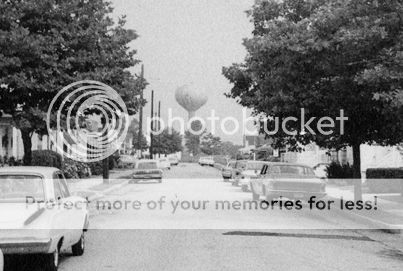
We did the neatest job I ever did, just brush-blasting and painting a brand new golfball water-tower on the south Jersey seashore.
Ventnor’s new golfball. (Photo by BobbaLew.)
There were only three of us: Gardiner, and me, and a Myers & Watters employee named “Jerald.”
It was in Ventnor, south of Atlantic City.
It replaced an old water-tower that was too small, and leaked profusely.
And it was only 125 feet high. We tried a 175 foot golfball in Baltimore, and it was frightening.
We painted both the inside and the outside; inside with a ladder-rig we made, and outside with a spider.
My job was to help, and also tend a small three-bag blaster, pushed by a 100 cubic-feet-per-minute Schramm. That compressor also powered the spider, and Gardiner’s spray-equipment.
Gardiner brings the spider down. (Photo by BobbaLew.)

Gardiner sprays. (Photo by BobbaLew.)
All the painting was spray, which meant at least half blew away in the wind outside.
And we were applying all kinds of paint, including ship’s-bottom. Ventnor could afford it.
Atop the water-tower. (Photo by BobbaLew.)
Neatest job we ever did. It took over an hour to get to it, and over an hour to get back. Often me and Gardiner and Jerald stopped for breakfast along the way.
And the scenery was fantastic; pretty young teeny-boppers in skimpy bikinis headed for the beach.
When I left Gardiner and Jerald had to finish that water-tower themselves; I was sorely missed. But it was back to college for me.
What my father didn’t realize was he was exposing me to every kind of sin.
I drank my first beer with the Mahz-n-Wawdzzz crew in a Sinclair refinery in Marcus Hook, PA.
We’d often stop for a six-pak on the way back from Ventnor.
My father was trying to offset the money drainage that would have occurred if I continued at camp while at college.
He was also trying to expose me to worldliness.
What happened was I became more worldly, as it were, working for Mahz-n-Wawdzzz.
And some of the neatest persons I ever met couldn’t read nor write, and smoked, for God’s sake.
(I never have.)
Mostly all hated my father so much their goal was to deflower “Little Bobby.”
And they did, although my father probably never knew.

• I went to Houghton College (“HO-tin;” as in “oh,” not “how” or “who”) in western New York, from where I graduated with a BA in 1966. I’ve never regretted it, although I graduated a Ne’er-do-Well, without their blessing. Houghton is an evangelical liberal-arts college.

Labels:

Thursday, October 01, 2015

Moving on

At long last I feel like my season-of-grief is over.
That is, the grief that came with losing my beloved wife to cancer three years ago.
We were married more than 44 years, despite the nattering nabobs of negativism in her family.
They said I’d got her pregnant, and we’d never last a year. I wasn’t the blonde idiot they wanted, whose name was “Dave Green.”
I snagged a really good one.
She put up with me, so I accepted her for who she was.
I feel like my grief ended with my prostate operation.
It was a HUGE distraction; I had little time to think about the death of my wife.
I haven’t cried for a while.
So now I feel like starting over; going back to my roots, perhaps.
I’m a native of south Jersey. All my siblings feel like Delawareans. But I was 13 when my family moved to Delaware. (I’m the oldest.) I feel like I grew up in south Jersey.
I’ve always said New Jersey is comprised of two parts.
North Jersey is the dump for New York City, and south Jersey is the dump for Philadelphia.
Beyond that, PA is/was a hyper-religious state. One had to buy liquor at state-stores. Therefore, Pennsylvanians driving back from the Jersey seashore would stop at a south Jersey liquor store.
And there were plenty, along with nightclubs, bars, and houses-of-ill-repute.
South Jersey was a den-of-iniquity. My upbringing reflects that. Not a participant, just an observer — of madness.
I always say the world indeed has an asshole, and it’s south Jersey.
Since my wife’s death I’ve been sort of a hermit. I didn’t feel like going anywhere.
But now I feel like I should go visit south Jersey; see my original home.
My first home at 625 Jefferson Ave. in Erlton (“ERL-tin;” as in name “Earl”) is still there according to Google Street-Views. As is “the Triangle,” a vacant lot across the street where kids played baseball.
But I feel like I need to see it in the flesh.
Perhaps see the first-floor addition to our house my father designed with his tee-square.
Our next-door neighbors also built an addition, but it wasn’t as good as my father’s.
Our house was built about 1940, which makes it pre-plywood. It was sheathed and roofed with tongue-and-groove.
I’d like to visit “Christopherson’s Woods,” and see if it’s the same as when I played there. Back then the Christopherson children had to cross a creek in that woods to get to school. Last time I visited that bridge was gone.
I’d also like to visit Camden County Park and Cooper Crick. Erlton is in Camden County. (“Crick” was how “creek” was pronounced.)
Last time I visited the park was different.
A dam had washed out, or was removed.
And my elementary school is gone; apparently torn down.
TERRIFIED in corduroys and StrideRites. (First day in kindergarten, September 12th, 1949 — Erlton School has been torn down.) (Photo by my mother.)
I was terrified when I started kindergarten there. Never before had I been away from my parents. —There was no Pre-K back then.
And in the background was always the threat of nuclear annihilation. We practiced “duck and cover,” but how does one survive a direct hit from an atom bomb?
And in the early ‘50s it became even worse, the hydrogen bomb.
‘Lebenty-Times-Seben!
Isil beheadings seem tame compared to being vaporized by the Russkies.
I feel like I need to make that climb up Kings Highway to Haddonfield (“ha-din-FIELD;” as in “at”) to pass the old high-school where my father took me to a Thanksgiving football game.
We hiked to it.
And pass the stately Haddon Fortnightly near Grove Street, and the house where my piano-teacher lived. She was choir-director at our church, and would get my sister and I crying over Clementi exercises. Then blow her nose in triumph into her soggy handkerchief, which she then stuffed into the front bodice of her dress.
And find Centre St., where I went sledding with my father.
That hill was so long, they only closed the bottom third.
I’d continue south on Kings Highway past ancient Indian King tavern, where supposedly George Washington once stayed. Haddonfield is an old Revolutionary-War town, and has a cemetery with grave-stones from the 1700s.
I’d continue south and cross Haddon Ave., the main east-west drag from Camden, south Jersey’s extension of Philadelphia.
Hard by the intersection on Haddon Ave. was the Haddonfield Fire Department, with its incredibly loud fire-horn, that terrified me every day at noon. Auditory hallucinations, plus parents that raged when I got scared.
After Haddon Ave. I might pass the building that housed the old Acme (“ak-mee”) supermarket, where my mother refused to shop because it was “Of-The-Devil.”
Farther along I might pass the building that housed the A&P supermarket where my mother did shop, and where my maternal grandfather stole plums.
If you think I’m making this stuff up, I’m not.
My grandfather also begged, stand on the corner in his frumpy suit and fedora shaking a tin cup. How many times did we have to rescue him from the police-station?
Supermarkets are now 10-15 times bigger than that old A&P.
Finally I’d come to where Kings Highway crossed the railroad-tracks, though no longer at grade. That railroad is now a rapid-transit to Philadelphia. When it was converted, it went through Haddonfield below grade.
Kings Highway crosses the Haddonfield transit-station on an overpass.
It was that or elevate it. That grade-crossing was a bottleneck, both for drivers and trains.
After that I’d drive east out South Atlantic Ave. next to the tracks. When I was a child, S. Atlantic was a dead-end — now it’s through — and the railroad was Pennsylvania-Reading Seashore Lines to Atlantic City.
South Atlantic is where I first watched trains at age-2 with my father, and became a railfan for life (I’m now 71).
Where it all began in Haddonfield. (Photo by Robert Long ©.)
So ends my visit to my roots, although I’d also try Pakim Pond, where a Navy Corsair fighter-plane from Willow Grove Naval Air Station crashed and disappeared.
Plus eight Campbell Soup tomato-pickers drowned when their top-down Oldsmobile convertible sailed into the pond.
I was also told a railroad-locomotive was in that pond, but last time I visited, the dam that backed up the pond had washed out, and the pond was empty. No Corsair, no Oldsmobile, and no locomotive, although I wondered how it could get there with no railroad nearby.
So now I think I can go back.
A lot has happened since my childhood, including sublimation of myself in order to get along with a really good wife.
But now I am back to being unmarried, so I can be the person I once was.
This involves starting from scratch: going back to the madness that was my childhood.
I can’t say I’d wanna live there, but south Jersey is who I am.
If anyone wonders why I have a jaundiced-eye, it’s my south Jersey upbringing. Nothing like having your hopes dashed by finding that little hottie I lusted-after was nothing but another south Jersey slattern — sunning naked on Bare-Ass Beach.
I think I can make the visit.

• “Erlton” is the small suburb of Philadelphia in south Jersey where I lived until I was 13. Erlton was founded in the ‘30s, named after its developer, whose name was Earl.
• “Pennsylvania-Reading Seashore Lines” (PRSL) is an amalgamation of Pennsylvania and Reading railroad-lines in south Jersey to counter the fact the two railroads had too much parallel track. It was promulgated in 1933. It serviced mainly the south Jersey seashore from Philadelphia.
• RE: “Bare-Ass Beach.........” —There actually was a Bare-Ass Beach (“B-A-B”) south of Christopherson’s Woods, a sandbar along a north branch of the Cooper River not far from Kings Highway. And I did see my little hottie there sunning herself bare-naked. But I’d say that was more the social pressures of south Jersey; she may not have been a slut. —No hanky-panky was going on, at least not during my viewing. And this was despite some hard-rock greasers also sunning themselves bare-naked.

Labels:

Sunday, July 05, 2015

“What a long strange trip it’s been”


Jerry Garcia (deceased), long-time lead singer of “The Grateful Dead.”

Last night (Saturday, July 4th, 2015) the national TV-news reported The Grateful Dead would perform its final concert after 50 years.
The end of an era, so-to-speak, except I always felt that era ended with the ‘70s.
About 50 long years ago I became friends with a guy named Al Stokes. Albert, like me, was a native of deepest, darkest south Jersey.
South Jersey is a den-of-iniquity, where Satan rules.
New Jersey is two parts: north Jersey is the dump for New York City, and south Jersey is the dump for Philadelphia.
On top of this, PA was hyper about liquor, etc. So south Jersey had lots of liquor-stores and road-houses to placate evil-starved Pennsylvanians on their way back from the Jersey seashore.
Better yet, Al was from Wildwood, a seashore resort, and the pink-flamingo capital of the planet.
His father owned a junkyard, and I remember Al telling me about burning wiring-harnesses from cars to get the copper.
Al was writing a weekly column for a small weekly newspaper in Rochester (NY) called City/East, and I was doing motorsport coverage.
(City/East later expanded to become “City” newspaper.)
We were a pair: bleeding-heart liberals, and we had plenty to munch on, particularly Nixon’s Watergate scandal.
Al was a “Dead-head,” and I wasn’t.
He was hot to make me a “Dead-head,” a follower of “better living through chemistry.”
He wanted me to try pot, and mescaline, and L.S.D.
And “The Dead” seemed to represent this — awash in psychedelia.
He tried mightily to get me to smoke pot. He’d invite me to parties where everyone was zoning out.
“Get me outta here! It smells like burning wood.”
Thud! Another attempt skewered by supposedly improper values.
Al worshipped a local band that mimicked “the Grateful Dead.” He tried to get me to attend jam-sessions. I never did.
Finally I said to Al “your worship of ‘The Dead’ sounds like religion — like the solution to all life’s problems is chemical-madness and ‘The Dead.’”
He was taken aback. I had him good. Point well taken.
“All I gotta do is worship ‘The Dead,’ just like running to the alter to become a Bible-beating zealot.”
Funny, the TV interviewed “Dead-heads:” tie-dyed tee-shirts on aging fat-ladies.
They claimed following “The Dead” was a religion. But they weren’t taken aback.
Here they were slavishly following a religion that went out with the ‘70s. Aging hipsters.
Al had a Buick he beat the daylights out of, a ’63 four-door hardtop with the big engine. It was probably good for 120, and he’d cruise at 100.
It finally blew the motor on the Pennsylvania Turnpike Northeast Extension, driving to Wildwood.
By then Al had begun a job at a tool-and-die machining plastics, and became friends with a coworker who owned a Saab (“sob”) — one of the V4 Saab 96s.
He became a Saab freak, and bought one himself.
One afternoon leaving work his Saab got clobbered in the rear. It bent fenders and screwed up the unpowered rear-axle alignment. (Saabs are Front-Wheel-Drive.)
Al fished around and located a wrecked Saab in a junkyard. We could take the rear axle off it, and the fenders.
I remember crawling around in the snow removing the axle.
We got it off, and Al repaired his Saab.
So much for Rochester. Al had decided to move to San Jose, CA, to live with his sister.
His attempt to convert me into a “Dead-head” failed.
I was leery of chemical madness, and was stickin’ to my guns.
I purchased a few “Grateful Dead” albums. But to me they’re more a party-band, than out at the edge like Hendrix or Cream.
But they have one of the best lines from rock-and-roll music. It’s from “Sugar Magnolia” — “just like a Willys in four-wheel drive.”
The others are “Roll down the window, and let the wind blow back your hair” from Springsteen’s “Thunder Road.”
And “Strummin’ to the rhythm that the drivers made” from Chuck Berry’s “Johnny B. Goode.”
You have to be a railfan to understand that last one.
Now, of course, I wonder if Al is still alive. I did a Facebook search, but came up with 89 bazilyun Albert Stokes.

• The “Jeep” was first made by Willys in WWII. It’s been through various makers since, like American Motors, and now it’s Chrysler.
• I’m a railfan, and have been since age-2. A steam-locomotive chuffs four beats to the bar. Each driving-wheel (driver) rotation has four chuffs.

Labels: ,

Tuesday, June 30, 2015

Bill & Earl’s Garage


This sign wasn’t there when I was.

When we lived in Rochester (NY), we lived on a north-south arterial named Winton Road.
We lived in a tiny house that was built in 1865, probably the first house in the neighborhood.
323 North Winton Road. (Photo by BobbaLew.)
When it was built it was probably a farm-house, as the area around it was undeveloped.
The area was in the Town of Brighton, but as the area developed the City of Rochester annexed it.
The Town of Brighton still exists as a suburb southeast of Rochester.
Development brought sewers and public water. Gas-lines were also installed.
Winton Road also became a bus-route.
The area became city-like.
But our house stayed the same. No improvements were made, except an addition to the south.
That addition became the new front entrance, and the shed attached to the back became the kitchen.
We always liked the character of that house; we lived in an apartment across the street. It was the early ‘70s.
Suddenly the house was for sale.
It didn’t have a driveway to Winton Road, or visible parking, so I went around back to look.
Surprise-surprise. It was on a double-lot that extended all the way to the next street over.
It also had a standalone two-car garage.
I was unemployed at that time, but my wife was employed, so we made an offer.
Long-story-short, we bought the house with an FHA mortgage.
We had already been in the area a few years, in that apartment.
Not far away was a convenience-store.
And up Winton Road was a hardware and a Chevrolet dealer.
Across from the Chevrolet dealer was a post-office, and two supermarkets were not far. Within walking distance.
Winton crossed an east-west arterial not far from our house. It was called Blossom Road.
At the intersection were a number of small businesses, one of which was Bill & Earl’s Garage.
I never patronized the garage, but in a tiny attached part was “B & E Auto Parts.” It was manned by Earl, a kindly bespectacled gentleman perhaps 15 years older than me.
B & E Auto Parts became a hangout. The garage was a tiny, dingy place behind a small restaurant.
Parking was at a premium, but I could walk to it.
Bill was the shyster, or so it seemed. He was always suggesting engine-changes to fix some minor problem. He chain-smoked and pigged out on cholesterol. He often said he didn’t expect to make 70. Yet a photograph of the Piper Tri-Pacer he once owned was on his wall.
(My first flight was in a Tri-Pacer in 1956.)
Bill was always good conversation, but he wasn’t touching my car.
Earl was the opposite of Bill, a nice guy concerned with my welfare.
He loved jawing with someone who loved tinkering as much as he.
I liked working with Earl.
It was probably he that got me the carburetor-rebuild kit for my Vega’s two-barrel.
He also sold me a lotta tools, plus my annual points and plugs.
Together we got so I could work on my car.
And after the childhood I had, it was good to get some confidence.
We finally moved.
An old house is too hard to keep up. We built a deck, and remodeled our kitchen. But the house needed an immense amount of work. Most of the windows were original and still had bubbles in the glass. They were so drafty we were heating the outside.
Our new house is in the tiny rural town of West Bloomfield, southeast of Rochester, where I am now.
With our move it was so long to Bill & Earl’s Garage. But not before I had Bill align my giant Ford van, and tune its carburetor so it wouldn’t foul its plugs.
He tightened up the idle-circuit, but it still fouled its plugs.
It was because the power-valve was stuck open; its diaphragm was holed. I found that out later when I rebuilt the carb.
Apparently Bill & Earl’s Garage finally closed. Bill probably died, and maybe even Earl.
But I consider Bill & Earl’s Garage a pleasant time when I got so I could work on my own cars.
I don’t any more. I even farm out oil-changes. And cars are so technically challenging any more they’re beyond understanding.
The things I took on back then were setting points, rebuilding carbs, and even bodywork. I got so I could gap points by feel; that is, without a feeler-gauge.

• The “Tri-Pacer” was a tricycle landing-geared version of the “Pacer,” Piper’s first airplane that could carry four. The “Cub” only carried two.
• RE: “Points and plugs:” “Points” are a switch within the ignition-distributor, which when closed allows current to circulate through the ignition-coil to generate a spark. They had to be set just so, to allow the proper amount of current-dwell. The “plugs” are the sparkplugs. —Car-ignition has advanced beyond “points and plugs;” the switching mechanism that replaced “points” is now electronic, although sparkplugs are still used. But they are designed to last the life of the car; you no longer have to replace them.

Labels: