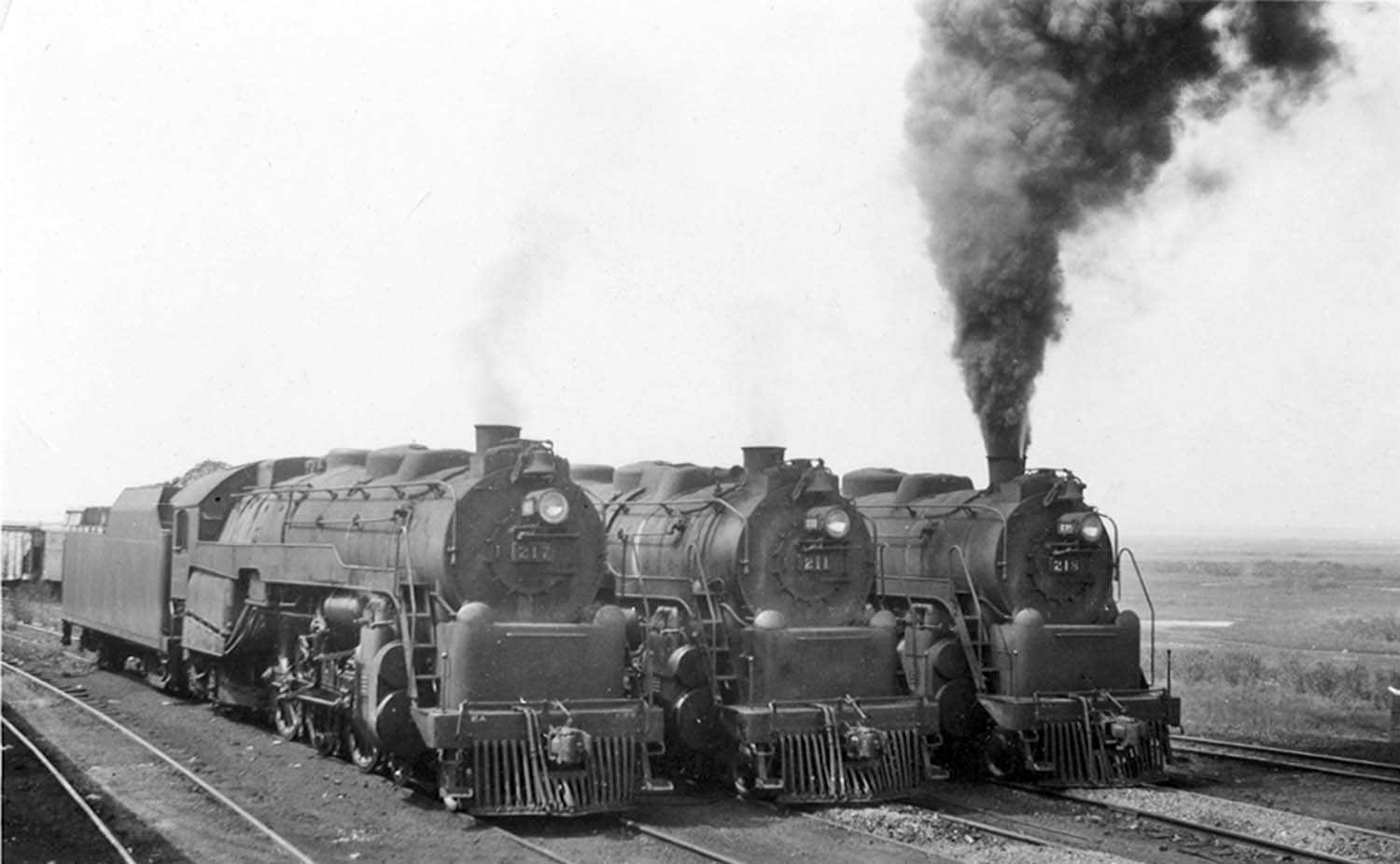
Friday, December 01, 2017

Monthly Train-Calendar Report for December 2017


Going away, Dudes. (SD40Es push 10G up The Hill.) (Photo by Jack Hughes.)

—The December 2017 entry in my own calendar is eastbound train 10G pushing through Portage (PA) toward the summit of Allegheny Mountain.
The two SD40Es are going away. They’re pushing the back of 10G, helping it up The Hill.
Over the top, the pushers stay on, and engage dynamic-braking. Their traction-motors are converted into generators that help hold back the train.
Prior to diesel-electric locomotives there was no “dynamic-braking” equivalent. The train had to depend on car-brakes to prevent a runaway down a hill.
A descending train was usually swathed in brake-shoe smoke. Other tricks were employed to enhance freightcar brake performance.
Thanks to dynamic-braking all that is history. And helper locomotives no longer turn at the summit to return downhill for another push. They stay on to help the train descend.
Visible is 6304. Anything 6300 on Norfolk Southern is SD40E. They were converted by the railroad from an EMD SD-50, a locomotive that wasn’t very reliable.
SD-50s were 3,500-3,600 horsepower, asking a lot from EMD’s 645 V16 prime-mover. (That’s 645 cubic-inches per cylinder.)
Norfolk Southern, and Conrail before it, were using SD40-2s as helpers on Allegheny Mountain.
They were worn out. So rebuild and downrate an SD-50, 3,500 horsepower to 3,000 = the SD40E.
SD40Es aren’t just helper-service. I’ve seen ‘em in other applications. But many are Allegheny Mountain helper-service.
“And here I thought locomotives on the back end of a train were just the railroad transferring power,” my hairdresser says. “They were pushing = helpers.”
A helper-set is two locomotives. Sometimes the helper-set goes up front. Occasionally a train is so heavy it gets multiple helper-sets; e.g. a helper-set up front, plus two helper-sets pushing. That’s six additional locomotives.
And the crews hafta be extremely savvy.
As a long train crests a summit it wants to break apart. Up front is pulling downhill, and the back end is still pushing uphill. Engage “seat-of-pants!”
“I need ya to lean on me,” I’ll hear on my scanner = the train engineer radioing the rear helper crew.
Or “Full dynamic, guys. This thing is gettin’ loose.”


HERE IT COMES! (Photo by Robert Malinoski.)

—So here’s Malinoski out taking color photographs in 1954.
The December 2017 entry in my Tide-Mark All-Pennsy color calendar is an I-1 Decapod (2-10-0) near Snydertown, PA.
Malinoski was a premier railfan photographer. Not Shaughnessy or Don Wood, but pretty good.
He also shot a lotta black-and-white.
Would that photography back then was as good as it is now.
Steam-locomotives are much more dramatic than diesel-electrics. Steam locomotion is gone.
What steamers I photograph are restored. The best I’ve seen is Nickel Plate 765, a restored 2-8-4 Berkshire.


Nickel Plate 765. (Photo by BobbaLew.)

(“Berkshire” is the mountains of western MA, where the 2-8-4 wheel arrangement was first tried.)
765 is a thrill, but the good stuff was 70-80 years ago when steam was in regular revenue service.
By 1940 the massive switch to diesel-electric locomotion began.
Pennsy hung on to steam longer than most. They were a coal-road, so wanted to stay with coal-fired steam locomotion.
Pennsylvania-Reading Seashore Lines (PRSL) in south Jersey was still using steamers when I was born — usually locomotives from Pennsy and Reading, its cofounders.
Those PRSL steamers are what made me a railfan. That was 1946 or ’47. My father took me trackside — free entertainment.
I’ve been a railfan ever since. Back then I was terrified of thunderstorms, but could stand right next to a panting steamer.
In 1954 Pennsy had both diesel and steam — too many diesels were needed. Some steamers were well-suited for certain applications; like a Decapod on mountainous railroading.
I had to look up Snydertown in my GoogleMaps. It appears to be Pennsy’s Mt. Carmel branch. Deks led heavy ore-drags up to Mt. Carmel for interchange with Lehigh Valley Railroad — iron-ore for Bethlehem steel.
Pennsy probably received the ore at its massive dock in Philadelphia.
What’s pictured looks like it’s not the famous Mt. Carmel ore-train, which usually had two Deks up front, plus two more pushing.
4483, shorn of its drive-rods, boiler-cladding, and most of its valve-gear.

The calendar also makes a grievous error.
It says only one Pennsy Dek remains, #4483, that it’s on display at Railroad Museum of Pennsylvania in Strasburg.
Wrong! 4483 is stored inactive near Buffalo, NY.
Anyone fact-check their calendars? Not their first mistake.


Engine change at Harrisburg. (Photo courtesy Joe Suo Collection©.)

—“Can there be a Pennsy calendar without a GG1 in it?”
I’ve said it hundreds of times. I’ve also said the GG1 was the greatest railroad locomotive ever built. Great to look at, and incredibly powerful.
The December 2017 entry of my Audio-Visual Designs black-and-white All-Pennsy Calendar is GG1 #4901 next to E8s in Pennsy’s Harrisburg station.
My guess is 4901 brought a passenger-express from Philadelphia, and now the train is being switched to diesels to continue west.
Harrisburg is where Pennsy’s electrification ended, although they considered electrifying all the way to Pittsburgh.
As a teenager in the late ‘50s and early ‘60s in northern DE I saw many GG1s. And it seemed every time I did they were boomin’-and-zoomin’.
Train-engineers said the GG1 utterly trumped diesel-electric locomotives. It took three or four E-units to pull what a single GG1 could pull.
“Why bother with diesels when they got such a great locomotive in the GG1?” they’d say.
Unfortunately a GG1 needs overhead wire to operate — the electrification around Philadelphia, plus what is now Amtrak’s Northeast Corridor from Washington DC to New York City.
The old Pennsy main from Philadelphia to Harrisburg is now also Amtrak, and remains electrified.
Diesel-electric locomotives also have electric traction-motors. But their current is generated on board by the diesel prime-mover. Electrification by overhead wire is a nice idea, but requires a lotta maintenance. Some of Pennsy’s electrification was taken down by Conrail. On balance I guess diesel-electric locomotion does better economically than overhead catenary.
Those diesels had to have steam-generators. Steam from the steam-engine got piped back through the train to heat it. To continue using such passenger equipment diesels needed steam-generators. GG1s also had steam-generators.
Now Amtrak’s passenger cars are heated electrically, sometimes by running the locomotive at high idle, but also occasionally a separate generator.
So west out of Harrisburg can’t be the GG1. Go back far enough and it woulda been steam locomotives. The picture is 1954. By then Pennsy passenger service was no longer steam. Although a few might be if diesels weren’t available and steam was.
Pennsy wouldn’t end steam until 1957, and was using steam to haul freight from Harrisburg west until the end.
Electrification was better-suited to railroading than side-rod steam locomotion. Traction-motors deliver constant torque, whereas side-rod steam locomotives render pulses.
But overhead wire was costly. Diesel-electric locomotion solves that, continuing electric traction. But diesels weren’t the GG1.
The calendar makes note of that lady checking her purse on the GG1’s track. Tempest-in-a-teapot! That GG1 isn’t going anywhere yet. When it did its engineer would blast the horn.
But I understand. My limit is 10 feet from the outside rail, and not on the track at all. I won’t even step across the track.
Even 10 feet can be frightening. 20-40 mph I can stand; 80-90 mph NO WAY. There is a photo-location in Summerhill PA I can’t do. It’s too close to Track One, and there’s no leeway.


FAKE! (Photo by Roger Durfee.)

—The December 2017 entry in my Norfolk Southern Employees’ Photography-Contest calendar is another by Roger Durfee, an NS conductor from Cleveland, who’s had many entries in this calendar.
It’s a Norfolk Southern double-stack passing frozen Sandusky Bay in OH. I don’t think much of it.
It’s that pink palm-tree; I suspect it’s fake. No way could a real palm-tree survive in such weather. The tree at right seems more like it.
Durfee is following a rule of photography: namely, every picture needs a foreground. Include pink palm-tree in foreground.
No-no-no-no-no!
That silly palm-tree looks utterly out-of-it in frozen snow.
Near my house a guy planted actual palm-trees. They lasted maybe a year-or-two. No way could an actual palm-tree exist here in the frozen tundra.
Durfee has done better. He has an eye for scenery.
This is a joke!

Labels:

Monday, October 30, 2017

Monthly Train-Calendar Report for November 2017


BAM! Got it! (Photo by Jack Hughes.)

—“Hey man! Where we goin’?” I asked my brother.
“Main Street Bridge,” he answered.
“You are not!” I said. “Yer headed for Jackson Street.”
“Nope. Tunnel Inn on Main Street.”
“720 Jackson Street. You are WRONG, dude.”
The November 2017 entry in my own calendar is eastbound 18N, Norfolk Southern auto-racks approaching Jackson Street Bridge atop The Hill in Gallitzin (PA).
This picture goes back a couple years. My brother was still on crutches. He fell off a ladder and broke his leg.
This train was climbing the west slope of Allegheny Mountain, so we set out to beat it to Gallitzin.
It’s on Track Two: signaled both directions. Two and Three use the original Pennsy tunnel. One, nearby, uses New Portage Tunnel. One is eastbound, Three is westbound, and Two can be either way.
Often heavy eastbound coal-trains use Two to avoid One and its “Slide:” at 2.28% slightly steeper than the original Pennsy at 1.75-1.8% average. New Portage is slightly higher than Pennsy’s original tunnel, so incorporates a ramp down to the original Pennsy grade.
Usually come November Yrs Trly starts using snow pictures in my calendar. Like other landscape calendar producers, I began using snow pictures in Winter: December, January, and February, melting snow in March, and maybe a light dusting for November.
It often snows atop Allegheny Mountain in November — even October.
This picture is an exception. Fall foliage is about over — we came too late. But it’s still around somewhat.
I’ve wanted to use this picture for years. But for October it’s late.
We slammed into adjacent Gallitzin Tunnel-Park, and both leaped out. The train was coming around the curve.
My brother tossed his crutches, and hobbled across the street. BAM! Got it! Would it be okay?
Later that night we looked at what he photographed, and his crutchless potshot was excellent.


A “double.” (Photo by Tim Calvin.)

—The November 2017 entry in my Norfolk Southern Employees’ Photography-Contest calendar looks like something my brother and I might shoot.
Or rather what I might do, since my brother is more into “in-yer-face” three-quarter locomotive shots. Which is fine, since I use plenty of his photographs in my calendar.
I’m more into “artsy” stuff = scenic views.
What’s pictured is what my brother and I call a “double;” two trains in one picture. I got that terminology from Phil Faudi, my railfan friend in Altoona, PA. Doubles are infrequent, although near Altoona we’re more likely to see one.
The double pictured is in Kendallville, Indiana. Two trains in one picture is luck. Photographer Calvin happened to be in the right place at the right time.
Trains around Altoona are frequent enough my brother and I have snagged quite a few.
Phil Faudi conducted railfan “tours” as a business a few years ago. Many of my photo locations are Phil.
My first “tour” we stood on the overpass in Lilly, PA. A coal-extra was slowly hammering up the west slope of Allegheny Mountain on Track One. On his railroad-radio scanner Phil could hear a double-stack approaching on Track Two.
“We’re gonna get a double, Bob.”
BAM! Got it!
I was thrilled. Never before had I got two trains in one picture.


My first double! (Photo by BobbaLew.)

I ran that picture years ago in my first calendar.
My brother and I snagged many since, plus me alone. Train frequency around Altoona is like that.
The railroad is a main artery of trade between the northeast and the rest of the nation. It used to be the Pennsylvania Railroad, but is now Norfolk Southern. The other main artery is what used to be New York Central across NY state. That railroad is now CSX.
I searched Kendallville in my Google-Maps. It looks like the railroad pictured is Norfolk Southern’s line to Chicago, ex NYC, I think.


You better not have yer laundry out! (Photo by John Dziobko.)

—The November 2017 entries in my All-Pennsy color calendar and my Audio-Visual Designs black-and-white All-Pennsy Calendar are equally uninspiring.
My All-Pennsy color calendar is M-1 (4-8-2) #6967 leading eastbound freight past “Lewis” Tower in Lewistown, PA.
Looking at this picture I see how filthy railroading was back then.
“Dirty old steam-engines,” my mother used to say.
Soot covers everything, tracks, the locomotive, especially the tower building.
Lewistown is on Pennsy’s famous “Middle Division,” Harrisburg to Altoona. The Middle Division was a final stomping-ground for Pennsy steam, especially the M-1 Mountains.
It’s slightly upgrade, following the Juniata river, then the Little Juniata. Not difficult, a river grade.
The M-1s were perfect, although they had to be coaled halfway to Altoona. Denholm had a giant coaling facility.
Upgrade on the Middle Division an M-1 could maintain 40-50 mph, sometimes faster. Better to not scrap the M-1s in favor of diesels when the M-1s were so perfect.
The picture is 1956. Use of steam on Pennsy ended in late ’57. Pennsy, being a coal-road, favored coal-fired steam locomotion.
Pennsy used to think its M-1 Mountains were the best steamers they had. The M-1s are 1923 on, not a 4-8-4, and only 70 square feet grate-area.
But they had a long combustion-chamber that enhanced coal burning. The M-1 is the boiler and firebox of the I-1 Decapod (2-10-0), but with that added combustion-chamber.
The M-1 was not a high-stepper like Pennsy’s K-4 Pacific.
It’s drivers were only 72-inch diameter, not the 80-inchers of a K-4.
(Still, 72 inches is six feet.)
It’s an “all-purpose” engine, not a boomer-and-zoomer. It hauled freight at a pretty good clip.
But, yer laundry better not be trackside. Everything will load up with soot.
As far as I can deduce, Lewis Tower is no more. The railroad is dispatched from Pittsburgh.


BAM-BAM-BAM-BAM! (Photo by George E. Votova©.)

—The November 2017 entry of my Audio-Visual Designs black-and-white All-Pennsy Calendar is a K-4 Pacific (4-6-2) stomping out of Long Branch on New York & Long Branch Railroad with a commuter-train toward New York City.
NY&LB connected to Central of New Jersey, and eventually became owned by it.
NY&LB became a commuter feeder toward New York City, and Pennsy wanted in. They threatened to build a competing railroad. A competing PRR railroad would have ended CNJ’s NY&LB.
Interestingly, all of that became Jersey Transit. Commuter railroading became too expensive for private enterprise. Commuter railroading toward New York City was turned over to gumint.
The other interesting point is the smoke a steam-locomotive generates. That much smoke would no longer be tolerated. What’s seen here would dissipate, but all one had to do was visit Altoona (PA) in steam-days. It was socked in with smoke = chuffing steam-engines burning coal.
Same thing in China. Power-plants burn coal, and cities sock in. People have to wear masks.
Railfans like to see similar pillars of smoke belching from restored steam locomotives. Crews have to over-stoke, or sand flues. Years ago railroad management poo-pooed smoke. It indicated the fire wasn’t burning well; that the fireman be called on-the-carpet.
Note the heavyweight parlor-car ahead of the combine. Mega-rich separated from the worker-bees.
The picture is 1934. By then Pennsy more-or-less ruled NY&LB.
Ten years later this is the world I was born into. When I started seeing railroading in 1946-’47, Pennsylvania-Reading Seashore Lines (PRSL) was still using steam-locomotives, although usually leased from its predecessors. What made me a railfan were Pennsy K-4s and Reading G-3s in regular revenue service. (Although I preferred Pennsy — that red keystone number-plate.)


Where it all began, EXACTLY. (Photo by Robert Long©.)

The above picture is 1956, about the end of steam on PRSL. Diesels were already in use.
“Where it all began” is another Pennsy K-4, in this case just leaving Haddonfield station, not far from where we lived. I was only age-2 or so when “it all began,” but have been a railfan since.

Labels:

Friday, September 29, 2017

Monthly Train-Calendar Report for October 2017


Shaddup and shoot! (Photo by Jack Hughes.)

—Proof of “shaddup-and-shoot!”
The October 2017 entry in my own calendar is loaded Norfolk Southern coal-train Y90 descending Track One atop the mountain where “The Slide” merges back to the original Pennsy main.
The Slide is steeper than the original Pennsy main: 2.28% versus 1.75-1.8 %. As first built it was 2.36% — enlarging New Portage tunnel for doublestacks slightly reduced the grade.
The Slide was a ramp to New Portage tunnel, part of a railroad the state built to circumvent its original inclined-plane portage railroad over Allegheny Mountain.
PA gave up on its New Portage Railroad almost as soon as it was built. That railroad was still part of the state’s Public Works System, combined canal and railroad.
It was so slow and cumbersome compared to Pennsy it couldn’t compete. So PA abandoned it.
Pennsy was interested. New Portage Railroad would give them an already-completed tunnel under the summit = a second tunnel.
Plus, an additional railroad grade up the east slope of the mountain. (Pennsy didn’t railroad it at first, but eventually did. That grade was abandoned a few years ago, and expressway over the mountain built.)
But that tunnel was slightly higher than Pennsy’s original tunnel. VIOLA; a ramp up to that tunnel from the original Pennsy grade. It’s called “The Slide.”
It’s not too steep, since even 2.36% is not 2.5%, which is when things begin getting difficult. Plus it’s currently only operated eastbound, downhill not up.
Y90 is a second section of 590. My brother was taking pictures of Y90 coming down The Slide. Train passed, he turned around and snapped this picture — just for the heck of it = a “shaddup-and-shoot.”
So I’m cycling through our hundreds of fall-foliage possibles, and happen across this picture. Holy mackerel! There it is = the October foliage picture for my calendar.
—You should know a tiny bit of cheating is in this calendar picture. My Photoshop-Elements can increase color saturation. But ya can’t overdo it.
I never used it before, but with this picture I tried it. Not much; just enough to overcome the flatness of the original image.
—You should also know the train is going away. The four locomotives are two rear helper-sets to hold back the heavy train as it descends the east slope. During 12 miles into Altoona the train will descend 1,016 feet. The helpers are adding dynamic-braking.


Fond memories. (Photo by Fred Kern.)

—About 1949-1950, when I was five or six, my father, knowing I was a railfan, took my sister and I on a short train trip into Philadelphia.
It was on a passenger-train very much like the one pictured. Five or six Pennsy coaches pulled by an E-6s Atlantic (4-4-2), Haddonfield (NJ) to Broad Street Station in Philadelphia.
We lived in a south Jersey suburb next to Haddonfield.
The October 2017 entry in my All-Pennsy color calendar is E-6s #1600 on the final PRR run to Norristown (PA) in 1953. Norristown is just west of Philadelphia.
We were on Pennsylvania-Reading Seashore Lines (PRSL), at least the old Pennsy line from Camden, NJ to Atlantic City. It went through Haddonfield.
PRSL was still using steam-locomotives. Dieselization had begun, but in the early ‘50s PRSL still ran mainly steam.
PRSL was a 1933 amalgamation of Pennsy and Reading railroads in south Jersey because they had too much competing track. Even side-by-side through the Pineys in many places.
PRSL had a few of its own engines, but mainly it used engines of Pennsy or Reading. Same with passenger-cars.
For me this ride was a thrill. West out of Haddonfield, then up the connector Pennsy built about the turn-of-the-century to get trains to NJ without ferries.
The connector crossed the wide Delaware river on Delair Bridge built 1895-’96. It connected to Pennsy’s main to New York City at Frankford Junction in North Philadelphia.
Looking out our windows, all we could see below was river then Pennsy’s yards. No bridgework.
Smoking steam-engines filled the yards. Pennsy still had plenty of steamers.
Our ride ended at Broad Street Station, still in use at that time. It was abandoned in 1952.
The station, which was not through, was a vestige of Pennsy’s original intent to save Philadelphia as a port. New York City become the premier east-coast port, so Pennsy merged up there too.
With Broad Street abandoned, 30th Street Station became PRR’s main Philadelphia railroad-station, but it’s not downtown.
From Philadelphia we took a short rapid-transit ride to Camden, where my paternal grandparents probably picked us up.
The E-6s was large for an Atlantic. The first Atlantics were a trailing-truck added to a 4-4-0 to support a larger firebox and boiler.
They were teakettles. Pennsy had ‘em too: their E-3s and later E-5s. Many railroads had ‘em, but they were teakettles — not modern like the E-6s.
The E-6s was developed about 1910 as a way to move passenger expresses from Washington DC to New York City. The railroad wasn’t electrified then.
The E-6s was a manifestation of Pennsy engineering, mainly Alfred W. Gibbs, to get the job done with as few drivers as possible: i.e. a big 4-4-2 instead of a 4-6-2 Pacific.
You couldn’t expect much from a 4-4-2. like climbing grades. E-6’s were flatlanders, later commuter power.
Many operated in south Jersey = terrain not challenging. Get toward 10 passenger-cars and ya needed a K-4s Pacific.
I saw many E-6 Atlantics, and that train-trip with my father is goin’ to my grave — along with the Grand Tetons at dawn, Don “Big Daddy” Garlits, and the Packard-Merlin P-51 Mustang.


King Coal in PA. (Photo by Willie Brown.)

—The October 2017 entry in my Norfolk Southern Employees’ Photography-Contest calendar is a Norfolk Southern coal-train near East View, PA.
East View is in southwestern PA, not too far from huge Bailey Mine. It may be Bailey Mine coal.
The photographer, Willie Brown, has been in this calendar before. Usually a picture of a Norfolk Southern coal-feeder to the main. He’s from Powhatan Point, OH, on the Ohio river, and there are coal-mines near.
He’s an engineer, and usually his pictures have been Norfolk Southern coal trains on a line from a mine. Usually his pictures were in Winter = snow.
It’s nice to see something other than his feeder trains. The engines all appear to be GE road power. 7667 is an ES44DC, 4,400 horsepower.
Coal comes in different types: powder for generating electricity, “metallurgical” that has contaminants that enhance steel-making, plus other types for industrial use.
Hardest is Anthracite. mainly from northeastern PA, It’s very rocky, and shatters like glass. It burned clean in steam-locomotives, and was used for residential heating. It burned clean, but you still had to shovel it and shovel out ash. Partly because of that, residential heating moved to fuel-oil, and now it’s natural gas or propane.
“Bituminous” coal is softer, and often contains contaminates like dirt or sand that cause soot.
Coal from Powder River Basin in Wyoming has lower heat-content, but not bad. It’s relatively free of impurities, particularly sulfur, so doesn’t generate as much soot or sulfur dioxide — which becomes sulfuric-acid in your nose.
Norfolk Southern moves all sorts of coal. Part of NS was the old Norfolk & Western in WV and KY, which shipped rivers of coal from Pocahontas coal-region.
Other railroads shipped coal, but they weren’t Norfolk & Western. One was Chesapeake & Ohio, now part of CSX.
Now Norfolk Southern includes the old Pennsy, which succeeded partly because of its coal business in PA.
Railroads are scrambling because the coal-business, a lynchpin, is dwindling. Natural gas is cheaper, and burns cleaner. Gumint is making coal-burning difficult.
Near Altoona is old Sonman coal mine; it was along Pennsy’s original main east of Portage. That original main was bypassed in 1898, and Sonman is no longer a mine.
But it’s trackside, so became a loadout for a number of mines that truck in coal.
That loadout loads long unit coal-extras for the railroad to ship. Sonman loads metallurgical coal, mostly for export.


Ready for duty. (From M.D. McCarter photo collection©.)

—The October 2017 entry of my Audio-Visual Designs black-and-white All-Pennsy Calendar is Pennsy H-10 Consolidation (2-8-0) #9964, probably readying for another peddler assignment near Chicago.
#9964 was built as an H-8sc, later updated to H-10. H-8s, H-9s, and H-10s were all pretty much the same boiler and firebox, but different cylinders, and differing tenders.
But #9964 has the tender of an L-1 Mikado (2-8-2).
Peddler-freights are no more, replaced by trucking. Trucking is much more flexible, as long as gumint builds the highways.
As railroading began towns did all they could to get railroad-service. Railroad magnates took advantage of this. Railroads got built difficult to operate.
New York, Ontario & Western, abandoned in 1957, is a prime example. Five mountains to cross, to hit every podunk investor that funded it.
Railroad-service required a railroad siding located along or near a railroad.
Railroads couldn’t go anywhere and everywhere. Hill-climbing had to be easy, which pretty much limited railroads to river courses.
Highway-trucks can do steep grades; railroads can’t.
Railroad-cars can carry quite a bit more, but can’t be as easily parked.
Peddler-freight was about done when I was born.
I remember a peddler serving Haddonfield, NJ, the town near where I lived growing up. This was about 1948. The peddler shoved cars into sidings, plus a coal hopper into a residential coal supplier.
Its locomotive was also a 2-8-0 Consol. The railroad was Pennsylvania-Reading Seashore Lines (PRSL), and went through Haddonfield to Atlantic City.
Residential coal-heat was also about done. Our house, built in 1943, had oil heat. It didn’t have a coal-chute.
My elementary school did, but converted to oil. (One time the school janitor showed us those boilers.‘Lebenty-times-seven! Fire and brimstone! “This is where we toss little boys that disobey the teacher.”
A house behind ours had a coal-chute. Every couple weeks a coal truck delivered.
My brother and I see a few local-freights in Altoona. There are still a few lineside industries using rail-service.
But mainly the local-freights are delivering cars to shortlines that were once Pennsy branches = more lineside customers.
Gumint often buys an old branch, then brings in or establishes an operator to continue rail-service. To maintain its tax-base = “jobs-jobs-jobs!”
(Visible at right is an old wooden Pennsy caboose — Pennsy called ‘em “cabin-cars.” And behind the turntable looks like a postwar Packard.)


Labels:

Wednesday, August 30, 2017

Monthly Train-Calendar Report for September 2017


Stacker 26T charges through Altoona. (Photo by BobbaLew.)

—Finally!
The September 2017 entry in my own calendar is eastbound Norfolk Southern doublestack 26T passing through Altoona (PA).
I was tiring of this location. It seemed like every time I arrived my brother had already set up there.
It’s under a street overpass, one of at least four in Altoona. Trains are so frequent, road-crossings at grade would be unsafe. Plus traffic would be snarled.
The railroad divides into express tracks and drag tracks through Altoona. 26T is on the express tracks. The drag tracks are visible at left.
Heavy coal extras usually get the drag tracks.
Anything on the drag tracks is in-your-face. The express tracks are a ways away.
I’d already shot this location many times, so what to do this time?
I cranked a lotta telephoto, and aimed west down the tracks through town.
The background is always messy. Visible is the roofed pedestrian overpass from Altoona’s Amtrak station to Railroaders Memorial Museum.
Altoona was once the basis of Pennsylvania Railroad’s operations. Shops were there, plus facilities to test and build locomotives.
Altoona is at the base of Allegheny Mountain, Pennsy’s biggest challenge when it was built in the 1840s.
If I crank telephoto that pedestrian bridge is less a distraction.
“26T, 238; One; CLEAR!” on our railroad-radio scanners.
“I see lights,” my brother says. It’s 26T miles away curving onto the long straight through town.
Here it comes! Under 17th St. bridge next to venerable Alto Tower, now closed. Then the roofed pedestrian bridge, then the unroofed overpass also toward the museum.
Around the bend it charges, headed east toward Rose, probably for a crew-change.
Click-click-click-click-click! Multiple shots — one has to be right. This is probably second or third to last.
The railroad is now Norfolk Southern. But it’s still Pennsy to me. It’s Pennsy’s railroad, and I’m a Pennsy man.


Way to go Mr. Shull! (Photo by Mark Shull.)

—The September 2017 entry in my Norfolk Southern Employees’ Photography-Contest calendar is a Norfolk Southern freight of auto-racks near Madison, NC.
Photographer Mark Shull, a Charlotte (NC) Roadway Shop supervisor, has been in this calendar before. He’s one of the regulars. Another is NS conductor Roger Durfee of Cleveland.
But what I’ve seen of Shull is not that inspiring. Shull always had the May flower-shot. Extravagant color perhaps a little over-saturated with Photoshop. (I’ve done it myself, but ya can’t push much.)
He hasn’t always been flowers. Once he shot an NS freight passing a large cornfield. That cornfield filled the foreground. He had to get the farmer’s permission.
Once he photographed a train on tracks across from a pretty bungalow. The bungalow was his background. He asked the homeowner’s permission — the owner probably got a reprint.
No way could a railfan like me live in such a house. Sleep would be impossible.
This time he snagged a really good one; the kind I encounter occasionally.
I look in my viewfinder, and why did I never see this?
The train looks like solid auto-racks. Enclosed excessive-height cars with two or three floors inside. —Two for trucks.
My brother and I see auto-racks often at Allegheny Crossing.
A solid auto-rack train is light.
100+ 120-ton coal gondolas will need help over Allegheny summit.
But not auto-racks.
The train pictured has two locomotives. I’ve seen auto-racks with only one. And that’s to take on Allegheny Mountain, although it may need help.
My guess is photographer Shull, like me, is doing multiple shots. Where would we be if not for multiple shots?
Shull has the locomotives right where they belong. I’ve done it myself. Bam-bam-bam-bam-bam! One has to be right.


Can there be an All-Pennsy calendar without a GG-1? (Photo by Fred Kern.)

—As I’ve said many times, can there be an All-Pennsy calendar without a GG-1?
The September 2017 entry in my All-Pennsy color calendar is Tuscan-red GG-1 #4912, pulling the Congressional Limited through Frankford Junction in north Philadelphia in 1952.
P-5 freighter #4788, followed by 4792, passes going the other way.
Pennsy’s GG-1 was the best locomotive they ever had. To me the GG-1 is the greatest locomotive of all time.
My family moved to northern DE in 1957. I began seeing GG-1s often, and most times they were doing 80-90 mph!
Pennsy’s New York City to Washington DC electrified line, now Amtrak’s Northeast Corridor, went through northern DE.
It was still stick-rail, 33 feet per section, but 143 pounds per yard, and maintained to the hilt. A GG-1 could put the pedal-to-the-metal.
A GG-1 could crank 9,000 horsepower to railhead. That’s incredible! Current diesel locomotives are good for 4,400 horsepower,
9,000 horsepower was temporary. At that rate traction-motors overheat.
But it could be applied long enough to rocket a train out of a station.
In 1959, at age 15, a neighbor and I travelled to Philadelphia to pursue railfaning.
We returned via Pennsy’s Congressional, which by then had coaches.


(Please disregard the switcher.) (Photo by BobbaLew.)

Pictured is our train, the “Congo,” approaching Philadelphia’s 30th Street station.
26 cars pulled by a single GG-1.
We quickly boarded the last car, then left.
Once on the main, the engineer put the hammer down!
Within minutes we hit 80 mph, then 90.
No wonder my grandfather was impressed.
He rode the Congo, and it blew him away.
From then on, every time he saw a GG-1 express on that electrified line: “must be the Congressional,” awe in his voice.
Quite a few GG-1s were saved. Best is #4935 at Railroad Museum of Pennsylvania.


#4935. (Photo by Tom Hughes.)

It was repainted the cat-whisker scheme, five gold pin stripes, as first applied by industrial-designer Raymond Loewy at the behest of Pennsy.
4935 is Brunswick-green, how most GG-1s were painted.
4912 is one of the few Tuscan-red GG-1s, and it’s still cat-whiskers.
By the time I arrived in DE, most GG-1s were no longer cat-whiskers. A wide single yellow stripe replaced the pin stripes.
But it still looked pretty good — it followed the original striping. I only saw one cat-whiskers.
4896, long ago scrapped, is the picture on this computer’s desktop.


#4896. (Photo by BobbaLew.)

4896 is the only GG-1 I went through, at Washington Union Terminal in early 1966.
That desktop picture is the only photograph I got of 4896. I saw it many times, but only snagged one photograph.
Those steeple-cab P-5a’s (there were both steeple-cab and box-cab versions — all GG-1s are steeple-cab) were supposed to become Pennsy’s electrified engines.
Electrification on PRR predates the GG-1.
But the GG-1 was so successful the P-5s were regeared for slower freight-service.
I didn’t even know they existed until I started seeing them.
The GG-1s lasted many years. —I used to say to an old high-school railfan “When the last GG-1 is retired, we’ll know we’re getting old.”
They were developed in the ‘30s, yet a few lasted until 1983 assigned to New Jersey Transit. Steam locomotives might last 30 years; diesels maybe 20.
No GG-1s are operable. They had transformers filled with PCB-based fluid, found to be cancerous.
Those transformer casings were drained and filled with sand or concrete.


2-8-2 L-1 Mikado maneuvers Freight Advance S-81 north of Catawissa, PA, in 1946. (Photo by Robert Malinoski©.)

—In 1946 I was two years old. Pennsy was dieselizing, but steam-locomotives were still in use. Which means I was lucky enough to see ‘em in actual revenue service.
The September 2017 entry of my Audio-Visual Designs black-and-white All-Pennsy Calendar is a 2-8-2 L-1 Mikado maneuvering cars of an Advance Freight in 1946.
In 1946 our family lived in a small Philadelphia suburb in south Jersey, just north of Haddonfield, an old Revolutionary War town. —I remember a cemetery with headstones dating back to the 1700s.
Pennsylvania-Reading Seashore Lines, a 1933 merger of Pennsy and Reading lines to counter too much parallel track toward south Jersey’s seashore, went through Haddonfield.
PRSL was still using steam locomotives, usually Pennsy or Reading, although PRSL had a few of its own.
PRSL was why I became a railfan, and “dirty old steam-engines” (my mother) were the reason.
My father would take me by bicycle trackside in Haddonfield to watch the PRSL steamers.
I was thrilled!
Free entertainment! (My cheapskate father loved it.)
The locomotive engineers were whistling for grade-crossings in Haddonfield, but my father claimed they were whistling at me!
I’ve been a railfan ever since.


Where it all began — the EXACT location. (Photo by Robert Long©.)

We’d go back to Haddonfield’s passenger station where the trains stopped. I was terrified of thunderstorms, but could stand right next to a panting steamer.
Notable is the L-1 Mikado is the same boiler and firebox as Pennsy’s famous K-4 Pacific (4-6-2) passenger engine. It’s the K-4 boiler/firebox on 2-8-2 underpinnings.
Both the K-4 and the L-1 were developed at the same time, 1914.
Pennsy was hot for standardization.
Many earlier Consolidations (2-8-0) were also built as Atlantics (4-4-2). Later Consols (H-8 through H-10) are also the G-5 4-6-0 commuter engine, and also the E-6 Atlantic (4-4-2).
The K-5 4-6-2 Pacific (not successful — only two were built) was the gigantic boiler/firebox of the I-1 Decapod (2-10-0). Plus the M-1 4-8-2 Mountains were also the boiler/firebox of the Decapod, although with an added combustion-chamber.
I don’t think I ever saw anything other than Consols on PRSL. South Jersey railroading wasn’t very successful. About the only freight-traffic was around Camden across from Philadelphia.
East of Camden was nothing. Except for shipping produce, and serving small farm-supply outfits. There was sand-mining, but that’s not coal or heavy industry.
Haddonfield did have a small coal-supply for residential heating. The only freights I saw were Consolidations delivering loaded hoppers to that coal-supply. The hoppers got shoved on a trestle to dump into trucks below. And by the late ‘40s coal-heat was withering away.
The main traffic was only in Summer: Philadelphians to the Jersey seashore to escape city heat.
Peak traffic in summer meant south Jersey’s railroads often had to use rented power and equipment, plus pay heavy overtime. Pennsy and competing Reading used to race to the seashore, sometimes exceeding 100 mph through south Jersey’s Pine-Barrens.
PRSL came about because Pennsy’s line and Reading’s Atlantic City Railroad served many south Jersey seashore points, and also had parallel lines to Atlantic City.
Auto-travel was also replacing train travel, and distances in south Jersey were short. To the seashore from our house was about 50 miles = fire up the Chevrolet.
At the turn-of-the-century train travel to “da showah” was a viable option. By the ‘50s, as roads were improved — and the state was doing it — train travel to “da showah” fizzled.
PRSL was response to the failure of south Jersey railroading.
But I did see steam locomotives in actual revenue service. I remember a rusty K-4 pulling a horse-track race excursion in 1956.
The last steam-powered train I saw was in 1957: a Consol powered peddler-freight heading east out the railroad toward Atlantic City. I saw it from a Piper Tri-Pacer at maybe 1,000 feet; first time flying.
Pennsy quit using steam in late 1957. Here we see a 31 year-old L-1 Mikado still in revenue service in 1946.
It’s more than I saw. PRSL wasn’t serious. Railroading in south Jersey filled the need before auto-travel and trucking.
The old Pennsy (PRSL) line to Atlantic City remains, now operated by Jersey Transit. Although I think Conrail Shared Assets delivers coal to Atlantic City’s power-plant, and may own the railroad.
Shortlines own some of the other ex-PRSL railroads.
Into Camden through Haddonfield is now the extremely successful PATCO rapid-transit. It’s below grade through Haddonfield, so my beginning vantage-point can’t be repeated.
PATCO goes into Philadelphia over a much earlier rapid-transit that used what is now called “Ben Franklin Bridge.” When built it was called “Delaware River Bridge.”
My uncle claimed he built that entire bridge single-handed with only a toothpick (“Marcy, it’s everywhere”).
My paternal grandfather claimed he was first across that bridge in his ’34 Packard when it opened in 1926. (Ditto).
The caption is unclear. It says “maneuvers” instead “leads.” —#1799 may be a yard shifter.


Labels:

Tuesday, August 01, 2017

Monthly Train-Calendar Report for August 2017


Solid crude-oil moves toward the PBF refinery in Delaware City, DE. (Photo by Jack Hughes.)

—My brother Jack hung around a few hours at Allegheny Crossing before driving home to near Boston, a nine-hour trip for him.
I already left; five hours for me.
It was a beautiful morning, and 64R was headed east toward the PBF refinery in Delaware City.
The August 2017 entry in my own calendar is Norfolk Southern train 64R heading toward Lower Riggles Gap road overpass north (railroad east) of Altoona.
64R is solid crude-oil, all loaded tankcars, except for idlers at each end. The idlers supposedly supposedly protect the crew in a pile-up. Those tankcars have incredible momentum.
I avoid Lower Riggles Gap road overpass, because the railroad is long tangents on each side. I like curvature.
The railroad runs northeast to southwest from Tyrone (“tie-RONE;” as in “own”) along Allegheny front to Altoona, about 14 miles. In Altoona it turns west to cross Allegheny Mountain.
If the sun is out, it’s perfect light in the morning at the east end of the overpass.
That’s what makes this picture work — despite the long straight.
64R is loaded, so it’s heavy. It needed help over the mountain; loaded crude always get help over the mountain.
65R with only one unit, #1111, the so-called “Barcode unit.” (Same overpass looking railroad-east.) (Photo by Jack Hughes.)
64R will go down the Susquehanna River to Perryville on Chesapeake Bay. Then it will go up the Northeast Corridor toward Wilmington, DE.
Before Wilmington it will branch off toward the PBF refinery to unload. Then empty it returns as 65R for another load.
The oil fields are not Norfolk Southern. 64R began near Chicago, handed over from Burlington-Northern Santa Fe or Canadian Pacific.
Westbound may even use Norfolk Southern’s locomotives, although unloaded might have been only one.


A local! (Photo by Greg Ropp.)

—What a joy to see a local in this calendar.
The August  2017 entry in my Norfolk Southern Employees’ Photography-Contest calendar is a local mixed freight in Norcross, GA.
Furthermore, 5080 is one of the old high-nose GP38-2s, probably built in 1973 for Southern Railway.
I wonder how old this picture is, since I don’t see 5080 in the active roster.
5080 doesn’t have the chopped nose that became popular back then. NS has since rebuilt many of its GP38-2s with chop-nose “Admiral” cabs.
Some railroads were chopping the noses of their GP-7s and GP-9s, which were well before the chop-nose phenomenon.
Yet Southern and Norfolk & Western continued ordering high-nose power.
It assumes an engineer and fireman, since the engineer can’t see left. Now that fireman may well be the train-conductor.
I think I see two locomotives, and it’s single track.
Most of Allegheny Crossing is two or three tracks. One section has five tracks = four running tracks, and one storage track.
The multiple track is across Allegheny Mountain. North (railroad-east) of Altoona, both eastbound and westbound are two running tracks, plus a third signal-controlled siding.
After Gray Interlocking, before Tyrone, it’s back to only two tracks.
Snagging a local is not that common. If I hear C42 on my railroad-radio scanner, I know that’s a local.
I think this is C42 at Gray. (Photo by BobbaLew.)
Locals run fairly often out of Altoona, but mostly I see long-distance freight pulled by road power.
It’s double-stack (intermodal), trailer-on-flatcar, or unit coal or crude-oil. Grain also runs as unit-trains, as do auto-racks.
Mixed-freights are fairly common, but mostly I see double-stacks. Yard-to-yard mixed freight isn’t that common any more.


Transfer to Enola curves off mighty Rockville. (Photo courtesy Bob’s Photo©.)

—When the Pennsylvania Railroad was proposed back in the 1840s, Harrisburg to Pittsburgh, there were two major natural barriers, Susquehanna River and Allegheny Mountain.
The August 2017 entry of my Audio-Visual Designs black-and-white All-Pennsy Calendar is a long transfer snaking off Rockville Bridge across the Susquehanna.
The Susquehanna wasn’t too difficult. Pictured is bridge number-three.
The first bridge was wood, and I think only one track.
The second was iron, and two tracks.
Still a bottleneck for what mighty Pennsy became.
Pictured is its replacement, four tracks wide, built entirely of stone, opened in 1902.
I used to say “it would take a direct hit from a thermonuclear warhead to take it out, but a washout occurred not long ago. Putting paid to the rumor the bridge had a concrete core. It was stone through-and-through.
Rockville is 3,820 feet long, forty-eight 70-foot arches, almost three-quarters of a mile. The Susquehanna isn’t deep; it can’t accommodate deep-draft shipping.
As such the footiings don’t go deep.
When Interstate-81 encountered the Susquehanna, building atop Rockville was considered. Thankfully it wasn’t done. I-81 crosses downriver on its own bridge.
Rockville is wide enough for four tracks, as originally used. But was cut back to two and three when Pennsy modernized its cross-state mainline.
More trackage was removed by Norfolk Southern after an intermodal container blew into the river. NS now owns Rockville; it purchased the old Pennsy main from Conrail in 1999.
Conrail succeeded Penn-Central after it went bankrupt. Conrail operated both the old Pennsy main, and also the old New York Central main across NY. (That line is now CSX.)
Rockville is no longer the linchpin it was.
Even Harrisburg became a bottleneck = no room to expand.
Enola yard (“aye-NOLE-uh;” as in “hay”) opened in 1905 on the west bank of the Susquehanna across from Harrisburg. Pennsy could thereby avoid Harrisburg.
Pennsy redirected its torrent of freight through Enola, then east on additional lines back to its main.
Enola was also where electrification began. Freight got switched to electric power for lines east of Enola.
Harrisburg still saw plenty of freight, and here we see a single Alco RS-11 transferring a long drag from Harrisburg to Enola.
The RS-11 was fairly successful, Alco built 425, 38 for Pennsy.
1,800 horsepower on two four-wheel trucks. I’m sure RS-11s were also used as road power. They were intended to counter EMD’s GP-9.
The RS-11 is not the so-called “alligator;” that’s the RSD-15. Railfans called ‘em alligators because of their long short-hood — which could be high or chopped.
The RSD-15 was on six-wheel trucks, 2,400 horsepower.
Both are the road-switcher format, initiated by Alco in 1941 with its RS-1.
Dieselization was by cab-units first, but road-switchers were easier to operate, especially backing.
Operation was easier still when the short hood started being chopped. It allowed a full cab-width windshield; the engineer could thereafter see left.


Rare birds. (Photo by Jim Buckley.)

—The August 2017 entry in my All-Pennsy color calendar is a Pennsy freight toward Enola pulled by two Westinghouse E-3b locomotives. 4996 and 4995 were the only two locomotives in the class, purchased in 1951. Westinghouse built four experimental locomotives, promoted by the desire of electrified railroading to use direct-current (DC) traction-motors, as in diesel-electric locomotives.
The overhead wire on Pennsy was alternating-current (AC). GG-1s were AC, as were most Pennsy electric locomotives. Only the third-rail DD-1s were direct-current.
Alternating-current didn’t degrade over distance as much as direct-current.
Yet the traction-motors in diesel-electrics were direct-current. In order to use overhead wire current with DC traction-motors, it had to be rectified from AC to DC.
Westinghouse’s experimentals used on-board ignitron rectification.
It wasn’t until much later, the ‘60s, that railroading began to use dependable rectification, silicon rectifiers in the E-44.
E-44s. (Photo by Dave Sweetland.)
The E-44 was ignitron rectification at first, but switched to silicon rectification.
“44” stood for 4,400 horsepower, but some E-44s were uprated to 5,000 horsepower.
Pennsy also wanted to replace its aging P-5 freighter fleet. The P-5s were originally passenger engines, but the GG-1s were so successful Pennsy regeared the P-5s  for freight service.
Westinghouse’s experimentals were an effort to replace the P-5, as well as use direct-current traction motors.
The experimentals didn’t work very well. Pennsy put up with ‘em, but they were scrapped in 1964.
An E-2b in Wilmington Shops. (Long-ago photo by BobbaLew.)
Other experimentals were the E-2bs, but they were alternating-current. Only six were built. General Electric built ‘em in 1952, and they were also scrapped in 1964.
There were both box-cab and steeple-cab versions of the P-5. The steeple-cab resulted from a grade-crossing accident that killed the crew in a box-cab. GG-1s are steeple-cab too = not Raymond Loewy (“LOW-eee”); all he did was restyle ‘em.
Both the DD-2 and an E-3c are visible. (Long-ago photo by BobbaLew.)
I’ll never forget the first time I saw the experimentals at PRR’s Wilmington Shops.
I was completely clueless.
It wasn’t until my “Pennsy Power” book by Al Staufer that I knew what I saw. I also saw the one-and-only DD-2.
I still have my “Pennsy Power” books, both I and II — there was a third, but I don’t have it.
Those books are as long as I live, and go to my railfan nephew when I’m gone. —Now even mighty Pennsy is gone.
—The Staufer books identify 4996 and 4995 as E-3bs; the calendar misidentifies ‘em as E-3c; the E-3cs are two six-axle trucks. (The E-3bs have the three four-axle trucks pictured.)
The calendar also misidentifies the actual E-3cs as E-2bs.
I trust Staufer; that calendar has mucked up before.
Also, the calendar says the train is eastbound — the light tells me it’s westbound. (Although I may have Enola’s track layout wrong. As I recall, electrification is into the east side of the yard — like the train is approaching Enola from the east.)


Labels:

Saturday, July 01, 2017

Monthly Train-Calendar Report for July 2017


Lotta planning here. (Photo by BobbaLew.)

—The July 2017 entry in my own calendar is the most satisfying I’ve ever taken.
It slam-dunks the question of how can I successfully include that gorgeous old Tyrone (“tie-RONE;” as on “own”) station-building in an “Allegheny-Crossing” photo?
It’s Amtrak’s eastbound Pennsylvanian, which runs in the morning east from Pittsburgh, pulling away from its Tyrone stop.
Tyrone is where the railroad turns east toward Harrisburg, after running along Allegheny front north of Altoona.
I’m not sure the building is the old Tyrone station. I’ve seen another.
It currently houses the Tyrone Area Historical Society.
Over-and-over I’ve tried to include that gorgeous building in a train-picture.
I’ve tried various angles: none worked: —A) the tracks are too far from the building, OR —B) a train blocks it.
I needed eastbound on Track Two, the track nearest the building.
Trouble is, Track Two is normally westbound. There’s one dependable exception: Amtrak’s eastbound Pennsylvanian, which uses Track Two to safely make its Tyrone station-stop. Passengers are not required to cross tracks.
Both tracks are signaled both ways, which means dispatchers can send a train west on an eastbound track.
Similarly Amtrak’s Pennsylvanian, can run east on the westbound track.
Sometimes eastbounds get Track Two, but the only train I’m sure of is Amtrak’s eastbound Pennsylvanian.
Things are falling into place. I have my eastbound on Track Two.
Next was my location. It’s not part of the station complex.
My brother was driving — I let him drive.
Off into scattershot parking under the interstate overpass. Zagging around we got trackside. Amtrak’s eastbound Pennsylvanian, would stop at Tyrone about 9:30-10 a.m.
It was slightly overcast. Direct sunlight wouldn’t work.
Bam-bam-bam-bam-bam! Five or six multiple shots. My calendar shot is probably the last or second-to-last.
Finally got it; that gorgeous building behind the train.
Later at home I decided to boost color saturation with my Photoshop-Elements® — but not much; too much is obvious.
All to boost that yellow building with its green roof.
It was also boosting the train, the blue on that GENESIS® unit.
First time I tried it, after also boosting my October fall-foliage picture.
The main thing is I finally included that building in an Allegheny-Crossing picture.
A large amount of analysis and forethought was involved, and it worked.


Industry on parade. (Photo by Kyle Ori.)

—The July 2017 entry in my Norfolk Southern Employees’ Photography-Contest calendar is a Norfolk Southern SD40-2 serving the ArcelorMittal steel plant in Cleveland.
The calendar says it’s moving coke cars, perhaps retrieving.
Coke is coal degassed, essentially carbon, which will burn. Coal is heated in ovens to produce coke. It’s not burned.
Railroading made the Industrial Revolution possible. This steel plant is the Industrial Revolution exemplified, although much later.
Vast quantities of iron-ore and coke (or coal) are needed to produce vast quantities of steel — stronger than iron.
Visible is the huge infrastructure needed to produce vast quantities of steel.
The Pennsylvania Railroad’s WWII poster. (Art by Dean Cornwall.)
This nation’s response to Hitler and Imperial Japan was smoke-belching plants like this. Coal-smoke and pollution be damned.
I look at this, but don’t see belching coal-smoke. I’m not savvy, but I think I see two blast-furnaces. Giant ductwork is atop each one, perhaps to draw off smoke and burn it again.
To make steel I think coke mixed with iron-ore gets burned in a blast-furnace. I think that’s what melts out the iron. Making steel is after the blast-furnace, when other molten metals and/or carbon are alloyed with the molten iron.
Whatever, the huge quantities of iron-ore and coke (or coal to make coke) are readily transported by railroad.
And they appear to be coke cars. Coal-cars are not as high-sided. Coal is heavier than coke.
Often coal-cars get converted to coke cars by adding paneling that increases side-height.
It’s nice to see something other than road engines in this calendar. It’s also nice to see “Industry on parade.”


PRR Decapod prepares to couple coal-cars for shoving up on Sodus Bay wharf (track at left). (Photo by Jim Shaughnessy©.)

—It’s July 4th 1956, and photographer Shaughnessy is at one of his favorite haunts, Sodus Bay wharf up on Lake Ontario, where coal from Pennsy trains was loaded into lake-ship for Canada.
The July 2017 entry of my Audio-Visual Designs black-and-white All-Pennsy Calendar is PRR I-1 Decapod (2-10-0) #4524 preparing to couple coal-cars to shove up onto Sodus Bay wharf.
The coal will be transloaded into a lake-ship bound for Canada.
Sodus Bay became a terminus for the old Northern Central, in which Pennsy got control in 1861. Actually NC originally went from Baltimore to Sunbury (PA) via York (PA). Pennsy wanted to counter Baltimore & Ohio.
Northern Central later extended into NY.
North of Sunbury were other railroads I don’t know, but they all became Northern Central = Pennsy’s Elmira branch north from Williamsport (PA) into NY.
NC bought the Sodus Point & Southern in 1884 allowing shipment of PA coal on Lake Ontario.
A gigantic wooden trestle-wharf was built at Sodus Bay. Pennsy used it to transload coal into lake ships. The one pictured is the second wharf, which accidentally caught fire and burned in 1971 during dismantling. (The first wharf was smaller.)
The Sodus Bay wharf. (Long ago photo by BobbaLew.)
The line to Sodus Bay was a branch off a line to Canandaigua (NY), or vice-versa. Pennsy ran passenger-trains to Canandaigua, and coal to Sodus Bay.
Most of the Elmira branch was abandoned, although portions remain operated by Finger-Lakes Railway and Ontario Midland.
Finger Lakes operates a segment from Penn Yan to Watkins Glen, junctioning at Himrod to an old New York Central line to Williamsport (PA) south.
Finger Lakes also operates some of that old Central line with trackage-rights, although Norfolk Southern owns it as its Corning-Secondary.
Ontario Midland operates from east of Webster (NY) to a junction with the old NYC Hojack. (That portion of the Hojack is also OMID.)
That junction was the NC’s (Pennsy) Sodus Point & Southern. OMID operates from that junction south to Newark (NY) where the railroad bridged the CSX main and OMID now interchanges.
Both Ontario Midland and Finger Lakes are shortlines.
Shaughnessy took a lot of photographs of Pennsy’s Elmira branch. It was a final stomping-ground for Pennsy steam.
The picture is 1956; Pennsy ended steam in 1957.
From Watkins Glen to Penn Yan was difficult, uphill and torturous with many curves. I’ve driven along it.
As such it was well-suited for Pennsy Decapods = powerful plodders slamming heavy coal-trains to Sodus Bay wharf.


(Photo by Jim Shaughnessy.)

Shaughnessy snagged one of his best-ever photographs there: a Dek up on the wharf. Sodus Point still uses it on its website.
(From the April 2016 Audio-Visual calendar.) (Photo by Jim Shaughnessy©.)
This calendar has used this location before. It even looks like 4524. Shaughnessy snags this month’s picture, than jumps across the wharf tracks to snag the April picture in Audio-Visual’s 2016 calendar.


Grunge city. (Photo by Robert Malinoski.)

—Allow the Industrial Revolution, as symbolized by the Pennsylvania Railroad, to take over the bucolic PA countryside, and this is what you get.
Seedy industrial buildings covered with soot.
The July 2017 entry in my All-Pennsy color calendar is a passenger-train in Altoona (PA) waiting for helpers to get it up Allegheny Mountain.
9838 is an FP-7, four feet longer than an F-7 to accommodate a steam-generator for train heat.
Altoona is east of Allegheny Mountain. It was Pennsy’s base of operations to climb the mountain — its greatest challenge.
Helper locomotives have to be added to make the climb. At least it’s not so steep a train has to be broken up.
Altoona became Pennsy’s shop town. The railroad even built locomotives there.
It became “grunge-city.” The air would be so loaded with coal-smoke it was just about unbreathable. That’s railroad steam-locomotives burning coal.
Altoona is no longer railroad-city, although it still has a giant locomotive shop to the north, Juniata (“june-eee-AT-uh;” not “Juanita,” as my mother used to say) Shops.
The railroad is no longer Pennsy; it’s now Norfolk Southern. And NS still uses Juniata Shops. They were a prime selling-point when NS purchased the old Pennsy line from Conrail.
Most of the old railroad facilities in Altoona are gone, which means the sooty buildings pictured here are probably gone. Gone too are the many railroad yards Pennsy had.
The buildings were called “Altoona Works.” Pennsy even had a testing facility for its locomotives.
Even Pennsy switched to buying its locomotives from outside suppliers when it dieselized.
Works still exists as a control-point on the railroad. It’s next to where Altoona Works was.
The light in this picture is familiar: direct afternoon sunlight exaggerating soot on the buildings.
A mountain to the east is visible; it’s not Allegheny Mountain. The train is headed railroad-west (compass southwest), and will turn right to climb Allegheny Mountain.
That mountain to the east has a notch in it at Tyrone. Little Juniata River goes through, as does the railroad toward Harrisburg.
Allegheny Mountain has no breach.

Labels:

Wednesday, May 31, 2017

Monthly Train-Calendar Report for June 2017


“Trash is back.” (Photo by BobbaLew.)

—The caption is “Trash is back,” which I should explain.
The June 2017 entry in my own calendar is a westbound trainload of trash on Track Three near South Fork, PA.
South Fork is where the Johnstown Flood began.
All the purple containers contain trash; often it stinks.
For some time Norfolk Southern held the contract to move east-coast trash out west.
Then it lost the contract, probably to CSX. I’ve seen trash-trains on CSX too.
But last September I went to Allegheny Crossing myself. I set up my tripod on an overpass near what my brother-and-I call “the sewer-plant” (visible in back), and here came a trash-train.
Norfolk Southern apparently got the contract back.
A single helper-set of two SD40Es is leading.
Often the trash-train doesn’t get helpers; it’s fairly light.
One of the train’s lead units may not be loading. I hear that on railroad radio occasionally.


Something my brother and I might do. (Photo by Michael Breen.)

—The June 2017 entry in my Norfolk Southern Employees’ Photography-Contest calendar looks like something my brother and I might take.
It’s an empty coal-train from a power-plant in NC, headed back to western PA, probably giant Bailey Mine, for reloading.
Photographer Breen successfully pulled off a difficult lighting challenge.
Perhaps his location is the only place to photograph this trestle, and early morning light the only time it works.
As the sun continues across the sky, it would strongly backlight.
Even at dawn the train is backlit. It’s traveling through scenic Shenandoah Valley.
At least the front of the locomotive is lit.
Verdant countryside, no buildings, although one is barely visible at left.
Looking at this, early railroad builders would ask “where’s the traffic?”
That powerplant burns what is called “steam coal.”
Bailey Mine is huge; underground mining of the Pittsburgh No. 8 seam.
Although Enlow Fork and Harvey mines are affiliated.
Norfolk Southern serves Bailey with its old Monongahela line. The complex can load 10 unit coal-trains per day. The cars get dumped at the powerplants — they’re not hoppers.
Giant rotators grab the cars, and turn them upside-down. I’ve included a YouTube video of this.
The cars have rotating couplers.
Boom-zoom! Load ‘em up; dump the contents. Vast quantities of coal get burned to satisfy our nation’s need for electricity.
Except burning coal is dirty, and now natural-gas is cheaper.
Coal-burning powerplants require scrubbers to clean up emissions. And coal-burning creates gobs of carbon dioxide. Natural-gas probably does too.
Our thirst for energy may eventually make living on this planet impossible.
So too the freedom of auto-travel.
Meantime, don’t take away my air-conditioning, or my car.
When the crunch comes, engage engineers and Microsoft’s Cloud to solve all our problems.


Beautiful Bel-Del. (Photo by Robert Malinoski.)

—The June 2017 entry in my All-Pennsy color calendar is a southbound freight on Pennsy’s bucolic Belvidere-Delaware branch.
Bel-Del has a long history, chartered in 1836 as the Belvidere Delaware Railroad, but not actually built until 1851.
PRR began operating it as the Belvidere Division of the United Railroads of New Jersey Grand Division in 1871, and purchased the line soon afterwards.
Bel-Del was originally intended to connect to a proposed line west to the Susquehanna River through PA.
That line wasn’t built, but the Bel-Del funneled coal from PA’s anthracite region (northeast PA) to New York City, becoming fairly successful.
Bel-Del also intended to ship freight between Philadelphia and New York City.
But that was roundabout compared to Camden & Amboy, and Pennsy later having its own railroad Philadelphia to New York City.
(Camden & Amboy, one of our nation’s first common-carrier railroads, was entirely within NJ, requiring ferry-crossings both at Philadelphia and New York. —Pennsy crossed the Delaware River at Trenton.)
Bel-Del is gone, lost to trucking on gumint highways, and also lack of lineside traffic generators.
All it really did was move anthracite coal from northeast PA toward New York City — and that declined with the decline of anthracite heating.
Visible is the Delaware River at left, and the Delaware & Raritan Canal right next to the railroad.
The canal was also proposed to get anthracite from northeast PA toward New York City, and was suggested much earlier than the ascendency of railroading.
It was also suggested to shorten shipping from Philadelphia to New York City, to avoid shipping around southern NJ.
But the canal wasn’t chartered until the same day as the Camden & Amboy Railroad, and wasn’t completed until 1834 — railroading was already skonking it.
The Bel-Del ran north out of Trenton up to Belvidere, and eventually farther north where it connected to Delaware, Lackawanna and Western at Delaware Water Gap. Anthracite from DL&W could be shipped on Bel-Del.
Bel-Del was very scenic, more scenic than successful. It’s just one of many scenic railroads lost. What’s left are the main stems that became profitable.
So even now, ancient as they are, mainly that they’re privately owned, railroading flattens trucking. Truck companies are privately owned too, but not the highways.
A single train may have as many as 250+ freight-containers. That’s 250 trucks, maybe less if double-bottom.
Each truck has a driver, yet that 250-container train gets by with only two-or-three crewmen, sometimes just one. No wonder the Teamsters hate railroading.
And there is no way under Heaven trucking can move as much bulk cargo, e.g. grain or coal, as railroading.
No way can a single highway-truck hold 120 tons of coal. Single coal-cars are now 120 tons, and a single train may have more than 100 cars.
The locomotives pulling this train are also venerable. They’re Alco RS-11s.
Alco is American Locomotive Company dieselized. American Locomotive, of Schenectady, NY, a merger in 1901 of Schenectady Locomotive Engine Manufactory with seven smaller locomotive manufacturers, supplied many of the steam-locomotives used on railroads.
Alco made the transition to diesel locomotives, and was fairly successful.
But it went out of manufacturing locomotives when General-Electric, its electrical supplier, brought out its own locomotives.
Diesel-electric locomotives use electric traction-motors. The diesel-engine turns a generator.


Who’da thunk. (Photo by William F. Herrmann©.)

—Who woulda thunk these two rivals would merge and become the largest corporate bankruptcy at that time?
The June 2017 entry of my Audio-Visual Designs black-and-white All-Pennsy Calendar is Pennsy and New York Central passenger trains side-by-side in Buffalo Terminal.
The Pennsy train is the Baltimore Day Express, Pennsy’s only passenger-train leaving Buffalo during daylight hours during the ‘60s.
It’s pulling out.
Both engines have simplified paint-schemes, Pennsy no longer cat-whiskers, and Central no longer lightning-stripes.
Cat-Whisker E7 at Railroad Museum of Pennsylvania.

Lightning-Stripe NYC E-unit.
By now both railroads were in trouble, and could no longer afford the original schemes.
Chessie went after Central, and Pennsy went after Norfolk & Western. Neither happened. The gumint refused.
Penn-Central occurred because both railroads needed merger.
It’s interesting to note the recent shakeout in northeast railroading since Conrail was broken up and sold.
Conrail, which included both mains, was the gumint solution to the Penn-Central debacle. Conrail became profitable and privatized.
Norfolk Southern is N&W/PRR consummated, and CSX — previously Chessie — now owns the old Central main across NY.
4309 is an E7A, 2,000 horsepower. The Central unit is an E8A, 2,250 horsepower, a later model of EMD’s E-unit.
Both contain two V12 diesel prime-movers, and ride on six-axle trucks.
But only four axles were powered. The center axles were unpowered.


Labels:

Sunday, April 30, 2017

Monthly Train-Calendar Report for May 2017


“Click-click-click-click-click” = one has to be right! (Photo by BobbaLew.)

—Every once-in-a-while the stars align and I get a great picture.
The May 2017 entry in my own calendar is one I’m very happy with.
It’s loaded Norfolk Southern coal-train #590, eastbound on Track One, rounding the curve towards Carney’s Crossing.
I’ve avoided Carney’s in the past. Both approaches are long tangents, particularly westbound. Eastbound is a little better, but can be a lighting problem.
My brother and I were chasing trains near Altoony, and we heard 590 on our railroad-radio scanners.
Carney’s was the only place we had time to go.
I set up my tripod at Carney’s; I would use telephoto — about 200 mm.
I decided to take multiple shots, but not motor-drive. That’s too fast.
Here it came, slowly hammering up The Hill. Carney’s is the west slope.
590 is a heavy train, but had only one helper-set pushing. “Click-click-click-click-click;” one has to work. Five altogether; this calendar picture is my third or fourth.
No sky, just trees in the background, and track in the foreground.
Keep it simple, dude.
Very dramatic,
and if I may say so, not a helper-set, or a Crescent Cab (which I think looks awful).
7267 is an EMD SD70-ACu, rebuilt by Norfolk Southern from the many Union Pacific SD90MACS it acquired via EMD for conversion in its Juniata (“june-eee-AT-uh”) Shops.


Lookit the purty flowers. (Photo by Bruce Kerr.)

—The May 2017 entry in my Norfolk Southern Employees’ Photography-Contest calendar is a Norfolk Southern intermodal freight framed by green foliage, and lavender flowers.
The flowers must be right in front of the camera, because they’re outta-focus. You can’t tilt current SLR digital cameras, to focus both near (foreground) and far (back).
Seems the contest judges do this every year = predictable as rain. Flowers in May.
Entrants can count on it. Photographer Kerr goes out to snag a flower picture — and thereby gets in the calendar. I’m sure others did the same.
Not that exciting a picture to me.
The railroad uses the calendar to promote itself.
The lead locomotive, #3602, is a new General Electric ET44AC, meant to meet Tier-4 emission regulations.
Burning hydrocarbon fuels, like gasoline or diesel-fuel, is dirty; it pollutes the atmosphere.
Railroad locomotives were unregulated until not too long ago. Tier-2 limited pollutants, Tier-3 more so. Now we have Tier-4, which severely limits pollutants.
Behind 3602 is 2760, an SD70-ACu, one of the ex Union Pacific EMD SD90-MACs rebuilt by Norfolk Southern in its ex-Pennsy Juniata shops.
Behind 2760 is 7519, a General Electric ES44DC, built in 1996.
All units are six-axle road power, 7519 is 4,400 horsepower, as is 3602.
2760 is 4,300 horsepower. (“AC” is alternating-current traction-motors, “DC” is direct-current — which had been the norm.)
The train is at the entrance of Rutherford (PA) Intermodal Terminal on the old Reading (“redd-ing;” not “reed-ing”) toward New York City. Reading became the Conrail main toward New York City after Pennsy’s electrified line became Amtrak.
The train appears to be trailer-on-flatcar.
I wonder if it’s 21E, the UPS train. 21E gets an extra unit = three instead of two. It’s very priority, vans cross-country, mainly UPS, but now also FedEx.
It’ll switch to BNSF (Burlington-Northern Santa Fe) near Chicago.


Stompin’ out of Englewood. (Joe Suo Collection©.)

—Another photograph from the Joe Suo Collection.
The May 2017 entry of my Audio-Visual Designs black-and-white All-Pennsy Calendar is a PRR M-1 (4-8-2) locomotive stomping out of Englewood, IL.
It’s 1941.
The reason Suo chose it is because the M-1 has a gigantic coast-to-coast tender; 25 tons of coal.
With a scoop to replenish boiler-water from track-pans, such a locomotive could go 7&1/2 hours without stopping.
As far as I know, Suo is the most recent owner of Audio-Visual Designs, founded in 1964 by Carl H. Sturner.
The calendar began as a collaboration between Sturner and photographer Don Wood to publish some of Wood’s fabulous train-pictures into a black-and-white All-Pennsy Calendar.
Sturner was a railfan, and Audio-Visual Designs also published small railroad photo-cards for sale.
Audio-Visual Designs may also be involved in paraphernalia for tourist railroads; I’m not sure, and can’t get a helpful “Audio-Visual Designs” hit.
My first Audio-Visual Designs black-and-white All-Pennsy Calendar was 1968 or ’69.
Wood’s most fabulous Pennsy pictures — the Mt. Carmel ore-train in snow, and the GG-1 through Elizabeth Curve — ran in the calendar.


His BEST photograph. (Photo by Don Wood©.)


STAND BACK! (Photo by Don Wood©.)

I cut out the pictures, matted ‘em, and put ‘em on my walls.
Thankfully I have both images in this computer.
Sturner died some time ago, Wood not too long ago. Audio-Visual Designs went through various owners, and is now apparently owned by Suo.
That calendar may have been Audio-Visual’s most successful product. Audio-Visual Designs is not a major calendar publisher.
I’d get that calendar every year, although I guess there were a few years it didn’t publish.
For years it was my only calendar. Now I’m up to seven; but mainly as wall-art that changes every month. Only one is an actual calendar.
Plus one is my own calendar, published by Shutterfly, with train pictures by my brother and I.
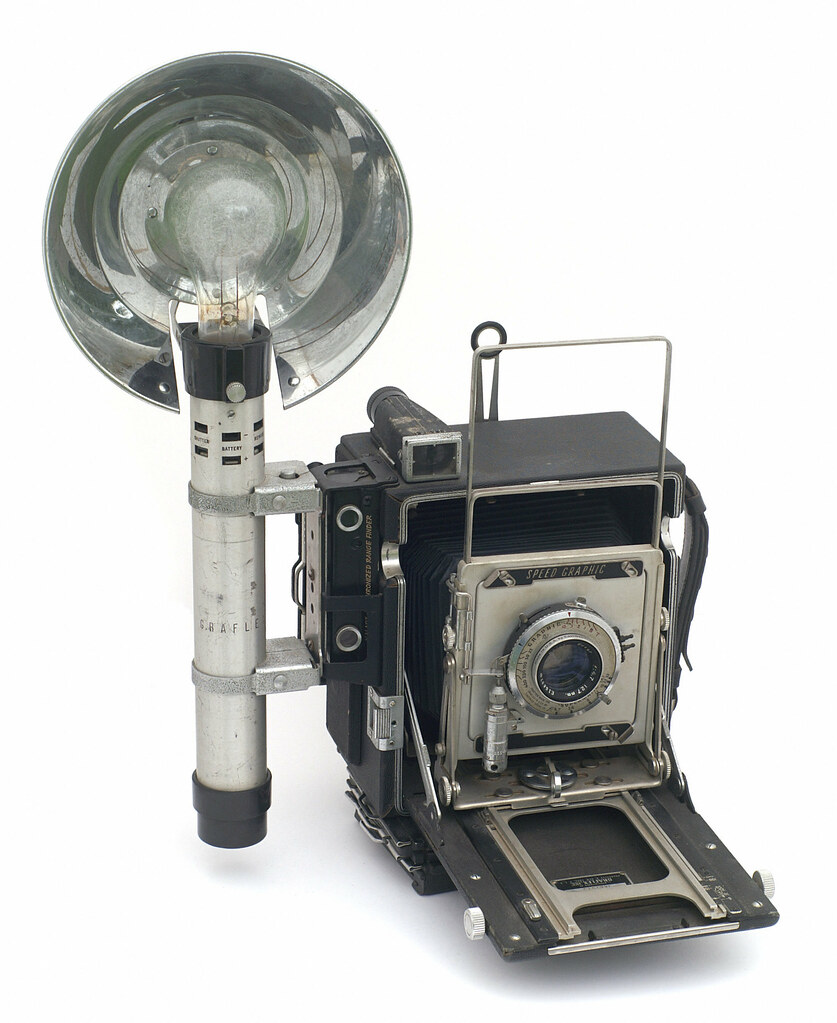
Would that Wood had what my brother and I have. He was using a 4x5 Speed Graphic, the norm as a news-camera back then.
He couldn’t take the multiple shots I often take — “one has to work!”
He was also setting shutter-speed and lens-opening himself. I shoot “shutter-priority;” lens-opening is automatic per metering by the camera.
My camera could also automatically set shutter-speed, but I shoot 1/400th or faster to stop blurring of a locomotive-front.
My brother’s camera is more “point-and-shoot.” Shutter-priority for him is nearly impossible, so locomotive fronts often blur in marginal light.
So there’s Wood out there with only one chance to snag a fabulous picture.
He better have his lens-opening right. Plus he has to be steady on his feet. I’ve seen pictures of him without a tripod. I tripod my telephotos; usually I can hand-hold 150mm or less at 1/400th or so — but not if it’s frigid. Tripod below freezing.
Wood was also using film and a darkroom.
During the ‘70s I was using the same, but 35mm versus his 4x5.
I’d roll my own Tri-X from bulk, and didn’t do color because Yellow Father (Kodak) wouldn’t let me.
I switched to digital 15-20 years ago with a Nikon D100.
Lenses were pretty good in the ‘70s, if you avoided zoomers.
Now all my lenses are zoomers, and I only have three. Back in the ‘70s I had seven or eight.
What’s really great is no more darkroom with stinky chemicals browning my fingers.
And no more Yellow Father dictating my color output.
Everything is now in this personal-computer, and I dicker with Photoshop®.
Need to boost fall-foliage color? I can do that; it’s called “saturation.”
Need to lighten locomotive running-gear to make it visible? it’s called “lighten shadows.”
I can also add sizzle to a picture with “unsharp mask” or “adjust sharpness.”
I couldn’t do any of that with Yellow Father.
But as always the photographer has to be an artist. —A) savvy enough to set up a fabulous picture, or —B) able to recognize a fabulous shot when they get one by accident.
That’s my dictum:  “Shaddup-and-shoot; ya never know what you’ll get.”
I have two photographs at the same location of the same Mt. Carmel ore-train. The one by Wood is fabulous, the other ordinary.
Wood would look at a scene and assess. There’s a mountain back there, but with any luck that column of belching steam will obliterate it.
Here comes a GG-1 charging Elizabeth Curve in north Jersey. Pan it, baby! It’s probably pushing 100!
That background building blurs, but what a shot!
Wood’s pictures eventually ran out. The Audio-Visual Designs black-and-white All-Pennsy Calendar had to start using other photographers. One is Jim Shaughnessy.
But now the Audio-Visual Designs black-and-white All-Pennsy Calendar seems to be faltering.
Suo is probably a railfan, but he’s not Wood.
Every once-in-a-while they publish a Wood picture. But they look like his rejects.
I continue to get the Audio-Visual Designs black-and-white All-Pennsy Calendar. But it often has “Courtesy of Joe Suo collection;” the dreaded three-quarter views that clog train-books.
This calendar picture is a three-quarter, as was last month — also Joe Suo.
Three-quarters aren’t very dramatic. I think my brother and I do better — and that’s without steam.


Probably off Mighty Rockville. (Photo by Walter Zullig.)

—The east end of Rockville Bridge is always a lighting challenge.
The May 2017 entry in my All-Pennsy color calendar is two Pennsy freights probably coming off Rockville Bridge.
It’s 1963.
The train with the F-units is waiting for the Geep-powered hotshot to pass, although that hotshot also has Fs.
It says the trains are eastbound, but I don’t know where I’m looking, like west across the river (not visible), or east toward Harrisburg.
I wonder if the trains are headed north up the Susquehanna. To Pennsy that’s east too. The hotshot is symboled BNY16 — that sounds like Buffalo.
Rockville is where Pennsy bridged the Susquehanna. The current bridge, a giant stone-masonry structure, is the third. It opened in 1902.
I always say it would take a direct hit from a thermonuclear warhead — an H-bomb — to take out that bridge. Although part of it washed-out and collapsed not too long ago.
The Susquehanna was a major barrier to building Pennsy. As Pennsy became a success, its bridge over the Susquehanna had to become substantial.
The current bridge can accommodate four tracks, although it’s been reduced to two and three. Two tracks across the Susquehanna were not enough back then.
The light in this picture tells me it’s early morning.
Later in the day, looking west especially, everything would be stridently backlit.
Even early morning is a challenge. Sunlight is coming from east-southeast = backlit yet again.
About the only place the bridge works is the western end, or far downriver in morning — and from the river’s west side.
Interstate-81’s crossing of the Susquehanna considered building atop Rockville. Thankfully that wasn’t done — it woulda ruined the view. I-81 uses it own bridge south of Rockville.
The bridge is a barrier to river navigation, although the Susquehanna isn’t deep enough to allow deep-draft ships.
That allowed Pennsy to build a massive low-level river-crossing; that is, it didn’t need a clear span, high enough or wide enough to permit large ships.
Yet Rockville is very substantial; it had to be to permit four tracks.
It’s endured numerous floods; the Susquehanna can run high. It’s draining a very large watershed.

Labels: